Sam Denby doesn't just ask why American cars got bad; he exposes how the very laws designed to save the environment accidentally created a monster that now chokes the industry. The most startling claim isn't that Detroit failed, but that the "Big Three" are now actively choosing to abandon the passenger car market entirely, not because they can't build them, but because a decades-old regulatory loophole makes SUVs too profitable to ignore. This is a story about how short-term survival tactics have calcified into long-term mediocrity, leaving American consumers with fewer choices and worse reliability.
The Illusion of the Bailout
Denby opens with a scene that perfectly encapsulates the desperation of 2008: CEOs driving hybrids to Congress to beg for a bailout after arriving by private jet the month before. "We're here today because we made mistakes," General Motors' Rick Wagoner told the Senate Banking Committee. "We're sorry to be asking for this support." This moment of contrition, however, masked a deeper structural rot. Denby argues that the decline wasn't sudden; it was a slow-motion collision between American complacency and Japanese efficiency. While the Big Three chased the high margins of trucks and SUVs, fueled by government incentives, Japanese automakers cornered the passenger car market. "In 2006, of the Consumer Reports list of the 10 best cars, all 10 were Japanese," Denby notes, highlighting a stark reality that the American public was beginning to feel but couldn't quite name.
The bailouts that followed were a lifeline, but Denby suggests they were also a bandage on a bullet wound. The government forced GM to restructure, shedding brands like Hummer and Pontiac, and vowing to build efficient cars. "The new Chrysler followed a similar strategy. It'd lean into the brands that worked... and it'd lean on the expertise of its new partner, Italian manufacturer Fiat, to overhaul its light passenger vehicles." The narrative promised a pivot toward the future. Instead, it set the stage for a retreat. Critics might argue that the bailouts were necessary to prevent total economic collapse, and they were. But Denby's point is that the solution didn't fix the underlying incentive structure; it merely delayed the inevitable reckoning.
The SUV Loophole and Artificial Demand
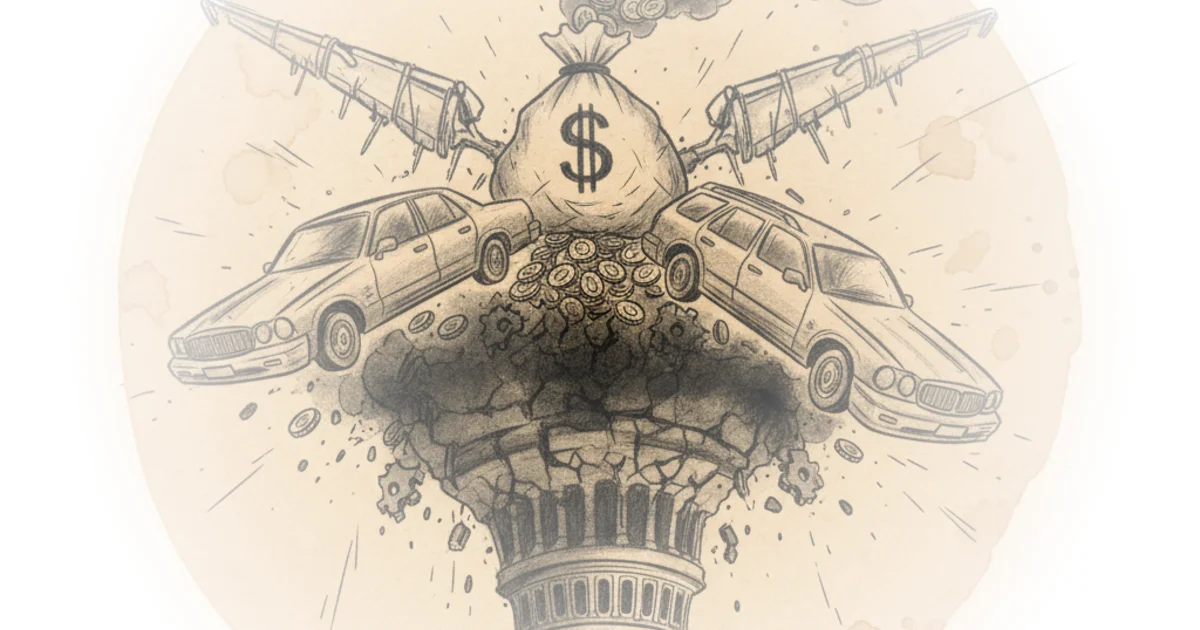
The core of Denby's argument lies in the regulatory architecture that makes trucks more profitable than cars. He traces this back to the 1970s fuel efficiency mandates, which created a distinction between "passenger cars" and "light trucks." "These qualities, especially the latter, are all pretty nebulous in nature," Denby writes regarding the definition of a truck, noting that the rules allow vehicles to be classified as trucks if they are designed to work off-road or transport property. This ambiguity birthed the "SUV loophole," allowing manufacturers to meet lower fuel efficiency standards while selling massive vehicles.
"Auto bailouts may have saved jobs, restructured securities, gave core American companies a new lease on life, and presented a future of more reasonable and efficient American-made vehicles, but they didn't fix a critical shortcoming in the American car market: the definition as to what exactly counts as a car."
Denby explains that this isn't just about fuel economy; it's about the "Chicken Tax," a 25% tariff on imported trucks that forces foreign manufacturers to build locally, leveling the playing field for domestic giants. The result is a market where "the demand for SUVs and light trucks in the US has appeared insatiable since the Great Recession," yet Denby insists this demand is "rather artificial in nature." He argues that the Big Three didn't just respond to consumer preference; they manufactured it through marketing and regulatory arbitrage. "While big three executives will mention high demand for light trucks as the reason they've given up on cars, their strategy and marketing created that very demand." This is a crucial distinction: the market didn't force their hand; they chose the path of least resistance and highest profit.
The Erosion of Trust and Quality
The most damning evidence Denby presents is the current state of reliability. The pivot back to trucks hasn't resulted in better products; it has resulted in a race to the bottom on quality. "In 2025, no Detroit brand cracked the top 10 in Consumer Reports auto reliability rankings," Denby points out, a statistic that speaks volumes about the industry's trajectory. He details specific failures, such as the Chrysler emissions scandal where vehicles violated standards despite passing lab tests, resulting in a guilty plea to criminal conspiracy. Even more troubling is the General Motors recall of 600,000 vehicles with catastrophic engine failures that the company knew about for years.
"For 6 years, consumers have been registering complaints about the massive 6.2 L V8 that powers Suburbans, Tahoes, Silverados, Escalades, Sierras, Yukons, and any other big GM vehicle completely and catastrophically failing within 100,000 mi of ownership," Denby writes. The company ignored internal investigations until the National Highway Traffic Safety Administration intervened. This isn't just bad luck; it's a symptom of a business model that prioritizes shareholder payouts over product integrity. Denby notes that Stellantis (Chrysler's parent) posted record profits in 2023 while cutting jobs and closing factories. "The real cost of the short-term boost became apparent quickly with factory workers going on strike, the Jeep and Dodge brands taking reputational hits as signs of corner cutting and cheap assembly became more apparent."
"The short-sighted business strategy of Detroit automakers has kept the big three afloat in a post-recession market. But it's all but ensured that they struggle to innovate, maintain any semblance of quality control, and get passed up by a host of ambitious upstarts."
Critics might suggest that the rise of Tesla and Rivian proves the market is simply shifting to electric vehicles, and that the Big Three are just slow to adapt. However, Denby's analysis suggests the problem is deeper than a lag in technology; it is a fundamental misalignment of incentives where the regulatory environment rewards volume and margin over quality and innovation.
Bottom Line
Sam Denby's most powerful insight is that the American auto industry's failure is not a lack of capability, but a strategic choice to exploit regulatory loopholes rather than compete on quality. The argument is strongest in its exposure of how the "SUV loophole" and the "Chicken Tax" have created a distorted market where making bad cars is more profitable than making good ones. The biggest vulnerability in the piece is its reliance on the assumption that consumer demand for trucks is entirely manufactured, ignoring genuine cultural shifts toward utility and safety. Readers should watch for how the upcoming electric vehicle transition will interact with these same loopholes, or if the Big Three will finally be forced to innovate or perish. The verdict is clear: without fixing the rules of the game, the Big Three will continue to win the wrong race.