In an era where modern architecture often prioritizes speed and cost over endurance, a striking counter-narrative is emerging from the global Hindu diaspora. Works in Progress reports that while Christian and Jewish houses of worship have largely embraced modernist minimalism, Hindu communities are doubling down on ancient canons, using modern wealth not to abandon tradition, but to perfect it. This piece offers a rare glimpse into a living architectural tradition that defies the obsolescence of the modern age, blending high-tech logistics with hereditary craftsmanship to build structures designed to last millennia.
The Theology of Stone
The article's most compelling argument rests on a fundamental inversion of how we understand public buildings. "A temple is not an auditorium designed primarily for the convenience of a human audience: it is a residence of God," the editors note. This distinction is not merely semantic; it dictates the entire engineering and aesthetic approach. Unlike contemporary office towers, which the piece notes often have a "design working life of 50 years," these temples are built with a different horizon in mind. "Load-bearing masonry is slow to build, but it is extraordinarily durable," the text argues, suggesting that the very slowness of the process is a feature, not a bug, ensuring the structure can withstand the elements for thousands of years.
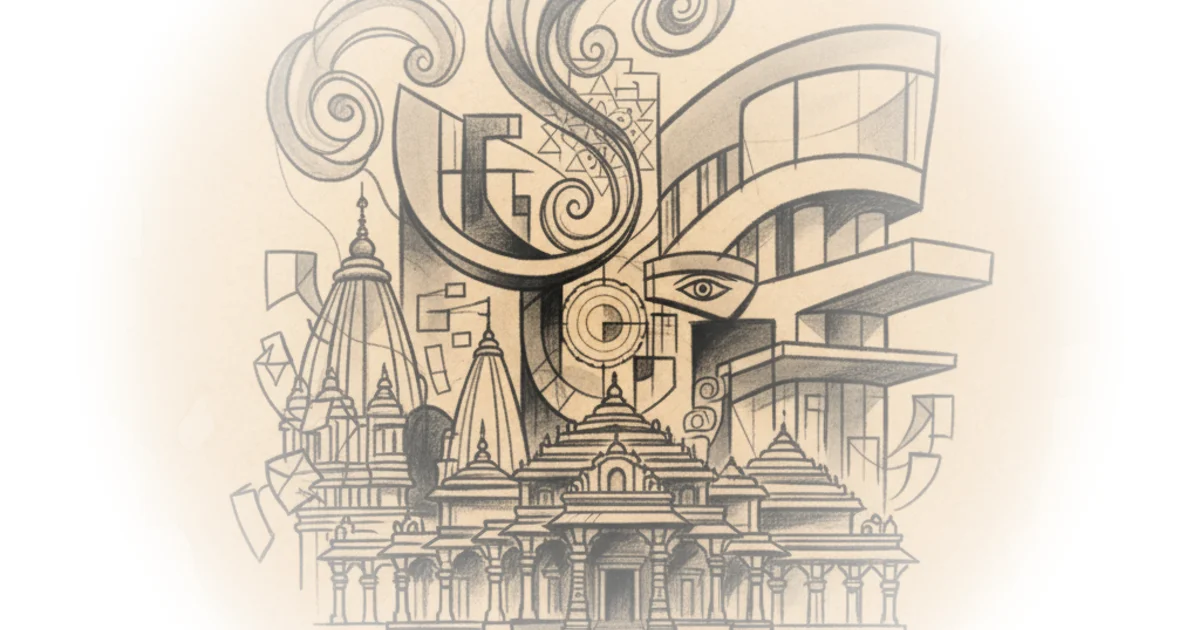
This commitment to durability is rooted in the Shilpa Shastras, architectural treatises composed between the fifth and fifteenth centuries. These texts function as both artistic guidelines and "rigorous algorithms," where measurements correspond to the geometries of specific constellations. The piece highlights that while modern construction relies on steel frames with stone as mere cladding, Hindu temples maintain a "resolutely premodern" structural logic. "Stability is achieved through the compressive strength of stone and through complex interlocking jointing systems," including mortise-and-tenon connections that prioritize longevity over the speed of assembly. This approach echoes the principles of dry stone construction, where the absence of mortar and the precision of the fit create a resilience that modern adhesives often fail to match.
Critics might argue that such rigid adherence to ancient algorithms limits architectural innovation or fails to address contemporary urban density. However, the article suggests that the innovation lies precisely in the hybridization of these ancient rules with modern capabilities, rather than in discarding the rules themselves.
"Modern affluence has enabled a more faithful embodiment of architectural tradition rather than a departure from it."
A Global Supply Chain of Devotion
Perhaps the most surprising element of this coverage is the description of the labor model. The construction of these temples is not a monolithic effort but a "complex hybrid of high-tech manufacturing, hereditary craftsmanship, and devotional volunteerism." Works in Progress details a logistical marvel where stone is quarried in Tuscany, Bulgaria, and Rajasthan, shipped to workshops in India for intricate carving by artisans from lineages that have preserved these skills for centuries, and then reassembled globally. The article describes this process as a "massive logistical puzzle involving tens of thousands of numbered pieces."
This global reach is evident in the BAPS Hindu Mandir in Abu Dhabi, the first traditional Hindu stone temple in the Middle East. The piece notes that the temple underwent "complete digital modeling and seismic simulation" to ensure resilience, utilizing a foundation reinforced with fly ash to reduce its carbon footprint. Yet, despite these modern interventions, the structural core remains true to the ancient tradition. The temple's carvings even extend beyond Hindu narratives to depict moral stories from Arabian, Mayan, and Greek civilizations, reinforcing the message of Vasudhaiva Kutumbakam—"the world is one family."
Similarly, the Neasden Temple in London required five thousand tonnes of Italian Carrara marble and Bulgarian limestone, shipped to India for carving before 26,300 pieces were sent back to the UK. The project was financed entirely by grassroots community efforts, including sponsored walks and recycling campaigns, with over 3,000 local volunteers participating in the construction. This integration of "hereditary skill with devotional energy" creates a site that feels less like a construction zone and more like a festival, where tools are sanctified and prayers mark critical stages.
Engineering the Sacred in a Seismic World
The article shines a light on how these ancient forms are being adapted to meet the safety requirements of the modern world, particularly in seismic zones. The BAPS Shri Swaminarayan Mandir in Chino Hills, California, serves as a prime example of this adaptation. Located in a high-risk tectonic area, the temple was designed with a base-isolation system consisting of 40 steel plates stacked with viscous liquid. This mechanism allows the heavy stone edifice to "float" independently of the ground during an earthquake.
"Engineers and architects refer to this configuration as the 'floating mandir'," the piece explains, illustrating how the rigid logic of stone can coexist with the fluid dynamics of modern safety engineering. This is not a compromise of the tradition but an evolution of it, ensuring that the "residence of God" remains intact even when the earth shakes. The project also required navigating complex regulatory hurdles, with temple representatives engaging local officials to explain the cultural significance of the traditional spires.
The scale of these projects is staggering. The Akshardham complex in New Delhi, completed in five years, involved 11,000 artisans and 8,000 volunteers, accumulating more than 300 million volunteer hours. The structure rests on a 3,000-ton plinth featuring 148 sculpted elephants, paying homage to the foundational support of the animal kingdom. The outer wall, the largest such wall built in India in eight centuries, depicts a narrative progression from animals to floral motifs to deities, serving as a visual text of the faith.
"The construction process itself is often viewed as a form of worship: tools are sanctified and prayers mark critical stages, ensuring the sacred character of the temple is maintained throughout its creation."
Bottom Line
The strongest part of this argument is its reframing of modernity: it demonstrates that technological advancement does not necessitate a rejection of tradition, but can instead provide the resources to realize ancient visions with unprecedented fidelity. The piece's biggest vulnerability is its focus almost exclusively on the BAPS organization, which, while a major driver of this movement, may not represent the full diversity of modern Hindu temple architecture. Nevertheless, the coverage successfully illustrates a unique convergence of global logistics, hereditary skill, and spiritual devotion that challenges the disposable nature of contemporary construction. As these temples rise from the dust of quarries to the skylines of London, Abu Dhabi, and California, they stand as a testament to a different way of building—one that looks not just to the next fiscal quarter, but to the next millennium.