David Lat transforms a routine legal newsletter into a sharp dissection of institutional decay, arguing that the legal profession's current crisis is defined not by high-profile policy battles, but by the quiet erosion of professional norms and the toxic fallout of past associations. The piece's most striking claim is that the "distraction" of personal scandal is now the primary metric for executive survival in both the corporate and government sectors, a shift that threatens the integrity of the judiciary and the Department of Justice.
The Cost of Past Associations
Lat opens with a stark juxtaposition, reminding readers of the fleeting nature of political favor before pivoting to the resignation of Kathryn Ruemmler as general counsel of Goldman Sachs. He frames her departure not as a voluntary career move, but as a casualty of the "Epstein files," noting that she appears more than 10,000 times in the documents. Lat writes, "The interests of Goldman were clearly being disserved by the Epstein-related controversies swirling around Ruemmler." This observation cuts through the corporate PR spin to reveal the raw reality: in the current climate, even pre-employment associations with a convicted sex predator can render a top executive untenable, regardless of their actual legal compliance.
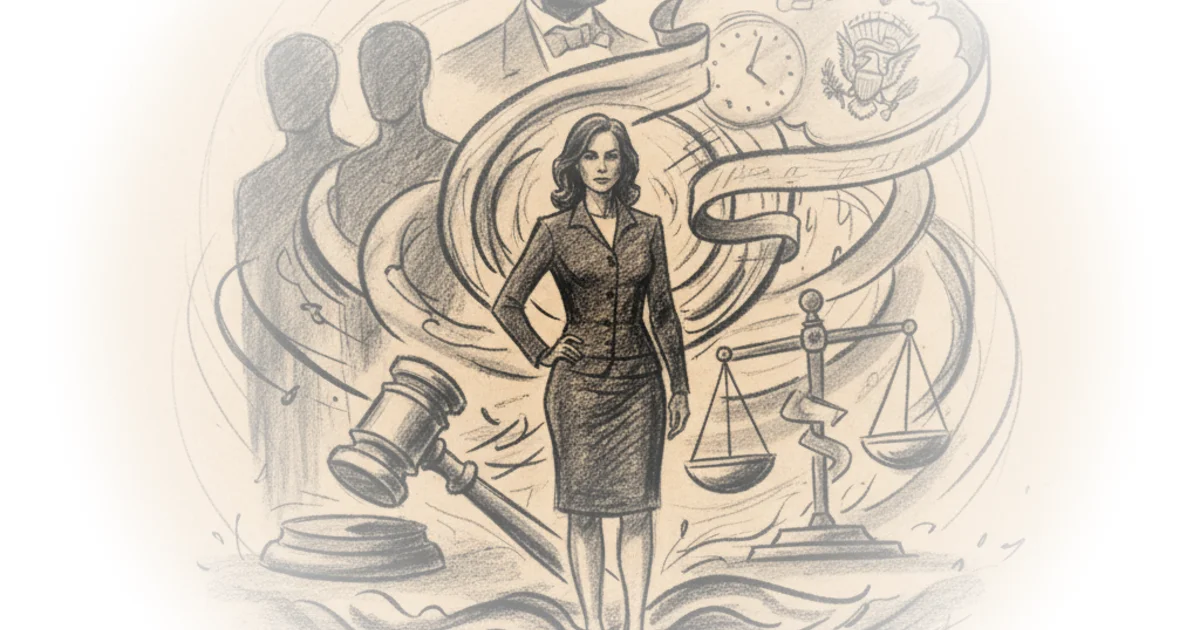
The author highlights the bizarre intimacy of these past interactions, quoting Ruemmler's email to Epstein where she wrote, "I hope you enjoy[ed] the day with your one true love. :-)" Lat uses this to illustrate how the "vampire rule"—where toxic individuals drain the energy and reputation of those around them—has finally caught up with a powerful figure. He notes that while Ruemmler's interactions may not have violated specific ethical rules, the sheer volume of contact created an "embarrassing distraction" that the board could no longer ignore.
"My responsibility is to put Goldman Sachs's interests first," she said in a statement, even as the evidence suggested her presence had become the very thing threatening those interests.
This framing is effective because it avoids the trap of moralizing about Ruemmler's personal life and instead focuses on the institutional calculus. However, a counterargument worth considering is whether this resignation sets a precedent for "guilt by association" that could unfairly punish professionals for past networking that was common in the legal and financial worlds of the early 2000s. Lat acknowledges the nuance, noting that Ruemmler's contact predated her arrival at Goldman, yet the stigma remains inescapable.
The Hollowing of the Justice Department
Shifting from Wall Street to Washington, Lat turns his attention to the Department of Justice, painting a picture of an institution in rapid retreat. He details the departure of Gail Slater, the Assistant Attorney General for the Antitrust Division, attributing it to pressure from conservative legal activists. Lat writes, "Some observers fear this could lead to weaker and more unpredictable antitrust enforcement." This is a critical point: the exodus of career prosecutors and policy experts is not just a staffing issue; it is a structural weakening of the government's ability to enforce the law consistently.
The article highlights a disturbing trend of high turnover, noting that U.S. attorneys' offices lost 14 percent of their headcount in a single year. Lat points to the firing of Donald Kinsella, a federal judge-appointed head of a U.S. Attorney's office, who was removed hours after his appointment by a deputy attorney general. This incident underscores a shift where political loyalty appears to supersede the traditional independence of the justice system.
Lat also touches on the behavior of Attorney General Pam Bondi, who refused to apologize for mishandling documents related to Epstein survivors. He quotes her dismissal of a Democratic representative as a "washed-up, loser lawyer," using this to illustrate a broader culture of incivility that has permeated the executive branch. The author suggests that this rhetoric is not merely personal but symptomatic of a system where institutional norms are being discarded for political theater.
Critics might argue that the focus on individual personalities like Bondi or Slater distracts from the broader policy shifts, but Lat's reporting suggests that the personalities are the policy in this administration. The refusal to apologize for errors that endanger victims, combined with the rapid turnover of career staff, signals a deliberate dismantling of the department's traditional role as a neutral arbiter.
The Judiciary Under Siege
The commentary then moves to the federal bench, where Lat examines a complaint against Judge Lydia Kay Griggsby. The allegations range from verbal abuse to bizarre demands, such as a clerk being told to eat lunch standing up in the judge's office. Lat writes, "Verbal browbeating is unacceptable, obviously. But having to provide updates on many, many cases is simply part of your job when you're clerking for a busy district judge." Here, he attempts to balance the gravity of the accusations with the realities of high-pressure legal work.
The author notes that while some allegations, like the judge banging on a bathroom door, are clearly inappropriate, others, like calling work product "crap," exist in a gray area of harsh feedback. Lat writes, "Is that abusive? One of the allegations involves the judge 'expect[ing] law clerks to give updates on the more than 200 cases assigned to them'—and administering a 'verbal browbeating' if the clerks 'were unable to provide, at a moment's notice, the exact details [she] wanted.'"
"The subject judge accepts that the environment and atmosphere in the chambers at that time resulted in an abusive workplace."
This admission by the judge is a significant moment, as it validates the complaints without requiring a full judicial inquiry. Lat suggests that while the judge has taken corrective steps, such as implementing coffee hours and exit interviews, the skepticism from advocates like Aliza Shatzman remains. The author's willingness to see how the corrective measures play out offers a balanced perspective, though it risks underestimating the difficulty of changing a deeply ingrained culture of abuse.
The piece also touches on the broader context of judicial nominations and the removal of climate change chapters from the Federal Judicial Center's manual, hinting at a politicization of the judiciary that extends beyond individual judges to the very resources they rely on. Lat notes that the Trump administration is asking U.S. attorneys to provide examples of "judicial activism" for potential impeachment referrals, a move that further erodes the separation of powers.
Bottom Line
David Lat's commentary succeeds in connecting disparate legal news stories into a coherent narrative about the fragility of professional norms in an era of intense political polarization. The strongest part of his argument is the demonstration of how personal scandals and political loyalty are now the primary drivers of career outcomes in the legal world, from Goldman Sachs to the Department of Justice. His biggest vulnerability lies in the potential for his analysis to be read as a critique of specific individuals rather than a systemic failure, though his focus on institutional dynamics largely mitigates this risk. Readers should watch for whether the corrective measures in the Griggsby case prove sufficient or if they signal a broader, unresolved crisis in judicial conduct.