Heather Cox Richardson delivers a chilling diagnosis of a government that has abandoned institutional integrity in favor of personal spectacle and systemic cheating. This piece is notable not for predicting the future of 2026, but for exposing how quickly the machinery of state can be repurposed to bypass courts, ignore public opinion, and rewrite reality when the executive branch decides rules are merely obstacles. The evidence presented—from a fouled reflecting pool to a constitutional right suspended by policy tweak—suggests a administration operating on a single, dangerous premise: that power is defined not by what you can do, but by what you can get away with.
The Architecture of Bad Faith
Richardson opens by dismantling the narrative of restoration surrounding the Lincoln Memorial's Reflecting Pool. While the administration hyped a "SPECTACULAR" renovation, federal records tell a different story of waste and decay. "In fact," Richardson notes, citing Politico, "the renovations Trump said would cost $1.5 million appear from federal contracting records to have cost almost $16 million, and the pool is now fouled with green algae." The administration's response was not accountability, but a flat assertion of victory. A spokesperson claimed the project was an expert fix, ignoring the reality that the pool is failing again.
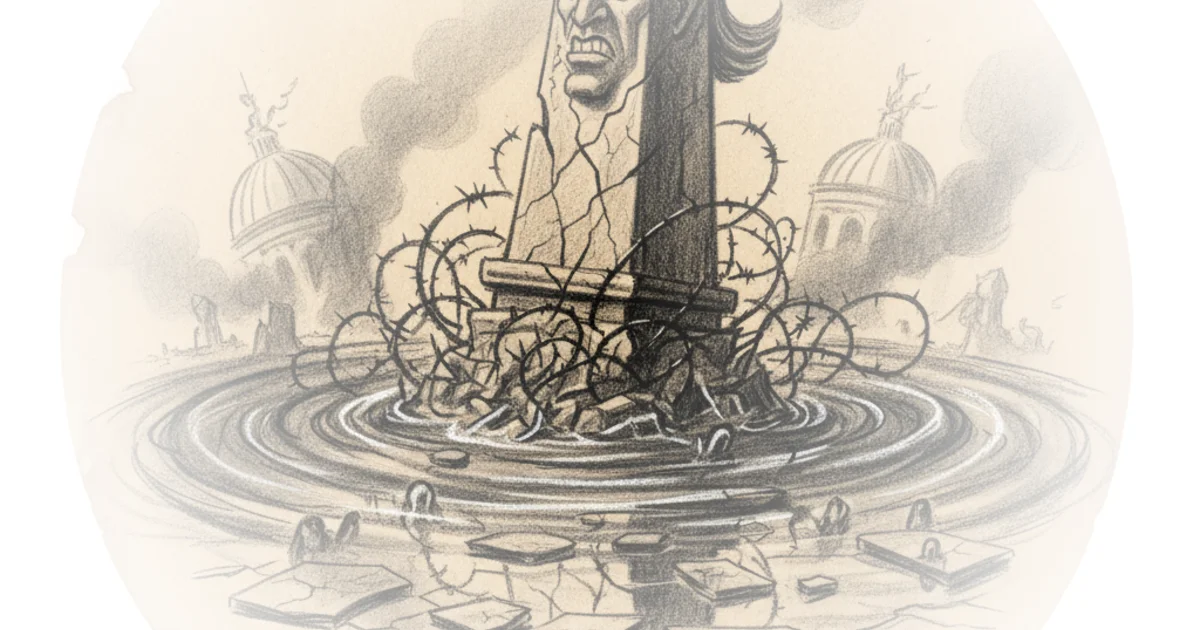
This pattern extends beyond aesthetics into the legal realm. Richardson highlights how the Kennedy Center board, packed with loyalists, engaged in a literal game of semantic shell games to defy a court order removing the president's name from the building. They missed the deadline by twelve hours and then certified compliance while hiding the facade under tarps. "Trump has made his career on the idea that there is always a way to cheat the system if you operate in bad faith," Richardson writes, "and he has carried that idea into the government." This framing connects the present actions to a long history of regulatory evasion, echoing the logic behind Goodhart's law: when a measure becomes a target, it ceases to be a good measure. The administration isn't trying to fix the pool or respect the court; they are gaming the metrics.
Trump has made his career on the idea that there is always a way to cheat the system if you operate in bad faith, and he has carried that idea into the government.
Critics might argue that bureaucratic delays and creative interpretations of orders are common in Washington, but Richardson's point is distinct: this isn't incompetence; it is a deliberate strategy of bad faith. The goal is to exhaust the opposition through procedural attrition while maintaining a public facade of compliance.
Spectacle as Policy
The commentary shifts to the bizarre spectacle of an Ultimate Fighting Championship event on the South Lawn, framed by the administration as a Bicentennial celebration but functioning as a vehicle for cryptocurrency promotion. Richardson exposes the financial entanglement where the Trump family's crypto venture, World Liberty Financial, receives cash from ticket sales and fighters' bonuses only to invest it in U.S. Treasury bonds, pocketing the interest. "World Liberty Financial gives its crypto to the fighters," she explains, noting that the arrangement effectively funnels public goodwill into private profit.
This spectacle masks a deeper disconnect with the American public. Despite the administration's hype, polls show a majority of Americans and even a significant portion of Republicans find holding cage matches at the White House inappropriate. Richardson uses this to illustrate how the executive branch is increasingly insulated from democratic feedback loops. The event also served as a stage for conspiracy theories, with influencers smearing former First Ladies while officials cheered.
The Illusion of Diplomacy and War
The most grave section of Richardson's analysis concerns the administration's handling of conflict with Iran. With a "deal" announced on social media before any terms were visible, the president declared victory over a war that the author argues was never necessary. Richardson cites national security scholar Tom Nichols to dismantle the administration's claims: "it is clear that Trump has failed to achieve every one of the goals he put forward for this war of choice, and now he is determined to sign, seal, and deliver America's capitulation as quickly as possible."
The human cost is starkly absent from the White House press releases but central to Richardson's critique. The war has left Iran intact, strengthened by drone stocks and cash, while depleting American weapons and raising gas prices for consumers. "The war leaves Iran battered, but more powerful," Nichols notes, a conclusion Richardson presents as the only honest assessment of the situation. Furthermore, the administration's claim of opening the Strait of Hormuz is exposed as hollow; as Nichols points out, such a declaration has "about as much effect as I or my wife or my cat declaring the strait open; only Iran can make that decision."
The war leaves Iran battered, but more powerful and with more cash at its disposal, while it leaves America weaker, with important stocks of weapons depleted, and with its consumers paying the price for the war at the gas pump.
Richardson also touches on the geopolitical embarrassment of thanking adversaries like Vladimir Putin and Xi Jinping for their help in a deal that supposedly secured American interests. This diplomatic maneuvering suggests a administration more interested in the appearance of a "Great Deal" than the substance of peace or security.
The Erosion of Constitutional Rights
Perhaps the most alarming revelation concerns the potential suspension of habeas corpus. Citing reporting from Maggie Haberman and Jonathan Swan, Richardson details how White House officials debated suspending this fundamental right to bypass courts regarding immigration detentions. When warned against a direct suspension due to public outcry, they opted for a policy tweak that treated long-term residents as new arrivals to deny them bond hearings.
"The question inside Trump's White House wasn't whether they could suspend rights—it was whether they could get away with it," legal commentator Joyce White Vance is quoted. This insight reframes the administration's actions not as a response to crisis, but as a calculated test of democratic resilience. The same logic appears in discussions of invoking the Insurrection Act against American protesters, an idea pushed by Vice President J.D. Vance and Stephen Miller even after federal agents killed civilians in Minnesota. Richardson notes that while the act was not invoked at that moment, it remains "a loaded weapon in a West Wing eager to test the limits of presidential power."
Bottom Line
Richardson's piece is a masterful synthesis of disparate events—a fouled pool, a crypto-racket fight, and a failed war—into a single thesis: the executive branch has shifted from governing to gaming. The strongest part of her argument is the consistent evidence that "cheating" is not an anomaly but the operating system of this administration. Its vulnerability lies in its reliance on future reporting to confirm whether these tests of constitutional limits will ultimately succeed or trigger a backlash, but the trajectory she outlines is undeniably clear. Readers should watch for how long the public tolerates the gap between the administration's spectacle and the reality of their policies before the illusion breaks.