Matt O'Dowd tackles the most existential question in physics not with abstract philosophy, but with a specific, recent experimental breakthrough from the Large Hadron Collider. While the idea that the universe should have annihilated itself into pure radiation is a staple of cosmology, O'Dowd brings a fresh perspective by focusing on the first-ever detection of symmetry violation in a new class of particles: baryons. This is not just a theoretical update; it is a crucial piece of evidence in the hunt for why we exist at all.
The Great Annihilation and the One-in-a-Billion Glitch
O'Dowd frames the origin of the universe as a mathematical puzzle where the starting conditions should have resulted in zero. He explains that at one-thousandth of a second after the Big Bang, the "Great Annihilation event should have wiped out all matter, leaving a universe of only radiation." The sheer scale of this near-miss is staggering. According to O'Dowd, the survival of our universe hinges on a "minuscule asymmetry between the amount of matter versus antimatter at that early time," amounting to just "one particle per billion to be preciseish."
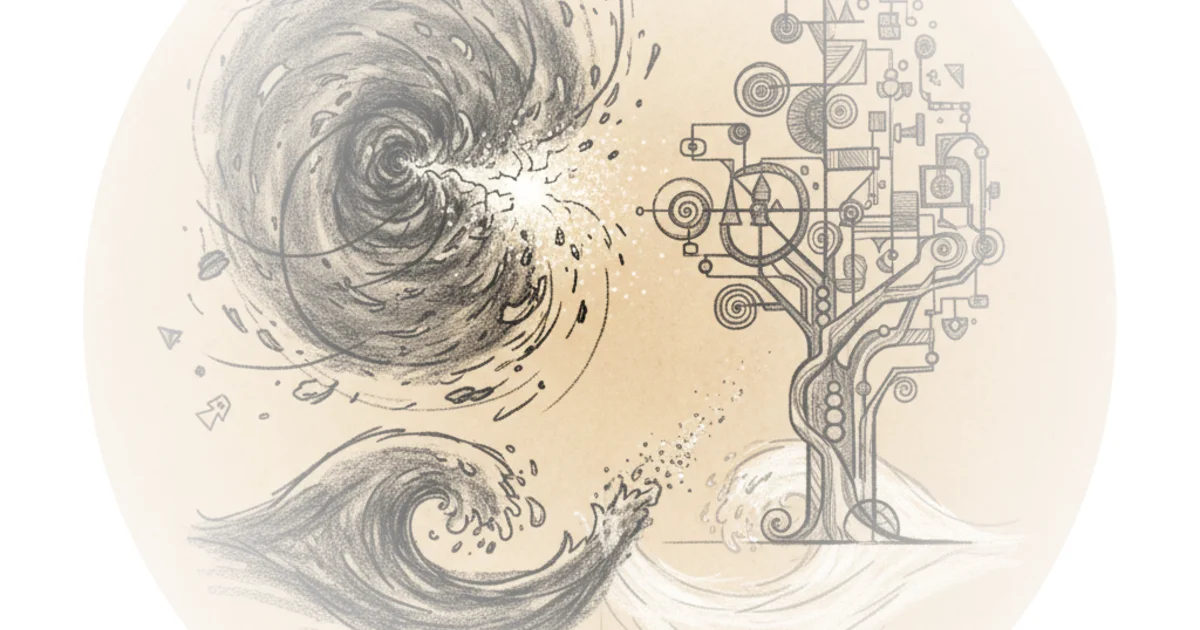
This framing is effective because it grounds a cosmic mystery in a tangible statistic. It transforms the abstract concept of "something rather than nothing" into a specific accounting error in the early universe. However, the standard model of particle physics struggles to explain this. As O'Dowd notes, "According to the raw standard model of particle physics, matter and antimatter should behave exactly the same." If the laws of physics were perfectly symmetrical, the universe would be empty. The fact that it isn't implies a fundamental flaw in that symmetry.
The minuscule asymmetry between the amount of matter versus antimatter at that early time is why there's something rather than nothing or at least nothing interesting.
The Hunt for CP Violation in Baryons
The core of O'Dowd's argument rests on a concept called Charge Parity (CP) symmetry. He describes antimatter as a "mirror reflection" of matter, where properties like electric charge and spin are flipped. In a perfectly CP-symmetric universe, swapping matter for antimatter would change nothing. But for matter to survive the Big Bang, this symmetry must be broken. O'Dowd points out that while scientists have observed this violation in mesons (particles made of two quarks), they have never seen it in baryons (particles made of three quarks, like protons and neutrons) until now.
The new data comes from the LHCb experiment at CERN. O'Dowd details how researchers analyzed the decay of bottom quarks, looking for differences between how matter and antimatter versions of these particles break apart. The result was a "very real difference between the rates of this decay between the matter and antimatter B baryons." This discovery is significant because baryons constitute the visible matter of the universe. If the rules governing protons and neutrons differ slightly from their antimatter counterparts, it provides a mechanism for the survival of the stars and galaxies we see today.
Critics might note that the observed asymmetry, while statistically significant at 5.2 sigma, is still too small to fully account for the total matter in the universe. O'Dowd acknowledges this limitation, stating, "Even with this observation, the degree of CP violation isn't enough to fully explain the amount of matter left over from the great annihilation event of the early universe." This is a fair and necessary caveat; the discovery is a step, not the final answer.
So the stuff of the antiverse is subtly different to the stuff of our universe.
Beyond the Standard Model
O'Dowd concludes by looking forward, suggesting that if the quark sector cannot fully explain the imbalance, physicists must look elsewhere. He highlights the potential of leptons (electrons and neutrinos) as the next frontier. "There are high hopes that we'll find the necessary asymmetry in the leptons," he writes, pointing to upcoming experiments like Hyper-Kamiokande in Japan. The narrative arc here is compelling: we have solved a piece of the puzzle, but the picture remains incomplete.
The author's choice to focus on the "interference between the different channels" of quantum decay helps demystify why the asymmetry occurs. He compares it to the double-slit experiment, where waves interfere constructively or destructively. In the case of antimatter, the "wave function phase that feeds into the decay probabilities" is inverted, leading to different outcomes. This analogy makes a highly technical quantum mechanical process accessible to a lay audience without sacrificing accuracy.
Bottom Line
O'Dowd's coverage succeeds in translating a complex, high-energy physics result into a coherent narrative about the origins of existence. The strongest element is the clear distinction between previous discoveries in mesons and this new, critical finding in baryons, which directly relates to the matter we are made of. The piece's main vulnerability is the inevitable realization that this single discovery does not solve the entire mystery, leaving the reader with more questions than answers. However, that is the nature of frontier science, and O'Dowd handles the uncertainty with appropriate rigor and excitement.