This briefing from Sinification does something rare in geopolitical analysis: it treats a single politician's rhetoric not as an isolated outburst, but as the audible crack in a dam that has been leaking for decades. While Western media often fixates on the immediate diplomatic spat, the editors here map a terrifyingly coherent strategy where historical revisionism, nuclear ambiguity, and indigenous rights movements converge into a single pressure point against Japan. The piece suggests that Beijing is no longer just reacting to Tokyo; it is actively constructing a long-term containment architecture that leverages Japan's own internal fractures.
The Architecture of Revisionism
The core argument rests on the idea that Prime Minister Takaichi Sanae's comments linking a Taiwan conflict to Japan's "survival" are not a new policy direction, but the culmination of a deliberate, decades-long project. Sinification reports that analysts view this as "a negative, denialist project that whitewashes colonial aggression, recasts Japan from 'perpetrator' into 'victim'," a move designed to hollow out the post-war peace constitution. This framing is crucial because it shifts the debate from "what did she say today?" to "what system is she trying to build?"
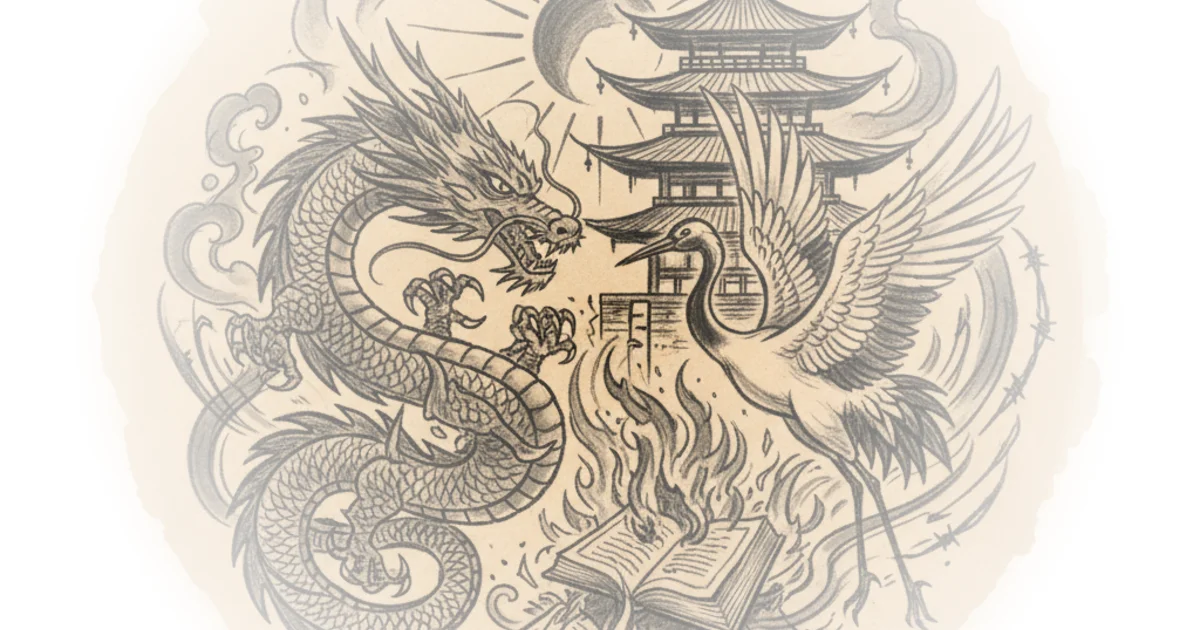
The editors draw a direct line from current rhetoric to the 1930s, noting that invoking an impending "existential crisis" to justify external aggression is a "habitual trick of Japanese militarism." This historical parallel is not merely rhetorical flair; it grounds the current tension in a specific, dangerous precedent. The piece argues that this revisionism serves as a "core component of right-wing ideology," aiming to transform Japan into a "state that can fight" rather than a peace-loving democracy.
"History may resemble the past, but it will not repeat itself indefinitely. What will not repeat is an era in which the Chinese nation and the peoples of other Asian countries can be trampled upon at will."
This quote from scholars Yang Bojiang and Wu Xian captures the shift in Beijing's confidence. The narrative here is one of inevitable decline for Japan, portrayed as a "weakening power lashing out." However, this teleological view—where history is seen as a straight line toward Chinese dominance—risks underestimating the resilience of Japan's alliance with the United States. Critics might note that assuming the US will simply "resist being dragged into a Japan-led Taiwan conflict" ignores the deep institutional inertia of the US-Japan security pact, which often functions regardless of the specific administration in Washington.
The Policy Menu: From Legalism to the Ryukyu Card
Perhaps the most striking section of the briefing is its granular look at Beijing's proposed countermeasures. The editors move beyond standard diplomatic protests to outline a sophisticated, multi-layered strategy. Sinification notes a push to shift from "moral diplomacy" to "rules-based legal diplomacy," where penalties for crossing red lines are pre-announced and automatic. This suggests a move toward a more predictable, yet more rigid, confrontation.
The economic strategy is equally calculated, proposing "targeted, constituency-specific measures" that would squeeze the political strongholds of the ruling Liberal Democratic Party while sparing more China-friendly regions. This is not a blanket embargo; it is surgical political warfare. But the most provocative element is the recurring proposal to "play the Ryukyu card."
"A notable recurring proposal is to 'play the Ryukyu card' by supporting Okinawa-based indigenous and anti-base claims as structural leverage over Japan."
This is a significant escalation in rhetorical and strategic terms. By supporting indigenous claims in Okinawa (the historical Ryukyu Kingdom), Beijing is effectively challenging the territorial integrity of Japan in the same way Tokyo challenges China's claims in the Taiwan Strait. This mirrors the historical complexity of the region, where the Ryukyu independence movement has long sought to distance itself from both Tokyo and foreign military bases. The editors suggest this is a "long-term pressure point," mirroring Tokyo's use of the Taiwan question.
However, this strategy carries immense humanitarian and geopolitical risk. While the piece frames this as "legal diplomacy," supporting separatist movements in a nuclear-armed neighbor's territory is a recipe for catastrophic escalation. The editors acknowledge that fringe voices are already calling for a revision of China's nuclear doctrine to allow a first strike, or even bombing the Yasukuni Shrine. These are not mainstream policies, but their presence in the discourse signals how thin the ice has become.
The Human Cost of Strategic Posturing
The briefing is striking for what it omits: the human cost of this strategic chess game. While the editors discuss "industrial weight," "nuclear doctrine," and "legal diplomacy," the reality of a conflict in the Taiwan Strait or the East China Sea would be measured in civilian lives, not just diplomatic documents. The piece mentions that Japanese militarism is portrayed as responding only to strength, but it does not fully grapple with the reality that in a modern conflict, strength is often indistinguishable from devastation for the populations caught in the middle.
The editors note that the dominant sentiment is confidence, with writers repeating the warning that "those who play with fire will get burned." Yet, this confidence is built on a premise of Japanese decline that may not hold up under the pressure of a real crisis. The piece admits that "nobody expects Tokyo to cooperate," suggesting a stalemate where both sides are digging in, waiting for the other to blink.
"Japan's attempt to obstruct unification [is] likened to 'a mantis raising its arms to stop a chariot'."
This metaphor, while vivid, reduces a complex geopolitical standoff to a simple fable of inevitable victory. It overlooks the possibility that the "chariot" could be derailed by the very "mantis" it underestimates, or that the collision could destroy the road they are both traveling on. The editors acknowledge that the US might be reluctant to intervene, but they also note the split between Japan as an "attack dog" and Japan as a power dragging a reluctant US into war. This ambiguity is the most dangerous variable in the equation.
Bottom Line
Sinification's briefing offers a chillingly clear window into how Beijing views the current crisis: not as a temporary diplomatic row, but as a structural confrontation where historical revisionism and military expansion are two sides of the same coin. The strongest part of the argument is its identification of the "Ryukyu card" as a potential long-term lever, revealing a strategy that targets Japan's internal cohesion rather than just its external alliances. However, the piece's biggest vulnerability is its overconfidence in a deterministic view of history, which may blind it to the unpredictable volatility of a crisis involving nuclear powers and entrenched alliances. The reader should watch not just for Takaichi's next comment, but for whether Beijing begins to operationalize its support for Okinawan indigenous claims, a move that would fundamentally alter the security architecture of East Asia.