Tom van der Linden makes a startling claim about Christopher Nolan's Interstellar: the film's most profound scientific breakthrough isn't about black holes or relativity, but about love as a tangible, dimension-transcending force. While most analysis fixates on the physics, van der Linden argues the movie is actually a meditation on how human connection defies the relentless entropy of time. This is a rare, sincere attempt to treat intimacy not as a plot device, but as the very mechanism that allows us to navigate the cosmos.
The Physics of Feeling
van der Linden begins by acknowledging the film's rigorous scientific grounding, noting that Nolan collaborated with physicist Kip Thorne to ensure accuracy regarding wormholes and gravity. However, the author quickly pivots to the film's controversial core: the idea that "love is the one thing we're capable of perceiving that transcends dimensions of time and space." This is the moment many critics dismiss as sentimental, yet van der Linden insists it is the film's central thesis.
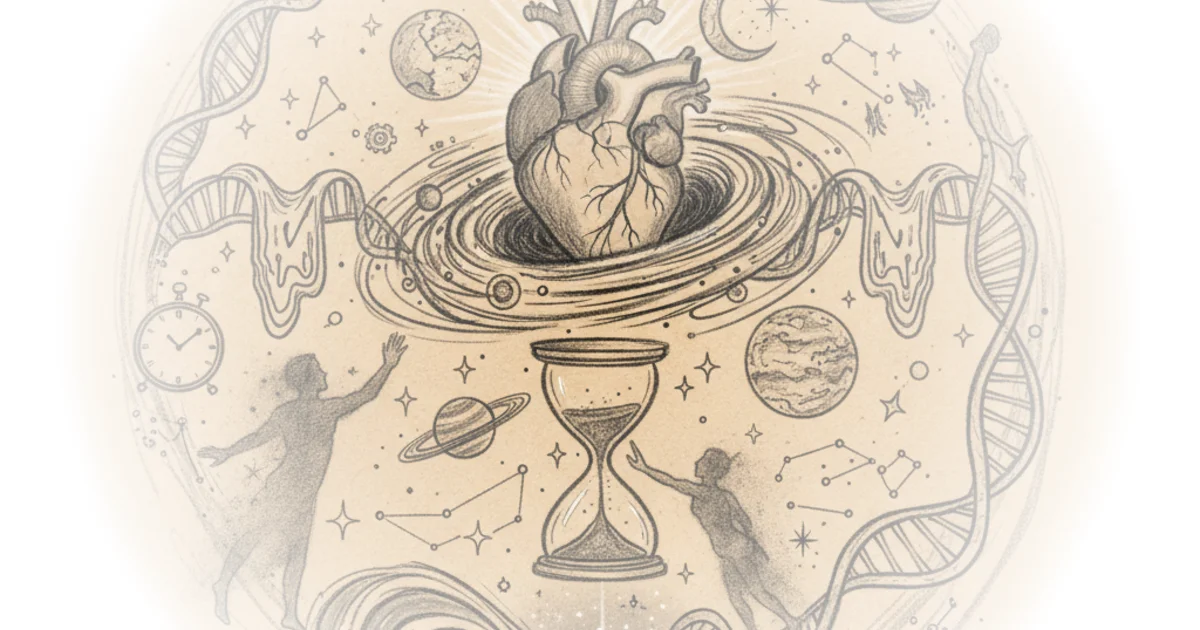
The argument suggests that while we are trapped in the linear "arrow of time," moving inevitably from order to disorder, love offers a unique form of resistance. As van der Linden writes, "Maybe it's some evidence, some artifact of a higher dimension that we can't consciously perceive." This reframing is effective because it treats the emotional arc not as a departure from the science, but as the only variable capable of solving the equation. The author posits that we may be "more terrified of intimacy than interstellar travel," a sharp observation on why this theme often gets overlooked in favor of technical debates.
Critics might argue that elevating love to a physical force undermines the film's hard sci-fi credentials, turning a story about relativity into a fairy tale. Yet, van der Linden counters this by grounding the concept in the human experience of loss, suggesting that the "devastating scene" where Cooper misses his children's lives is something every audience member feels on a smaller scale.
The Architecture of Memory
The commentary deepens as van der Linden explores how the film manipulates time to mirror the human condition. He notes that the first act is surprisingly linear, but once the crew enters the wormhole, "time becomes distorted. Not just for the characters in the film, but also for the audience." This structural choice forces viewers to experience the "dilation of time and subsequent feeling of loss" that the characters endure.
van der Linden draws a fascinating parallel to the 1962 French film La Jetée, suggesting that both stories rely on a specific, anchoring memory to navigate the chaos of time. In Interstellar, this anchor is not Cooper's love for his daughter, but her love for him. "The tesseract is not about Cooper. It's about Murph," van der Linden asserts. "She is the one haunted by her childhood, by a memory of a dad leaving his young daughter in her bedroom with a ghost she didn't understand." This distinction is crucial; it shifts the agency from the explorer to the one left behind, arguing that "it was her, not Cooper's connection to the past that gave the bulk beings a specific anchor point for communication."
Understanding that is what gave him the confidence to code the data into the watch. The watch that he knew she would come back for because he gave it to her.
The author argues that this mechanism—using a physical object imbued with emotional history to bridge dimensions—is the film's true metaphor for "atemporal" existence. It is our ability to document and remember that allows us to transcend the present moment. As van der Linden puts it, "Books allow us to reach back in time and access moments from the past... Today we revisit the past through photographs, audio recordings, music, and film."
Rage Against the Entropy
Ultimately, the piece concludes that Interstellar is not a story about defeating death, but about confronting the inevitability of time itself. The antagonist is not a villain, but entropy—the movement from order to disorder. van der Linden interprets the recurring Dylan Thomas poem, "Do not go gentle into that good night," as a command to "rage against time, against our cosmos being driven towards nothingness."
The author writes, "In time we find the essence of our mortality. The confrontation with our own annihilation always looming in the distance." By framing the film as a poetic response to this cosmic indifference, van der Linden elevates the narrative from a space adventure to a philosophical treatise. The film suggests that while we cannot stop time, we can "commit to memory all that which will be lost."
A counterargument worth considering is that this poetic interpretation risks ignoring the film's more pragmatic themes of survival and colonization. However, van der Linden's focus on the emotional cost of survival provides a necessary balance to the cold calculus of the plot.
Bottom Line
Tom van der Linden's analysis succeeds by refusing to treat the film's emotional core as a flaw, instead presenting it as the only logical solution to the problem of time. The strongest part of the argument is the distinction between Cooper's journey and Murph's anchoring memory, which recontextualizes the entire climax. The biggest vulnerability lies in accepting love as a literal physical force, a leap that may alienate hard science enthusiasts, though the piece wisely frames it as a metaphorical necessity for human meaning.
Against this sorrow, Interstellar gives us not science but poetry. Do not go gentle into that good night. Old age should burn and rave close of day. Rage, rage against the dying of the light.