While most travel writing fixates on the destination, Jason Slaughter turns the lens onto the infrastructure itself, arguing that Japan's railway network offers a masterclass in how public transit can be both ruthlessly efficient and delightfully eccentric. The piece's most startling claim isn't about speed, but safety: a system that has operated since 1964 without a single fatal crash on its high-speed lines, a statistic that forces a reckoning with the safety standards of other modes of transport.
The Engineering of Safety and Speed
Slaughter opens by dismantling the assumption that high-speed travel requires compromise. He notes that the Shinkansen, or bullet train, functions as the backbone of the nation's mobility, moving more people than any airline while departing with the frequency of a city metro. "Shinkansen run really frequently too at Tokyo Station they leave about every 6 minutes during rush hour," Slaughter writes, highlighting a density of service that makes driving or flying between major cities illogical. The core of his argument rests on the engineering choices that enable this: a dedicated network with no level crossings and a coordinated signaling system that keeps trains clear of one another.
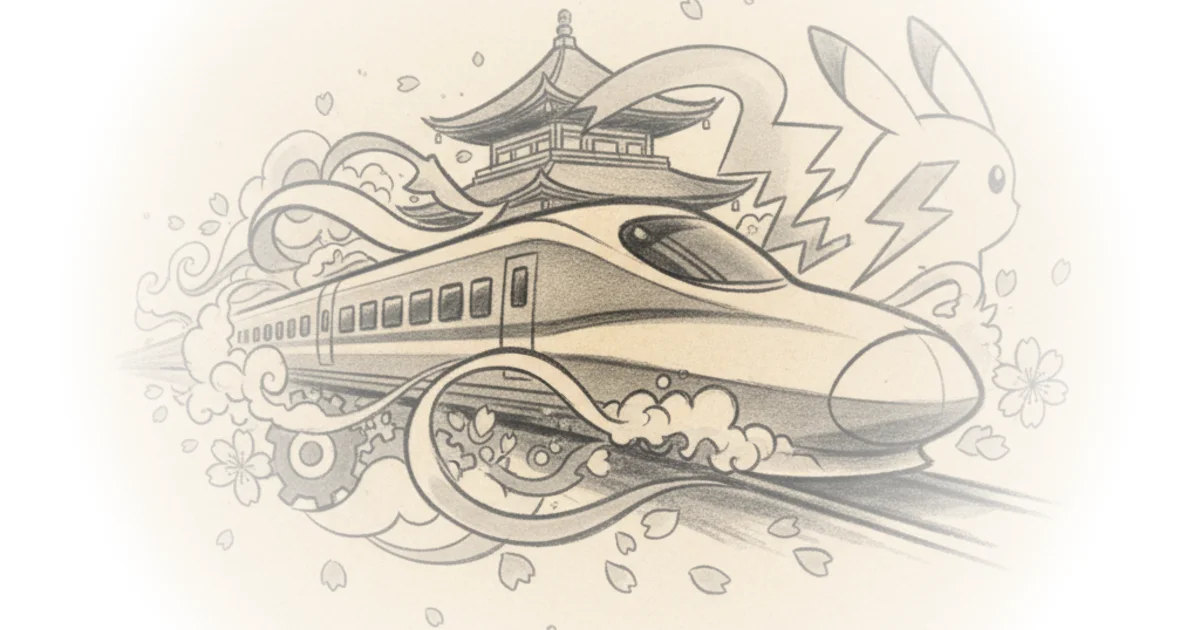
The author drives the point home with a sobering comparison of safety records. "Think about that how many car crashes have there been since 1964 or aerplane crashes or fatal accidents on literally any other form of transportation," he asks. This rhetorical pivot is effective because it shifts the reader's focus from the novelty of the technology to the mundane miracle of its reliability. The system is so robust that it automatically shuts down upon detecting seismic activity, a feature that underscores the prioritization of human life over schedule adherence. Critics might argue that the lack of accidents is partly due to the sheer volume of passengers and the specific geography of Japan, but the operational discipline required to maintain such a record remains a global benchmark.
"Japan really can be the most backwards futuristic country sometimes."
The Spectrum of Experience: From Utility to Luxury
Moving beyond the standard commuter experience, Slaughter explores how the administration of these lines caters to wildly different demographics without sacrificing the core utility of the network. He contrasts the utilitarian Hayabusa, which offers a smooth ride at 320 km/h, with the whimsical Hello Kitty Shinkansen. The latter is described as a "pink monstrosity" that has been decked out since 2018, complete with themed restrooms and merchandise shops where water costs four times the standard price. Slaughter observes that the theme fades as one moves away from the front cars, noting, "by the time you're at the end it's like you're not even on a Hello Kitty train so Book car two if you want to experience Peak Hello Kitty."
This segmentation highlights a sophisticated understanding of market demand. The network doesn't just move bodies; it curates experiences. On the other end of the spectrum lies the Sapphire Odoriko, a luxury train where "the green cars are the cheap seats" compared to the private compartments designed for corporate meetings. Slaughter details the friction in booking these premium experiences, recounting how he had to visit a ticket office in person because the compartments couldn't be reserved online. "The woman in the ticket office consulted a paper manual in order to book the correct compartment," he writes, a detail that perfectly encapsulates the tension between high-tech infrastructure and analog bureaucracy. This juxtaposition suggests that even in a hyper-modern society, the human element of service remains a critical, albeit sometimes clunky, component of the luxury experience.
Designing for Recreation and Niche Interests
Perhaps the most compelling part of the coverage is Slaughter's focus on trains designed for leisure rather than commuting. He highlights the BB Bas, a weekend train specifically engineered to transport road cyclists, allowing riders to bring their bikes to trail heads without dismantling them. "I love that Japan has trains like this that allow people to take recreational trips that would typically require a car in most other countries," Slaughter writes. This observation reframes the purpose of public transit: it is not merely a tool for getting to work, but an enabler of lifestyle and recreation.
The author also examines the High Rail 1375, a stargazing train that runs at high altitude. Here, the narrative takes a turn as Slaughter admits to booking the trip without fully understanding the itinerary. He expected to gaze at the stars from the window but instead found himself in a parking lot with the lights on, waiting for a break in the clouds that never came. "This was truly bizarre because we were literally in the parking lot of the station and they didn't turn off the lights or anything," he notes. Despite the disappointment, the experience underscores the sheer ambition of the network. The train even features a planetarium on board, a feature that Slaughter admits he didn't fully appreciate due to the language barrier. A counterargument worth considering is that such niche services might be economically unsustainable or impractical for the average traveler, yet their existence signals a cultural commitment to making the journey as meaningful as the destination.
Bottom Line
Slaughter's coverage succeeds by treating the train not as a mere vessel, but as a reflection of a society that values both extreme efficiency and playful specialization. The strongest part of the argument is the demonstration that high-speed rail can be safe, frequent, and diverse simultaneously. The biggest vulnerability, however, lies in the occasional friction between this high-tech vision and the analog realities of booking and service, a reminder that infrastructure is only as good as the human systems that run it.
"Fundamentally trains should be available for all kinds of trips not just commuting."
The ultimate takeaway is that Japan's rail network offers a blueprint for the future of mobility: one where safety is non-negotiable, luxury is accessible, and the journey itself is a destination.