More Perfect Union exposes a brutal economic paradox: the very corporations that profit from selling food are systematically engineering a workforce so underpaid that they must rely on the government to feed them. This is not a story about lazy freeloaders, as political rhetoric often claims, but a forensic look at how America's richest companies have turned the Supplemental Nutrition Assistance Program (SNAP) into a hidden line item on their balance sheets. In an era where food insecurity is rising, this investigation forces a confrontation with the reality that the "scam" isn't being committed by the hungry, but by the powerful.
The Human Cost of Corporate Profit
The piece opens by dismantling the abstract statistics of poverty with visceral, on-the-ground testimony. More Perfect Union writes, "What is it like to be in a grocery store for 6 hours hungry? It's torturing. You feel like you're being tortured." By centering the narrative on workers like Daisy Walter, who must choose between bills and food despite working full-time, the author shifts the blame from the individual to the system. This framing is essential; it strips away the moral judgment often attached to welfare recipients and replaces it with a clear picture of structural failure.
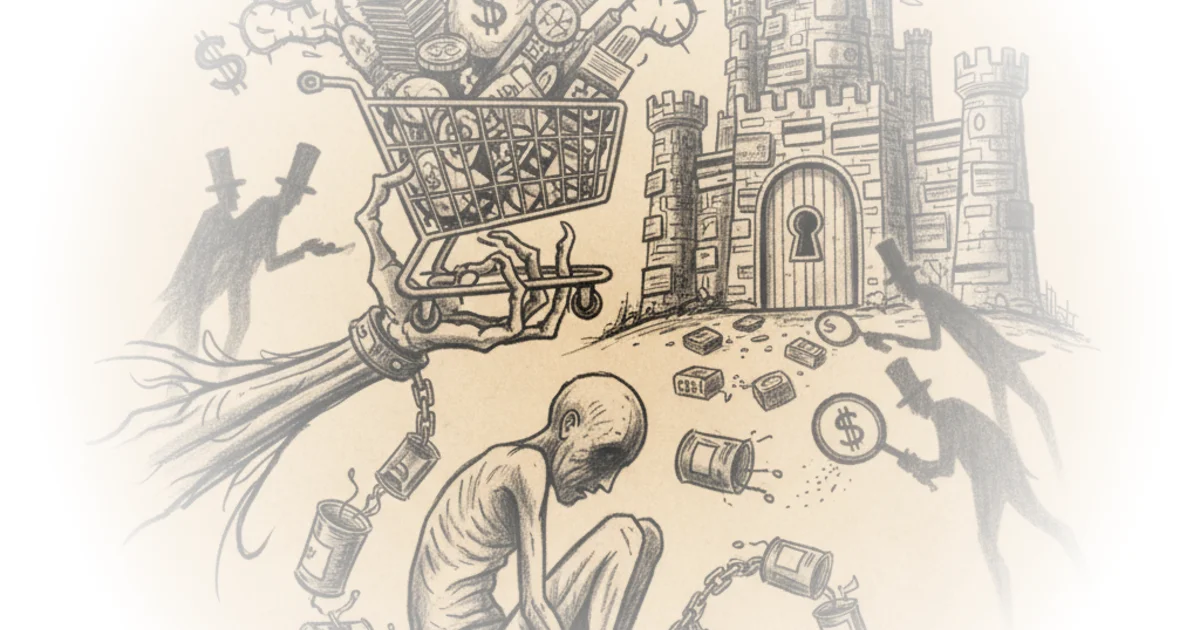
The investigation highlights a disturbing disconnect between corporate success and employee survival. The author notes that Safeway's parent company, Albertson's, generated nearly a billion dollars in profit in 2024, yet its employees are dreaming about food combinations while on the clock. More Perfect Union observes, "They work for a corporation... whose parent company... made nearly a billion dollars in profit in 2024. So, why are they on government assistance?" This question is the engine of the piece. It forces the reader to confront the absurdity of a system where a company can be wildly profitable while its own staff requires public subsidies to survive. A counterargument might suggest that these are entry-level positions not meant to support families, but the sheer scale of the phenomenon across major employers like Amazon and Walmart suggests a deliberate business model rather than a temporary labor market glitch.
The Mechanics of the Subsidy
The core of the argument moves from emotional testimony to hard data, revealing an intentional strategy to shift costs onto taxpayers. The author explains that corporations deliberately keep employee hours below the 30-hour threshold to avoid providing health insurance and other benefits. More Perfect Union states, "By keeping their employees hours low, these corporations are able to avoid offering those benefits and keep their employees incomes below the threshold needed to qualify for programs like SNAP or Medicaid. And that way the government picks up some of the cost." This is a devastatingly clear explanation of how the "free market" is actually a heavily subsidized arrangement for the wealthy.
The evidence presented is not circumstantial; it is internal. The author points to a confidential 2017 presentation from Kroger that explicitly acknowledges, "Many Kroger associates live under the poverty line," while simultaneously highlighting the revenue those employees generate through their SNAP benefits. More Perfect Union writes, "Nobody has perfected the scheme better than Walmart... nearly a quarter of every SNAP dollar is spent in their stores." This reveals the full loop of the scam: pay poverty wages, let the government feed the workers, and then collect that government money back in the register. The author's conclusion here is sharp: "The real freeloaders here are the big profitable corporations that are shifting the costs of people's basic needs onto taxpayers. They are the leeches on the system."
The Political Weaponization of Hunger
The commentary then pivots to the political fallout, critiquing the narrative pushed by the president and his allies who frame SNAP as a program rife with fraud. More Perfect Union counters this by noting, "According to President Trump and his allies, SNAP is rife with fraudsters and freeloaders... But we investigated and what we found was shocking because there are definitely people taking advantage of SNAP, but they're hiding behind lobbying firms and front groups, behind the doors of private jets and boardrooms." This distinction is crucial. It reframes the debate from individual morality to corporate accountability.
The piece details how new work requirements are designed not to encourage employment, but to create bureaucratic hurdles so complex that millions will simply give up. The author compares the new reporting rules to a nightmare scenario: "Imagine having to call up your cell phone company once a month. Sit on hold for 2 hours just to tell them how many calls you made and how many texts you got." This analogy effectively communicates the exhaustion inherent in the new rules. The author suggests a cynical political motive behind the timing of these cuts, noting that the deepest reductions are scheduled to occur after the 2026 election to avoid voter backlash. More Perfect Union writes, "Out of concern about how that might affect people's voting in November 2026, they move the deadline so that the deepest, most painful cuts will occur after people have cast their votes." Critics might argue that work requirements are necessary to ensure program integrity, but the author's evidence suggests the primary goal is cost-cutting to fund tax breaks for the wealthy, not administrative efficiency.
The real freeloaders here are the big profitable corporations that are shifting the costs of people's basic needs onto taxpayers. They are the leeches on the system.
Bottom Line
More Perfect Union delivers a compelling indictment of a system where corporate profitability is artificially inflated by public subsidies, all while politicians scapegoat the poor. The piece's greatest strength is its ability to connect the dots between internal corporate strategies and the lived reality of workers, exposing the "cheat code" as a feature, not a bug, of modern capitalism. However, the argument's biggest vulnerability is its reliance on the assumption that political will can shift quickly enough to reverse these entrenched practices, a hope that may be difficult to sustain in the current polarized climate.