Derek Muller takes aim at one of physics' most enduring intuitions: that gravity is a force. In a video designed to challenge what everyone believes they understand about falling objects, he argues that our everyday sense of gravity is an elaborate illusion — and he backs it up with Einstein's equivalence principle.
The Equivalence Principle
Muller opens with the thought experiment that changed Einstein's life: a man falling off a roof feels no weight. "He would be weightless," Muller explains, "and anything he dropped on his way down well it would remain stationary relative to him or moving in uniform motion." This observation — that the falling man experiences exactly what an astronaut experiences in deep space — is the foundation of general relativity.
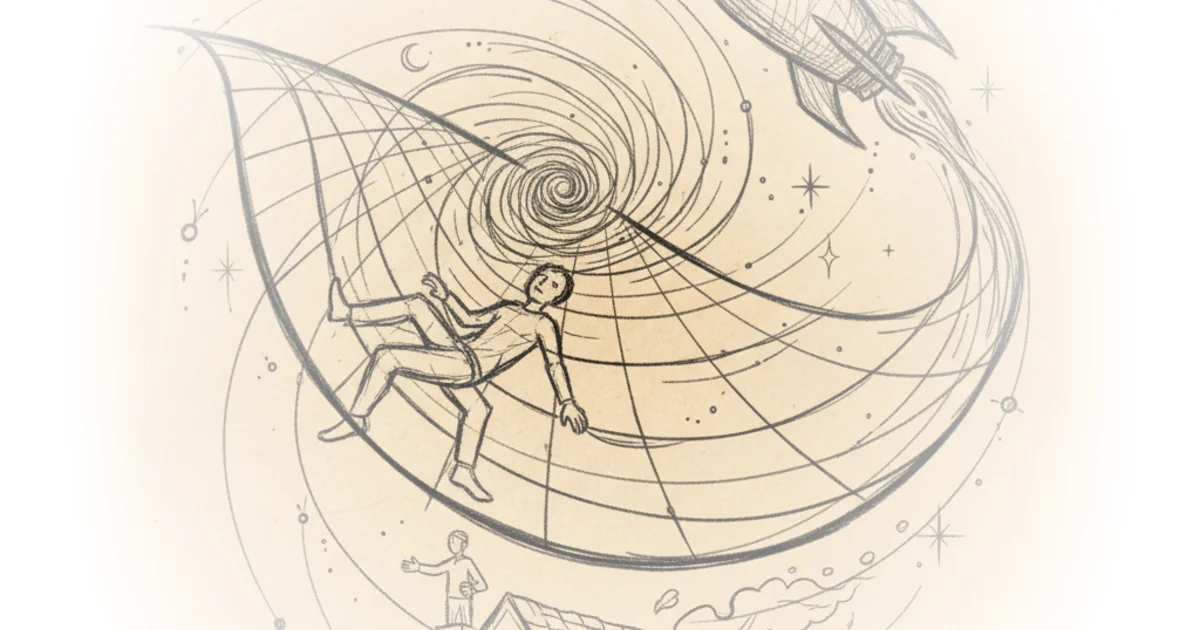
The core of Muller's argument rests on Einstein's equivalence principle. As Derek Muller writes, "Einstein looks at these two scenarios and says they are exactly the same thing not just similar physically they are exactly the same thing." This is the video's most radical claim: a person standing on Earth feels exactly like someone accelerating in a rocket ship through deep space — because both are accelerating.
The Curved Spacetime Revolution
Muller introduces curved spacetime using an airplane analogy. "Airplanes for example always try to fly the shortest route between cities essentially they just go in a straight line but since the earth's surface is curved the shortest path doesn't look like a straight line." These shortest paths over curved surfaces are what he calls geodesics — and they're the same paths objects follow through spacetime.
Derek Muller writes, "Gravity is just like that force it doesn't actually exist the real reason for you coming together was that you were all on straight paths geodesics on a curved surface." This is his central claim: gravity isn't a force pulling objects downward. It's the geometry of spacetime around massive objects. Objects appear to accelerate because they're following straight lines through curved spacetime — not because any force pulls them.
The Mass Mystery Solved
One of the most compelling sections addresses why all objects fall at the same rate. Muller notes that in Newtonian physics, this required explaining why gravitational mass (the property creating gravity) equals inertial mass (resistance to acceleration). "Scientists have spent a lot of time and effort experimentally testing down to around one part in 10 trillion that these two types of mass really are the same."
But in general relativity, there's no mystery. As Derek Muller puts it, "All objects appear to fall the same way because they're not accelerating they're just following straight-line paths through space-time until they encounter something that stops them." The apparent acceleration is the floor accelerating into them — not gravity pulling them down.
Light Bending and Experimental Confirmation
Muller then turns to experimental validation. He imagines a rocket ship coasting through deep space with light beam crossing the cabin. "Light travels in a straight line and hits a point on the opposite wall at exactly the same height as the source." But in an accelerating frame, light deflects downward.
This led to Einstein's prediction during the 1919 solar eclipse. Muller recounts how Arthur Eddington took pictures of stars during totality and found their positions "appeared deflected by the precise amount predicted by Einstein's general theory of relativity" — twice the deflection from a strictly Newtonian calculation.
The Bottom Line
Muller delivers a counterintuitive but rigorous case for why gravity isn't real in the Newtonian sense. His strongest move is reframing acceleration as deviation from geodesic paths rather than any force acting on objects. The evidence — Eddington's 1919 experiment and subsequent confirmations over a century — gives his argument empirical weight.
His biggest vulnerability: he acknowledges that "a lot of this might seem pretty far-fetched" but doesn't fully address why intuition resists this explanation. The philosophical problem isn't the math — it's accepting that our everyday experience of weight, of being pulled down to Earth, is a consequence of spacetime geometry rather than force.
Gravity doesn't actually exist. The real reason for apparent attraction is that you're following a straight path on a curved surface.
The piece succeeds in making general relativity feel not just comprehensible but intuitive — and forces readers to question what they've always believed about falling objects.