Matt Taibbi turns his attention to Leonid Krutakov, a Russian muckraker whose new book, "Oil and Peace," reframes global conflict not as a clash of ideologies or personalities, but as a desperate scramble for the finite energy that powers modern civilization. While Western discourse obsesses over carbon emissions, Krutakov argues that the true crisis is the "doomed math" of a world entirely dependent on a single hydrocarbon, a dependency that has turned every major geopolitical flashpoint from Ukraine to Iran into a battle over pipeline routes and extraction rights.
The Physics of Geopolitics
Taibbi highlights how Krutakov shifts the lens from moral judgment to material reality. The author writes, "The energy density of oil is incredible… It's hard to even imagine how many people would have to work, and for how long, to provide the energy equivalent of one voyage of a supertanker from the Persian Gulf to Rotterdam." This comparison is not merely rhetorical; it grounds the abstract concept of "energy security" in the visceral reality of human labor. By quantifying the sheer scale of energy we consume, Krutakov exposes the fragility of the global order. This argument gains weight when viewed through the historical context of the "Loans for shares" scheme, where the privatization of Russian assets in the 1990s was less about free markets and more about consolidating control over the very energy flows that now dictate international relations.
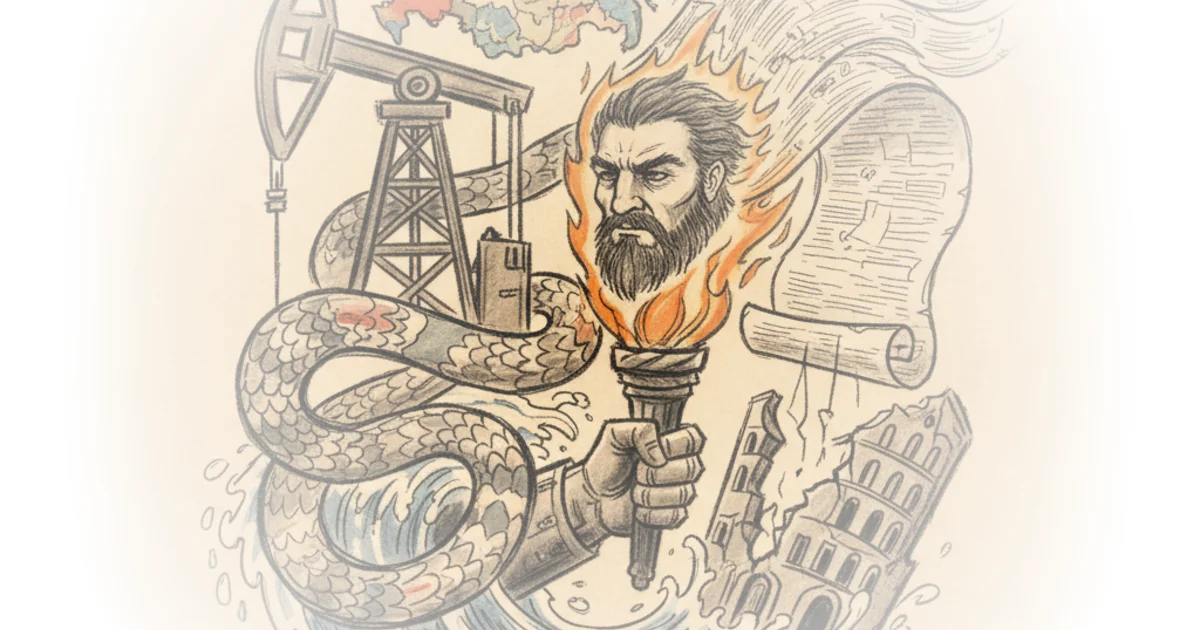
Krutakov's analysis suggests that the West's high-energy lifestyle is a temporary anomaly built on low extraction costs in developing nations. As Taibbi notes, "American analyses of these questions tend to focus obsessively on global warming, but Krutakov's book spends more time focusing on the doomed math of tying so much of our lives… to the production of one hydrocarbon." The implication is stark: the political unsustainability of this model is more immediate than the ecological one. Critics might argue that this materialist determinism downplays the role of human agency and diplomatic failure, yet the sheer volume of historical evidence Krutakov marshals—from the Civil War to the invasion of Russia by Hitler—makes the energy argument difficult to dismiss.
"Rockefeller built the world in which we live. He laid the foundations of the oil industry as vertically integrated with an internal pricing system that allows controlling the cost of the final product."
The Hidden Architecture of War
The interview takes a provocative turn when Krutakov challenges the standard narrative of the American Civil War. He asserts that the conflict "wasn't fought over human rights or a struggle over slavery" but was instead a clash between "muscle and machine," or biological versus mineral energy. Taibbi presents this not as a denial of slavery's horrors, but as an economic reading of the war's structural drivers: the Union's need to secure the nascent oil empire led by Rockefeller against the South's agricultural base. This reframing forces the reader to reconsider the "oil triangle" of the 19th century as a precursor to the modern energy wars.
Taibbi writes, "Krutakov he writes in detail about this key role oil played in triggering two world wars and misadventures in Iraq, Syria, Libya, and elsewhere." The connection is drawn explicitly to current events, with Krutakov suggesting that the war in Ukraine and tensions with Iran are merely the latest chapters in a 150-year struggle for control over the global market's energy underpinning. The author notes, "The Libyan story began with a project to construct an oil pipeline to Italy along the bottom of the Mediterranean Sea… Syria should have become part of the oil pipeline from Iran through Iraq." This specific detail transforms abstract geopolitical maneuvering into a concrete battle over infrastructure. The parallel to the "Energy density" concept is clear: just as oil concentrates solar energy over millennia, these conflicts concentrate decades of diplomatic tension into moments of violent eruption.
The Limits of Power
When addressing the role of the United States, Krutakov offers a sobering assessment of Russia's failure to convert its resource wealth into long-term power. He states, "Russia remains fundamentally a rentier country. Over the past 30 years Russia has failed to convert its energy opportunities into cognitive capital." Taibbi uses this to pivot to a broader critique of the global order, where raw materials are valued over education and science. The author writes, "Genuine supremacy is formed not in raw materials or the military sphere, but in education. Knowledge and science make a country truly great and significant for the whole of world civilization."
This perspective challenges the notion that military might or resource control guarantees stability. Krutakov argues that the current global crisis is a result of the West's inability to see beyond the immediate leverage of oil. As Taibbi puts it, "It became clear that the energy component would lead the world to a global clash over energy sources, which we are witnessing today: Iraq, Libya, Syria, Ukraine, Russia, Iran…" The administration's focus on specific geopolitical theaters often misses this underlying current. The executive branch's actions, whether in sanctioning Iran or supporting NATO expansion, are interpreted by Krutakov not as moral crusades but as moves to secure the "oil underpinning" of the global market.
Critics might note that attributing every conflict to oil risks oversimplifying complex ethnic and religious tensions. However, Krutakov's insistence on the "material resources that allow history itself to materialize" provides a consistent framework for understanding why certain regions remain volatile while others stabilize. The interview concludes with a reflection on the information war, where Krutakov warns that "the revolver has always been and remains the last argument in a debate when you have nothing left to respond with."
Bottom Line
Taibbi's coverage of Krutakov's work succeeds in stripping away the moralizing rhetoric that often clouds discussions of international conflict, replacing it with a stark, materialist analysis of energy as the primary driver of history. The strongest part of this argument is its ability to connect disparate events—from the Civil War to the Nord Stream explosions—through a single, unifying thread of resource dependency. Its biggest vulnerability lies in its deterministic tone, which may underplay the potential for human innovation to break the cycle of energy-driven conflict. Readers should watch for how the administration navigates the coming squeeze on global energy supplies, as the math Krutakov describes suggests that the window for a peaceful transition is rapidly closing.