Devin Stone cuts through the sensationalism of the Titan submersible disaster to ask the one question that actually determines whether justice is served: can a liability waiver protect a company that ignored every warning sign of catastrophe? While the public fixates on the tragedy itself, Stone argues the real legal battleground is whether the concept of "gross negligence" can pierce the shield of a contract signed by the victims. This is not just about a failed dive; it is a stress test for the limits of corporate accountability when safety is traded for speed and profit.
The Illusion of Consent
Stone immediately dismantles the narrative that the victims simply accepted the risk. He highlights the stark contrast between the legal documents and the marketing pitch. CEO Stockton Rush dismissed complex safety systems, boasting, "We only have one button that's it this is to other submersibles what the iPhone was to the Blackbird." Stone points out that this "MacGyvering" of off-the-shelf camping gear for a vessel designed to withstand crushing ocean pressure was the first red flag. The waiver passengers signed explicitly stated the vessel was not certified and that risks "simply cannot be eliminated," yet Rush allegedly told potential passengers the trip was "way safer than flying in a helicopter or even scuba diving or even crossing the street."
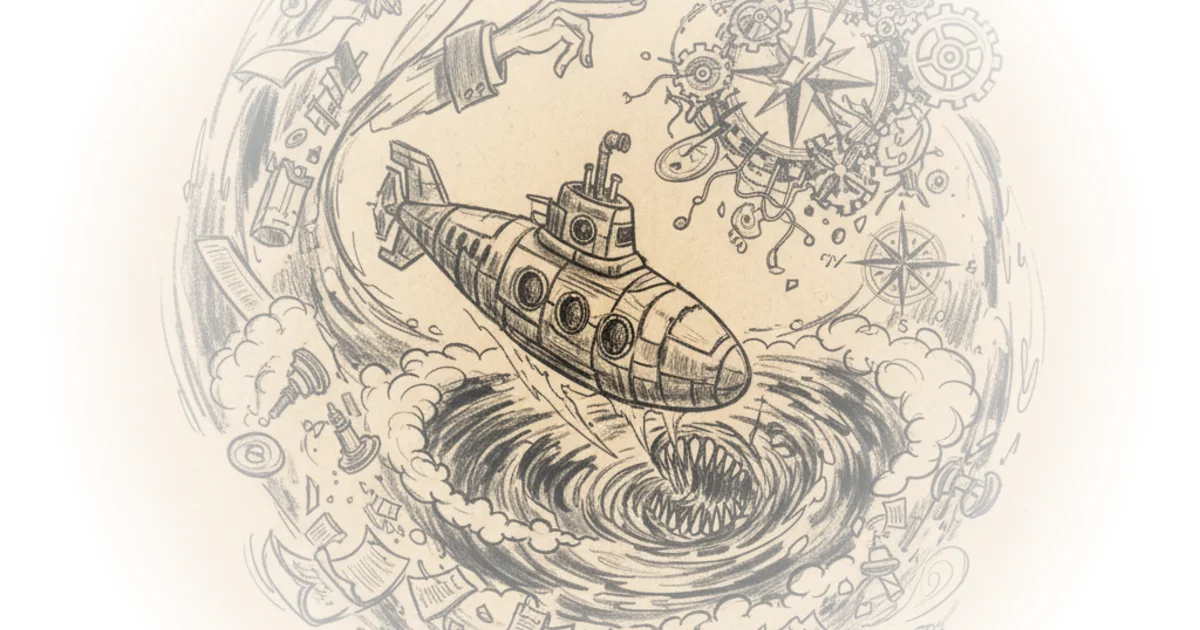
This contradiction is the crux of the legal argument. Stone explains that in the United States, liability waivers generally cover ordinary negligence—mistakes or general incompetence—but they crumble under "gross negligence." He defines this critical threshold clearly: "For there to be gross negligence you need to show that the defendant was more than careless that they were Reckless and engaged in behavior that might even appear to be deliberate." The commentary suggests that the sheer volume of ignored warnings makes this distinction the only path to recovery for the families.
The hallmark of gross negligence is that the defendant showed a total lack of care and disregard for the safety of others, and here that is definitely a distinct possibility.
A Trail of Ignored Warnings
The strength of Stone's analysis lies in his accumulation of specific, documented failures that occurred years before the implosion. He details how deep-sea exploration specialist Rob McCollum warned Rush that he was mirroring the "she is Unsinkable" mentality of the Titanic, only to be dismissed. Stone notes that Rush called these warnings a "serious personal insult," a reaction that underscores the hubris at play. The evidence mounts with reports from former employee David Lockridge and submersible expert Carl Stanley, who heard "cracking sounds in the hull" and warned that the carbon fiber might not withstand the pressure.
Stone highlights a particularly chilling detail regarding the vessel's design: the reliance on acoustic warnings for structural failure. Rush claimed that if the Plexiglas window failed, it would "crackle" first, giving passengers a warning. Stone dismantles this logic with precision, noting that relying on a cracking sound is like "setting up a camera to warn you thunder is coming... you will see the lightning before the Thunder but the time between them is minimal." In the deep ocean, that split second is the difference between life and death. The argument here is compelling because it moves beyond abstract legal theory to the physical reality of the engineering failures.
Critics might note that the passengers were sophisticated adults who signed the waivers, potentially arguing that they assumed the risk of a "risky recreational activity." Stone anticipates this, acknowledging that courts often uphold waivers for activities like skydiving where the participant has bargaining power. However, he counters this by citing the Oregon Supreme Court's view on unequal bargaining power, where a "take it or leave it" proposition can render a waiver unconscionable if the provider withholds critical safety information.
The Precedent of Gross Negligence
To ground the legal theory in reality, Stone draws a parallel to a Montana diving accident involving the death of an 18-year-old student. In that case, despite a signed waiver, the court ruled that the dive shop's failure to provide proper gear and certification constituted gross negligence. Stone uses this to illustrate that "a pre-injury release will only be enforced if in clear inconspicuous language it explicitly indicates the intent to release the provider from liability for injury caused by that party's own conduct or negligence." The implication is that Ocean Gate's conduct—using zip ties to reattach critical stabilization tubes and ignoring lightning damage to 70% of internal systems—falls squarely into the category of willful misconduct that no waiver can cover.
The commentary effectively uses this precedent to shift the focus from the jurisdiction of the Bahamas, where the waiver pointed, to the broader principles of public policy. Stone argues that while the waiver chose Bahamian law, courts in the victims' home countries may refuse to enforce it if it violates their public policy against shielding companies from reckless behavior. The argument is that the "total lack of care" displayed by the company makes the waiver legally void, regardless of the fine print.
If the terms of the waiver are clear and unambiguous then a court first considers whether the party being released provides a necessity or other essential service and second whether the agreement is inherently fair and not unconscionable.
Bottom Line
Stone's most powerful contribution is reframing the disaster not as an unavoidable accident, but as a series of deliberate choices that bypassed established safety norms. The strongest part of this argument is the evidence of repeated, documented warnings that were ignored, which creates a compelling case for gross negligence. The biggest vulnerability remains the jurisdictional battle, as courts vary wildly in how they treat liability waivers for extreme sports. Readers should watch for how international courts balance the specific language of the waiver against the undeniable evidence of the company's recklessness.
The legal paperwork won't save Ocean Gate if the evidence proves they were reckless; a waiver cannot protect a company that chose to ignore the laws of physics.