Dan Carlin's latest Hardcore History episode takes listeners on a journey into the twilight of the Norse gods — not as historical footnotes, but as living belief systems that shaped how Viking peoples understood reality itself. This is part two of a two-part series continuing Carlin's 2012 "Thor’s Angels" exploration, and it demands attention because it reframes what we think we know about the transition from paganism to Christianity in Northern Europe.
The Invisible Population
Carlin opens with a concept that challenges modern assumptions: the Norse didn't merely worship gods as their primary spiritual concern. Drawing on historian Neil Price's work The Viking Way, Carlin introduces the idea of an "invisible population" — beings like elves, dwarves, and trolls that were more important to daily life than the gods themselves. This is a revelation that most secular readers have never encountered.
"things that they talked about in ways that have come down to us as fairy stories or myths or Legends or folklore"
The distinction matters because it suggests these weren't peripheral beliefs — they constituted an entire cosmological framework that modern monotheistic frameworks struggle to comprehend. Carlin notes this is "difficult for those of us raised in an environment of monotheism to understand."
The Tinkerbell Effect
Carlin's most intellectually ambitious move comes when he introduces the Tinkerbell effect — a phenomenon describing how belief itself creates reality. He applies this framework to magic, sorcery, and ancient Norse cosmology with striking results:
"if lots of people believe in it and act on it magic might not be real but the effects are"
This is Carlin's thesis: belief systems produce real-world consequences whether or not the underlying metaphysics hold up. When a King consults an Oracle and attacks a rival kingdom based on prophecy, "that may be a bunch of bunk but he acted on it and people died and kingdoms rose or fell because of it." The magic becomes real through action, regardless of its metaphysical status.
Carlin quotes Shakespeare to seal this point:
"there are more things in Heaven and Earth Horatio, than are dreamt of in your philosophy"
The implication is clear: human imagination is limited, and the Norse understood dimensions of existence that our philosophy hasn't yet dreamed of.
The Gods Have Problems
One of Carlin's most illuminating sections contrasts Odin with monotheistic deities. The Christian God is supposed to know "when any Sparrow falls from a tree" — omniscient, omnipresent. Odin is different:
"Odin doesn't Odin has a couple of Ravens that he keeps for reconnaissance purposes one is named mind the other memory"
This reveals a Norse cosmology where gods possess finite knowledge and must actively seek wisdom. Carlin notes Odin "gave up an eye in his pursuit of wisdom that's why he only has one" — referring to his famous sacrifice at Mimir's well. The god of the Bible needs no ravens, no searching.
Critically, these gods had their own problems, goals, and issues. Unlike Christianity where you can "assume that the deities were on your side," the Norse gods might rank you "secondary or even lower on the list" — a theological difference that Carlin presents as genuinely alien to modern monotheistic readers.
The Terrifying Valkyries
Perhaps the most distinctive claimCarlin makes involves the true nature of Valkyries:
"looking at a valkyrie as terrifying and Akin to staring into Flame"
This directly challenges centuries of cultural distortion — from comic books to Hollywood adaptations — that have transformed these figures into something desirable. The actual sagas describe them as flame-faced terrors, not fantasy pin-ups.
Yggdrasil and Parallel Universes
Carlin's most speculative connection comes at the intersection of Norse mythology and modern physics:
"Yggdrasil connects the various Realms of existence this gets us back to our physicist idea of other dimensions or multiple World theories"
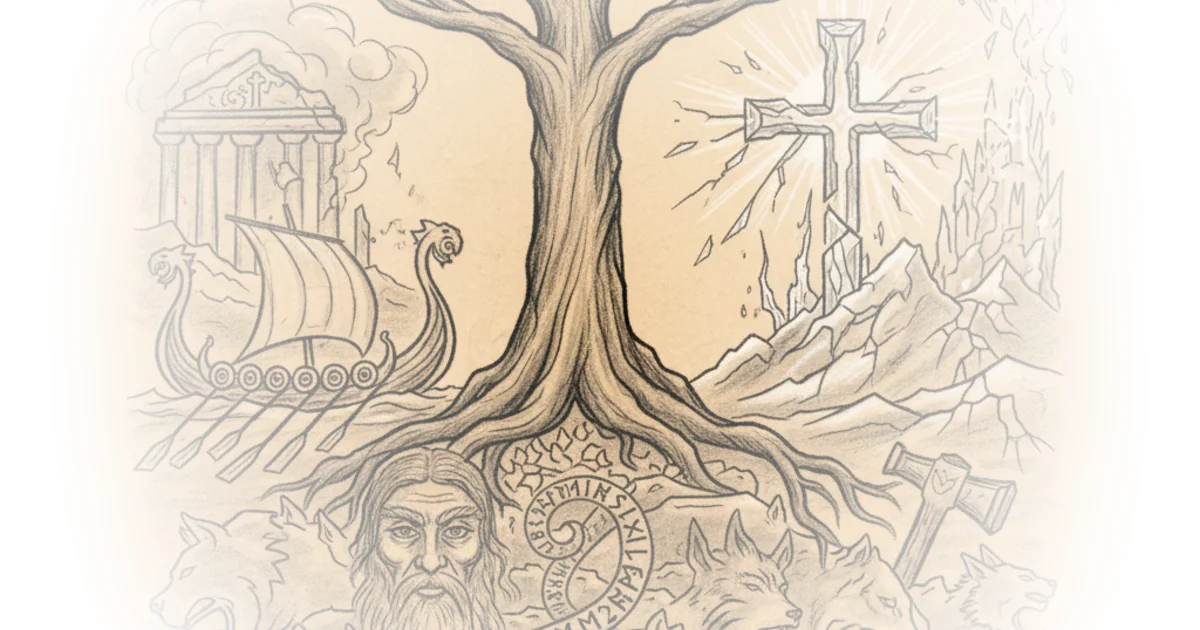
The world-tree connects midgard (human existence) to Asgard, Jotunheim, and realms of fire and ice — parallel universes in all but name. Carlin wonders if physicists might someday explain elves, trolls, and magic as "representations of things that a physicist could explain in scientific terms." It's a fascinating speculation: perhaps the Norse were glimpsing other dimensions, but lacking the vocabulary to describe them except through myth.
Christianity's Spread
The historical thread involves how Christian bishops spread through Germanic lands:
"when the Christian Bishops are going around trying to convert people like the Saxons or other Germanic tribes"
Carlin cites Adam of Bremen's 11th-century account describing a temple at Uppsala in modern Sweden featuring Thor, Odin (Woden), and Frey — with Thor centrally placed as the most important god. This is how Christianity arrived: not through instant conversion but through centuries of religious negotiation.
Bottom Line
Carlin's strongest argument is that belief systems produce measurable reality regardless of their metaphysical truth — a point he makes repeatedly about magic, prophecy, and the gods themselves. His vulnerability is less obvious: the physics-speculation thread, while intriguing, feels undercooked compared to his thorough treatment of Norse religion. The piece's real value lies in making the unfamiliar alien again — showing how genuinely strange pre-Christian belief systems were, and why that matters for understanding how Christianity actually took hold in Northern Europe.