Dave Borlace cuts through the dense technicality of the latest IPCC report to reveal a stark truth: the path to limiting global warming is not just a scientific challenge, but a massive, expensive geopolitical restructuring that our current political systems are ill-equipped to handle. While most coverage fixates on the terrifying temperature targets, Borlace focuses on the "how," arguing that the transition requires a wartime-level mobilization of global capital and a ruthless dismantling of corruption that few leaders are willing to attempt.
The Cost of Survival
Borlace frames the upcoming COP24 conference in Katowice not as a diplomatic gathering, but as a critical juncture where the gap between scientific necessity and political reality will be tested. He notes that the report outlines a blueprint for the next 80 years, describing it as "a proposed blueprint of how the entire planet geopolitical and technological infrastructure will have to operate... to ensure the survival of the human species." This framing is effective because it shifts the conversation from abstract emissions targets to the concrete mechanics of civilization.
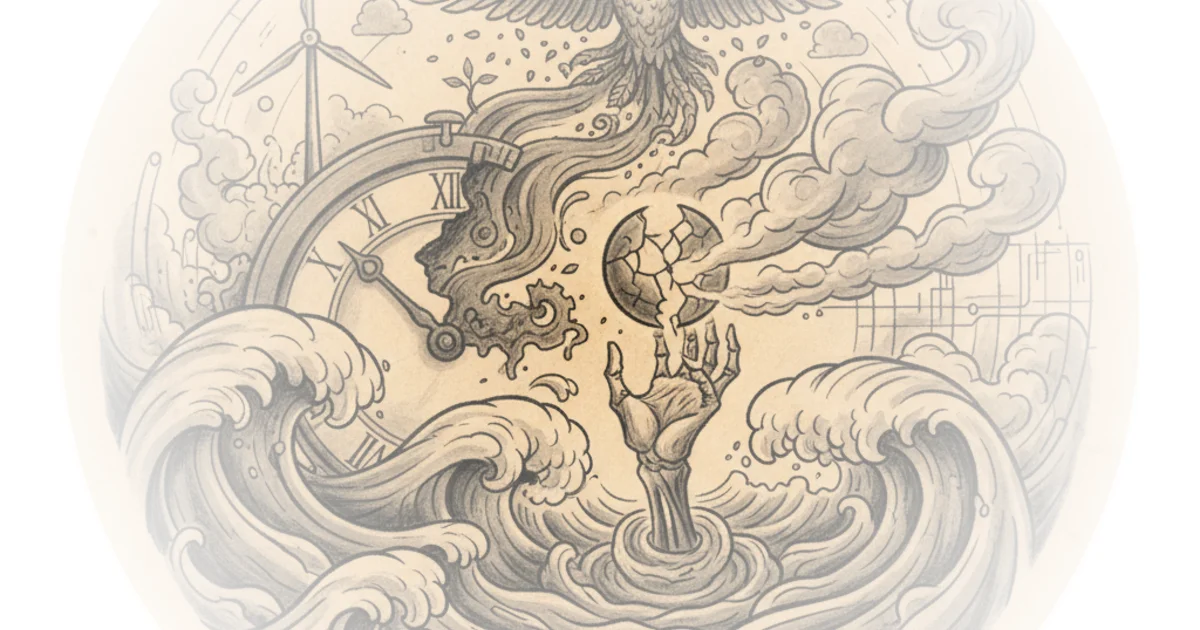
The author argues that the central tension lies in the economic fallout of rapid decarbonization. The report warns that "unprecedented measures may suffer from a lack of broad political and public port especially if they worsen existing short-term economic and social tensions." Borlace interprets this as a warning that if the transition is mishandled, it could trigger the very social unrest it aims to prevent. He suggests that the administration and global bodies must ensure that "as the fossil fuel companies go down they don't take the rest of us down with them," necessitating massive retraining programs and cross-border cooperation to avoid a collapse in living standards for displaced workers.
Critics might argue that Borlace places too much faith in the willingness of governments to execute such a coordinated "wartime" effort, given the historical failure of voluntary commitments like the Paris Agreement. Yet, his analysis of the financial scale is undeniable. He points out that limiting warming to 1.5 degrees Celsius requires "marked up scaling in supply-side energy system investments... reaching levels of between one point six and three point eight trillion US dollars per year globally."
"We essentially in an emergency not dissimilar to the one we faced in the Second World War where industries were transformed forever within a couple of years to respond to what was obviously a clear and present danger."
Decoding the Pathways
To make sense of the staggering numbers, Borlace dissects the complex modeling scenarios used by the IPCC, specifically the "Shared Socio-economic Pathways" (SSPs) and "Archetypal Pathway Scenarios." He explains that these models range from a sustainable best-case scenario to a "fossil fuel development pathway" which represents the worst-case outcome. His clarity in translating these acronyms—such as the "Low Energy Demand" (LED) scenario, which relies heavily on consumer-side changes—is a crucial service for busy readers trying to grasp the options.
The data presented is unforgiving. Under the LED scenario, Borlace highlights that "renewables contribution would need to have risen to 73 percent in primary energy and seventy-seven percent in electricity generation" by 2050. Furthermore, the industrial sector faces a "91% reduction in co2 emissions by 2050." These are not incremental adjustments; they represent a total overhaul of the global economy. Borlace notes that "investments in low emission energy will overtake fossil fuel investments globally by 2025," signaling a definitive shift in capital flow that is already underway in the models, even if political will lags behind.
However, the author also identifies a significant governance gap. He quotes the report's concern that transitions are "inherently exposed to the risks of free riding and moral peasants corruption." Borlace's commentary here is sharp: "governments sit down talk to each other identify the root causes of corruption apply legislation to stamp it out and then enforce that legislation ruthlessly." This is a bold claim, suggesting that without a global crackdown on corruption, the necessary funding and coordination will evaporate.
"The challenge is therefore how to strengthen climate policies without inducing economic collapse or hardship and to make them contribute to reducing some of the fault lines in the world economy."
The Political Reality
The most provocative part of Borlace's analysis is his assessment of why previous efforts have failed. He argues that the "Paris agreement in 2015 was a good step forward but it showed us that allowing nations to decide unilaterally on their level of commitment to contributions doesn't work." With current commitments pointing toward "3 degrees of warming or more by 2100," the author contends that the only viable path forward is mandatory, not voluntary, intervention.
He warns that the "loss of economic value of carbon-intensive assets" will be a major driver of financial instability if not managed correctly. The transition requires "robust stringent and urgent transformative policy interventions," a phrase that implies a level of coercion and central planning that contradicts current free-market orthodoxy. Borlace suggests that the "common thread" of the report is the need to keep warming below 1.5 degrees, but he admits that even achieving the "slightly less delusional 2 degrees Celsius increase" will bring "massive social economic and political challenges."
Bottom Line
Borlace's strongest contribution is his refusal to treat the climate crisis as a purely technical problem; he correctly identifies it as a profound political and economic restructuring that demands a level of global coordination rarely seen in history. The argument's vulnerability lies in its assumption that the "ruthless" enforcement of anti-corruption measures and mandatory global policy shifts is politically feasible in an era of rising nationalism. The reader should watch for whether the executive branch and international bodies can move beyond the "voluntary" framework that has dominated the last decade, or if the gap between the 1.5-degree target and political reality will continue to widen.