Paul Cooper doesn't just recount the rise and fall of the Assyrian Empire; he reframes the very nature of ancient history by showing how a civilization that viewed itself as the cutting edge of human progress was already standing on the ruins of a world twice its age. This narrative choice transforms the Assyrians from distant, brutal caricatures into a people grappling with the same existential dread of collapse that defines our own era, making their story startlingly immediate.
The Ghosts in the Desert
Cooper opens with a masterful narrative hook: the journey of Xenophon and the Ten Thousand, Greek mercenaries stranded in the heart of Mesopotamia after their employer's death. He uses their confusion to illustrate the sheer scale of Assyrian loss. "The greeks continued their march unmolested through the remainder of the day and arrived at the tigris river. It was a large deserted city this wall was 25 feet in breadth 100 in height," Cooper writes, highlighting the dissonance between the Greeks' modern (for them) perspective and the ancient reality they stumbled upon. The argument here is that the Assyrian collapse was so total that it erased memory itself, leaving later generations to invent myths about gods and fire to explain the silence.
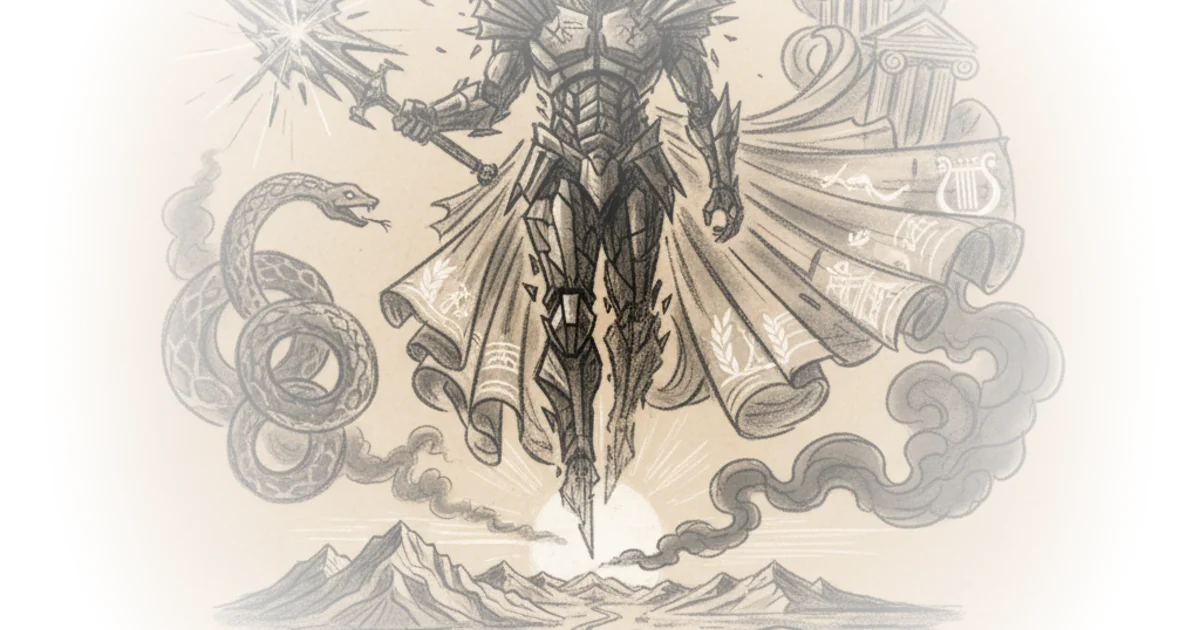
This framing is effective because it grounds high-level history in a visceral, human experience of loss. Cooper notes that Xenophon asked locals who built these cities, only to find that "no one he spoke to could tell him anything and it seemed no one even knew the names of these great cities." The sheer magnitude of the erasure is the point. Critics might argue that focusing on the Greek perspective risks centering the wrong narrator, but Cooper uses Xenophon precisely to measure the distance between the Assyrian zenith and the post-collapse void. It underscores that the empire didn't just fall; it vanished.
The city of nineveh had already been an ancient ruin for more than two centuries when Xenophon stumbled across it, a testament to how completely a civilization can vanish beneath the sands.
A People of the Cutting Edge
The piece shifts to correct a common misconception: that the Assyrians were primitive ancestors. Cooper argues they were, in their own minds, the heirs to a millennia-old tradition. "The assyrians did not think of themselves as we might think of them as an early culture at the dawn of human history but as a people on the cutting edge of human progress," he asserts. This is a crucial distinction. By detailing their reverence for Sargon the Great—a figure as distant to them as Julius Caesar is to us—Cooper shows a society deeply conscious of its own lineage.
The author weaves in the religious and cultural fabric to support this, describing how the city of Ashur became a god itself. "The god was believed to quite literally live in the highest chamber of the city's temple often in a statue dedicated to if you visited another city on business it was considered sensible to give an offering to the city's god," Cooper explains. This isn't just religious trivia; it's a structural analysis of how political power was legitimized through divine interconnection. The argument holds up well against the grain of modern secular analysis, forcing the reader to accept the Assyrian worldview on its own terms rather than dismissing it as superstition. It suggests that the empire's strength lay in this total integration of the sacred and the political.
The Weight of History
Cooper's most poignant observation comes when he contrasts the timeline of the Assyrians with the Greek and Roman golden ages. "The first stones of the parthenon in athens would not be laid for another half century the coliseum in rome would not be built for another 500 years but the city of nineveh had already been an ancient ruin for more than two centuries," he writes. This temporal jarring is the piece's intellectual core. It forces the reader to realize that the "ancient world" was not a monolith of simultaneous development but a layered history where one empire's sunset was another's prehistory.
The narrative suggests that the Assyrians were not merely conquerors but curators of a long, fragile human experiment. By focusing on the libraries, the vaults of gold, and the hymns to Marduk, Cooper paints a picture of a sophisticated society that understood the value of knowledge and art long before the West invented the concept. The vulnerability here is that the podcast format, while engaging, sometimes glosses over the brutal mechanisms of Assyrian expansion in favor of their cultural achievements, potentially softening the reality of their "empire of iron." However, the focus on their eventual, total collapse serves as a counterweight, reminding us that even the most advanced systems are fragile.
Bottom Line
Paul Cooper's greatest strength is his ability to humanize a civilization often reduced to a footnote of brutality, revealing instead a people who saw themselves as the pinnacle of human achievement standing on the bones of their predecessors. The piece's biggest vulnerability is a slight romanticization of their cultural depth, which occasionally obscures the violent reality of their imperial machinery. Readers should watch for how this framing of "deep time" influences our understanding of modern geopolitical collapses, as the Assyrian story is less about the fall of a state and more about the fragility of memory itself.