Walter Kirn delivers a haunting meditation on the cost of living a life built on fabrication, framing the act of hoarding secrets not as a clever prank, but as a corrosive force that isolates the deceiver from their own family. The piece's most striking claim is that the father's elaborate hoaxes—ranging from fake UFO landings to fabricated cryptids—were not merely hobbies, but a desperate, pathological attempt to manufacture significance in a world where he felt fundamentally unappreciated.
The Architecture of Deception
Kirn introduces us to a father who treats fraud with the casual discipline of a craftsman. "In his spare time and with no thought of profit, the way other men fish or build radios from kits, he perpetuated frauds against the public," Kirn writes, immediately establishing the banality of the father's evil. This framing is effective because it strips away the thrill of the con; there is no money changing hands, only a hollow need to be the architect of reality. The father's creations, like the "mummified wolfboy of Glacier National Park," are described as his "crowning achievement," yet the narrative reveals the profound emptiness behind the triumph.
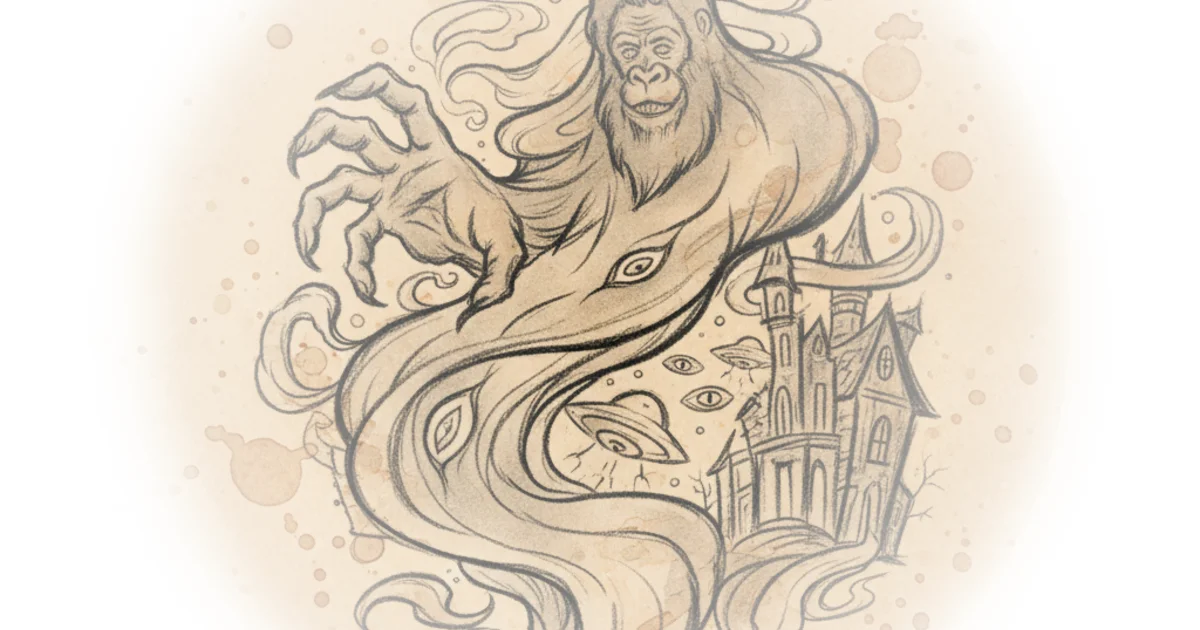
The story pivots on a specific night when the father, seeking companionship after a marital fight, recruits his thirteen-year-old son to help create a crop circle. Kirn captures the eerie intimacy of the moment: "I feel anxious, tired, and honored." This emotional contradiction is the core of the piece's power. The boy is honored to be let into the secret, yet anxious about the moral weight of the deception. The father's instruction to "keep the radio on, but keep it low. Sound carries miles on a night like this" underscores the paranoia that fuels the entire enterprise.
"We are a club," he said, opening his eyes, "but not one that meets. Not meeting is the point. We'd rather pick up a newspaper, read about a Bigfoot track discovered in Wyoming, say, and realize another one of us is out there. It's our way of saying hello to one another. Of sending smoke signals."
This passage is crucial. Kirn suggests that the hoaxers are not connected by a shared goal of truth, but by a shared isolation. They communicate only through the destruction of truth. The father's claim that "There are lots of us... Intelligent men" serves as a pathetic defense mechanism, elevating a childish prank to a professional fraternity to soothe his own ego.
The Cost of the Lie
As the narrative progresses, Kirn exposes the collateral damage of the father's hobby. The deception is not contained to the public sphere; it bleeds into the home, warping the relationship between the father and his wife. The mother's demands for affection and material things are met with the father's withdrawal into his workshop. "She's sad," he says dismissively. "That's natural in a woman. It's biological. They get attached to places. Through the smells." This reduction of his wife's pain to a biological imperative highlights the father's profound inability to connect with anyone who isn't a pawn in his game.
The father's philosophy is laid bare in a chilling conversation with his son: "A man is just a human being... And I made her think that. I built myself up big. I made her believe I had powers. Women demand it. Then they punish you when they learn the truth." Kirn argues that the hoaxes are a reaction to the vulnerability of being ordinary. By fabricating extraordinary events, the father attempts to control the narrative of his own life. However, this control comes at the price of authenticity. The boy realizes that the circle they create in the cornfield will "drive people crazy," but the true madness is the isolation it creates for the creators.
Critics might note that Kirn romanticizes the father's genius a bit too much, perhaps glossing over the sheer cruelty of manipulating the public's fear and wonder. Yet, the story's strength lies in its refusal to let the reader off the hook; we are invited to admire the father's ingenuity even as we witness the devastation it causes.
The Inheritance of Cynicism
The most tragic element of the piece is the son's transformation. Once a "straight-A science student," the boy eventually adopts his father's cynicism to survive the social chaos of adolescence. He joins a clique of girls interested in the supernatural and, ironically, becomes the one to debunk their beliefs. "Flying saucers," he tells them, "are usually just that: plates thrown in the air." When challenged, he doubles down: "People make things up. I can't believe you don't know that, Karla." The son has internalized his father's lesson: truth is malleable, and the only way to navigate the world is to be the one holding the rope.
The father's warning, "You're next," hangs over the narrative like a prophecy. The boy's cynicism is not a sign of maturity, but of infection. He has learned that the world is a stage for fabrication, and he is now an actor in a play where no one knows the script. The final image of the father in his basement, assembling "gizmos" and ranting about the "fallibility of the carbon-dating process," serves as a grim reminder that the lie has become the only reality he can inhabit.
"There's nothing on." "There is, though. There's a lot on." I stopped going home after school.
This exchange captures the complete breakdown of communication. The father sees the world as a void to be filled with his own inventions; the son sees the world as a place to escape. The lie has created a wall so high that even the people living in the same house cannot see each other.
Bottom Line
Kirn's piece is a masterful exploration of how the need to be extraordinary can destroy the very things that make life meaningful. The strongest part of the argument is the depiction of the father's hoaxes not as a triumph of intellect, but as a symptom of deep-seated insecurity and isolation. The biggest vulnerability, perhaps, is the lack of a clear resolution for the son; we are left with a young man who has learned to lie, but not why he should stop. Readers should watch for the subtle ways in which the narrative mirrors the father's own tricks, luring us into admiring the deception before revealing its hollow core.