Paul Cooper doesn't just recount the fall of an empire; he reconstructs the sensory experience of a civilization that refused to die, only to be slowly eroded by time and siege. By anchoring the narrative in the 19th-century observations of Théophile Gautier, Cooper bypasses dry chronology to ask a haunting question: what does it feel like to walk through the ruins of a world that once thought itself eternal? This approach transforms the Byzantine Empire from a historical footnote into a visceral meditation on impermanence, offering a perspective on institutional collapse that feels startlingly relevant to our own era of fragility.
The Art of Ruin
Cooper begins not with emperors or battles, but with the haunting imagery of a city reclaimed by nature. He leans heavily on the writings of Gautier, a French art critic who visited Istanbul in 1852, to frame the Byzantine legacy as a landscape of "austere melancholy." Cooper writes, "I do not suppose that there in the world of ride more austere ly melancholy than upon this road which extends for nearly a league between a cemetery and a mass of ruins." This choice to foreground the physical decay of the city's defenses sets a somber tone, suggesting that the true story of Byzantium is not just in its political triumphs, but in the slow, inevitable return of stone to earth.
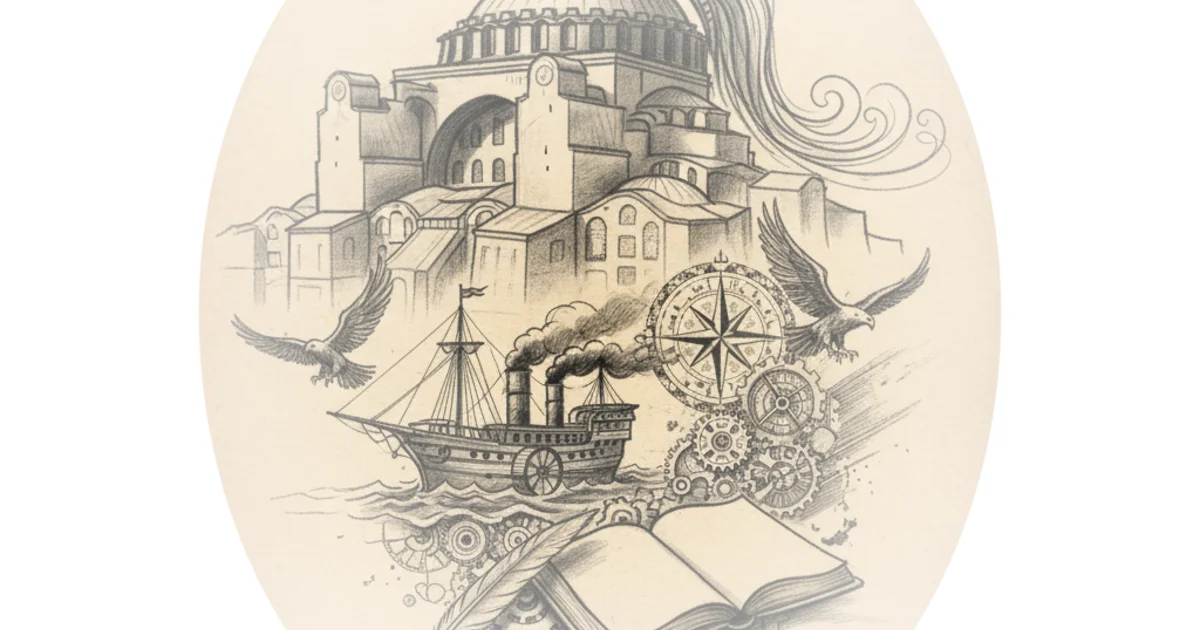
The author's focus on the visual details of the crumbling walls serves a dual purpose: it humanizes the historical scale and underscores the fragility of even the most "impregnable" fortifications. As Cooper puts it, "fig trees sprouting from their towers and vines and grasses bursting from the cracks in the masonry... the roots of trees became chains to confine them." This poetic description does more than paint a picture; it argues that nature itself was an active participant in the empire's dissolution, slowly dismantling the man-made barriers that had held back the world for a millennium. Critics might argue that this romanticization of decay distracts from the specific military and economic failures that actually toppled the state, but Cooper's intent is clearly emotional resonance over tactical analysis.
The whole haunting scene seemed like something out of a dream or a magical tale as the weight of the city's history seemed to weigh down on him.
The Geography of Survival
Before diving into the human drama, Cooper takes a bold detour into deep time, tracing the formation of the Mediterranean Sea itself. He frames the region not as a static backdrop, but as a volatile, living entity shaped by cataclysmic events. He describes the Zanclean flood, where the Atlantic Ocean burst through the Strait of Gibraltar, as "one of the most impressive and terrifying sites that has ever occurred on earth." This geological prologue is a masterstroke of framing; it establishes that the Mediterranean has always been a place of violent transformation, setting the stage for the political upheavals that would follow.
Cooper argues that Rome's rise was inextricably linked to its mastery of this volatile geography. He notes that the Romans succeeded because they "excelled at organization, mass production and military expansion," turning the Mediterranean into a self-sustaining engine of conquest. "Rome's expansion during this time seemed as inevitable as the rushing torrents of water that had once poured through the Straits of Gibraltar," Cooper writes, drawing a direct parallel between geological force and imperial momentum. This comparison effectively illustrates the sheer scale of Roman ambition, suggesting that their empire was as much a natural force as the tides.
However, the narrative quickly pivots to the limits of that power. Cooper details the Antonine plague, a biological shock that shattered the illusion of Roman invincibility. He cites the Greek physician Galen, who described soldiers "bringing up a little bright fresh blood and afterwards even part of the membrane which lines the artery." The sheer horror of these descriptions serves to remind the reader that no amount of organization can fully shield a civilization from the randomness of disease. The plague didn't just kill people; it broke the social contract, leading to a period where "rival generals fought viciously over who would rule, burning cities to the ground." This section effectively argues that the seeds of collapse were sown not just by external enemies, but by internal fragility exposed by biological catastrophe.
The Thousand-Year Echo
The core of Cooper's argument lies in the unique endurance of the Eastern Roman Empire, which he frames as a "bridge between two continents and two ages." While the West crumbled, the East persisted, preserving the knowledge of the Ancients in its great libraries. Cooper writes, "Byzantium had its beginning as the eastern half of the Roman Empire while the west of that Empire fell the East remained it lasted for another thousand years after what people commonly think of as the fall of Rome." This distinction is crucial; it challenges the popular notion of a sudden "Dark Age" and instead presents a story of gradual, resilient adaptation.
Yet, Cooper does not shy away from the eventual reality of the fall. He returns to the walls of Constantinople, the very symbol of Byzantine strength, to illustrate the finality of its end. The narrative suggests that the empire was ultimately "crushed between" the rising powers of East and West, a victim of its own strategic position. The imagery of the walls, once a barrier against the world, becoming a graveyard of vegetation, serves as a final, poignant metaphor for the empire's fate. As Cooper observes, "it had been easier to believe oneself mere some of those cities of the Arabian legends all the inhabitants of which had been by some magical process turned into stone." This line captures the surreal feeling of confronting a lost civilization, where the past feels so distant it might as well be a myth.
Critics might note that the focus on the "tragic" nature of the fall risks overlooking the cultural continuity that survived in the Ottoman Empire and beyond. The transition was not a total erasure, but a complex layering of histories. Cooper touches on this by mentioning the shift from Constantinople to Istanbul, but the emotional weight of the piece leans heavily toward the loss of the Roman legacy rather than the birth of a new one.
Bottom Line
Paul Cooper's greatest strength is his ability to fuse geological scale with intimate human observation, making the fall of Byzantium feel less like a history lesson and more like a warning about the impermanence of all human constructs. The piece's biggest vulnerability is its occasional tendency to prioritize atmospheric melancholy over the gritty, structural details of economic and military decline. For the busy listener, the takeaway is clear: even the most enduring institutions are subject to the slow, relentless erosion of time, and the walls we build today may one day be nothing more than a garden for fig trees.