Most cultural essays on national identity rely on grand monuments or battlefield victories, but this piece locates the soul of Bulgaria in the steam of a public bathhouse. Justin E. H. Smith argues that the way a nation washes itself reveals more about its historical amnesia and political aspirations than any statue ever could. By tracing the lineage of Sofia's mineral springs from Roman imperial outposts to modern Bulgarian identity, Smith exposes a deliberate erasure of the Ottoman centuries that shaped the very landscape he describes.
The Architecture of Memory
Smith begins by establishing Ivan Vazov not merely as a literary figure, but as a architect of the Bulgarian "lived world." He notes that while Vazov is the "patriarch of Bulgarian literature," his true power lies in how he constructed a sense of belonging that bridges the gap between the Ottoman twilight and a European dawn. Smith writes, "His works rage against Turkish massacres and atrocities, and one of his most famous poems... helped usher in a new sense of Bulgarian identity: teaching children that they were born of a wondrous land, descended from a heroic people." This framing is crucial because it sets the stage for Smith's central thesis: that identity is often forged by what is chosen to be remembered, and more importantly, what is scrubbed away.
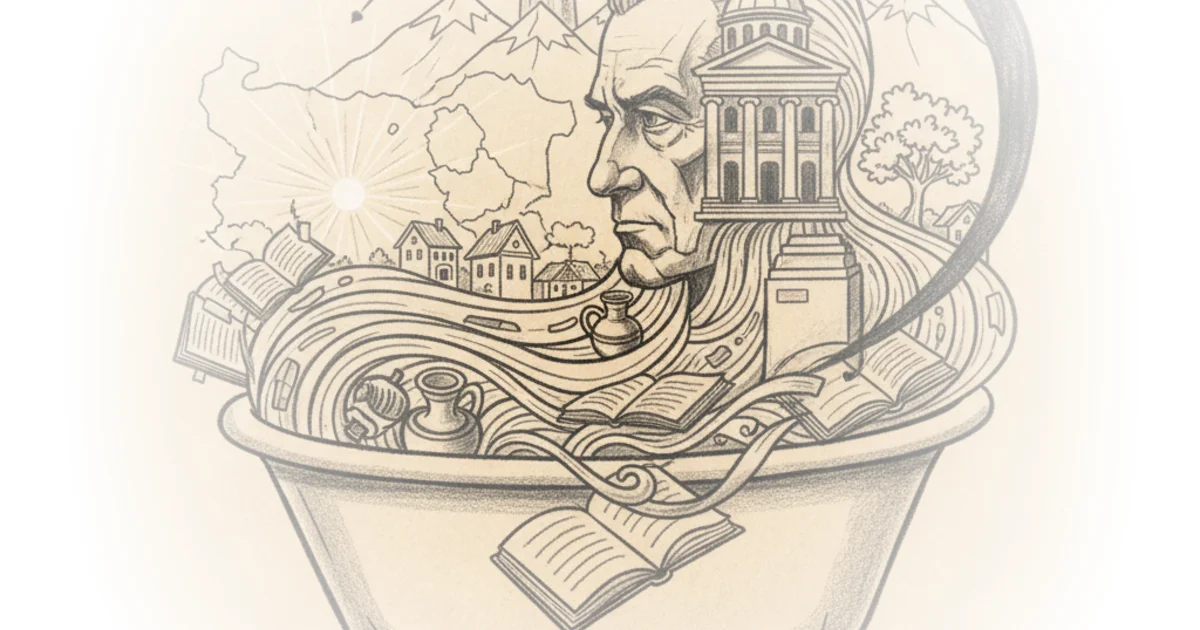
The author pivots from the grandeur of Vazov's poetry to the intimate, almost taboo subject of bathing. He contrasts the American aversion to communal nudity with the Slavic tradition of the banya, describing it as a "liminal zone, that is, a threshold, a transitional place: a place for meeting, for ritual, for business, for gossip, sometimes even for encountering spirits or performing magic." This distinction is vital. It moves the bathhouse from a utilitarian space of hygiene to a spiritual frontier where the self is renegotiated. Smith observes that in Russian folklore, the bathhouse houses the Bannik, a spirit that could be placated with soap or could "suffocate bathers, or burn the bathhouse down." By invoking these spirits, Smith suggests that the act of bathing is never neutral; it is always a negotiation with the unknown, a crossing of boundaries between the living and the dead, the safe and the perilous.
To step into the steam was to risk transformation, to enter a world where impurity could be washed away and identity reshaped.
This analysis holds up well against the backdrop of Slavic folklore, where spirits like the Rusalki (water spirits) and Samodivi (forest maidens) inhabit similar threshold zones. Smith effectively uses these myths to argue that the bathhouse is a site of "drama of identity as much as of cleansing." However, a counterargument worth considering is whether this spiritual framing romanticizes the physical realities of public health and sanitation in historical contexts, potentially glossing over the very real dangers of disease in such communal spaces.
The Roman Inheritance and the Ottoman Erasure
The core of Smith's argument emerges when he dissects Vazov's essay "In the Warm Waves." Smith points out that Vazov constructs a direct genealogy from the Roman Empire to modern Bulgaria, completely bypassing the five centuries of Ottoman rule. Smith writes, "Historical annals say nothing about which Roman emperor first built the mineral bath in our capital, Sofia. Yet the truth is that this blessed water was known long ago... crowned with vaulted arches even in the earliest days of Roman rule." This selective memory is not an accident; it is a political act. By focusing on the Roman thermae as the origin of the bathhouse, Vazov aligns Bulgaria with Western civilization and European order, effectively washing away the Ottoman hammam tradition.
Smith argues that this erasure is intentional. "Ottoman hammams, with their centuries of architecture, medical traditions, and rituals, vanish into steamy air. The genealogy runs from Thrace to Rome to Byzantium to Bulgaria, as if the Ottoman centuries had never happened." The author suggests that for Vazov, a man who made his career memorializing resistance against Ottoman rule, the hammam was "too intimate, too ordinary a reminder of the empire he was writing against." The bath becomes a tool of purification, not just of the body, but of history itself. Smith notes, "The absence of Ottoman hammam is itself a lesson in the politics of memory and the shaping of the lived world."
This is a powerful observation on how national narratives are curated. Smith writes, "In this sense, the bathhouse becomes more than a place to soak: it becomes an archive of memory, a site where identity is curated, impurities rinsed away, and a nation emerges clean, steaming, and (somehow) Roman." The argument is compelling because it highlights the paradox of national identity: it often requires the active forgetting of the very influences that shaped the culture. Yet, Smith acknowledges the futility of this erasure. He points out that the physical landscape tells a different story. "And yet Ottoman traces are everywhere, even when scrubbed from the page. One only has to look at the ubiquitous cheshmata [fountains] scattered across the land. The very word comes from Ottoman Turkish çeşme, itself from Persian čashmeh, meaning 'spring' or 'source.'"
The absence of Ottoman hammam is itself a lesson in the politics of memory and the shaping of the lived world.
Smith's insight here is that language and infrastructure often betray the official historical narrative. While Vazov's poetry and essays attempt to draw a clean line from Rome to the present, the very words used to describe the water sources are a testament to the Ottoman presence. This creates a tension between the "lived world" of the bathhouse as a Roman legacy and the "lived world" of the fountains as an Ottoman inheritance. Smith suggests that true belonging requires acknowledging this layered past, rather than scrubbing it away to fit a preferred European narrative.
The Politics of Water
The piece concludes by reflecting on the broader implications of this historical selection. Smith argues that the bathhouse, whether Roman or Slavic, functions as a "wet wing" of empire or a site of spiritual liminality. In Rome, bathing was a tool of civilization, a way to enroll conquered peoples into the order of the empire. In Slavic culture, it was a place of danger and renewal, where one risked the self to be reborn. Smith writes, "In both settings, bathing worked as a kind of Bildung: incarnate schooling in how to belong, teaching the small gestures and shared habits that mark identity, showing that you act as others do, and can you please pass the soap?"
This comparison is effective because it universalizes the experience of bathing while highlighting the specific cultural stakes. Smith's analysis of Vazov's work reveals how the choice of which history to inhabit is a choice of which identity to claim. By focusing on the Roman connection, Vazov was not just describing a bath; he was performing a national ritual of purification. Smith notes, "Vazov chooses one such road for Bulgaria and closes others." This act of closing roads is the essence of nation-building, but it comes at the cost of historical complexity.
Critics might argue that Smith's focus on the erasure of the Ottoman period risks oversimplifying the complex relationship between Bulgarians and their Ottoman past, which was not solely one of resistance but also of coexistence and cultural exchange. However, Smith's point is not to deny the complexity but to highlight how national heroes like Vazov were forced to simplify it to forge a coherent identity in the face of foreign domination.
Bottom Line
Justin E. H. Smith delivers a masterful dissection of how national identity is constructed through the selective memory of everyday rituals. The piece's greatest strength lies in its ability to reveal the political stakes hidden within the steam of a bathhouse, showing how the erasure of the Ottoman past was a necessary condition for Vazov's vision of a European Bulgaria. Its vulnerability is a slight tendency to romanticize the spiritual dimensions of the bathhouse, potentially underplaying the mundane realities of hygiene and social control. Readers should watch for how similar mechanisms of historical erasure operate in other national narratives, where the "lived world" is curated to fit a preferred destiny.
In this sense, the bathhouse becomes more than a place to soak: it becomes an archive of memory, a site where identity is curated, impurities rinsed away, and a nation emerges clean, steaming, and (somehow) Roman.