Most political commentary treats the idea of states leaving the union as a fringe fantasy, but this piece from Stark Realities dares to ask a dangerous question: was the Civil War a legal settlement, or merely a military victory that left the constitutional argument unresolved? The editors argue that the prevailing narrative—that secession was permanently "settled" by bloodshed—is not just historically inaccurate, but a dangerous myth that ignores the foundational consent of the governed. With polling showing nearly a third of voters in states like Alaska and Texas open to separation, this is no longer an abstract debate; it is a looming reality for a fractured republic.
The Myth of the Settled Question
The piece opens with a sharp critique of the common refrain that the outcome of the Civil War legally forbade secession. Stark Realities reports, "The embedded contention that legal and moral questions are rightly and permanently settled by the outcome of a mass-murder contest is absurd on its face." This is a provocative framing, one that forces the reader to confront the human cost of the war rather than treating it as a mere procedural footnote. The editors argue that equating military conquest with legal finality is a logical fallacy that has calcified into dogma.
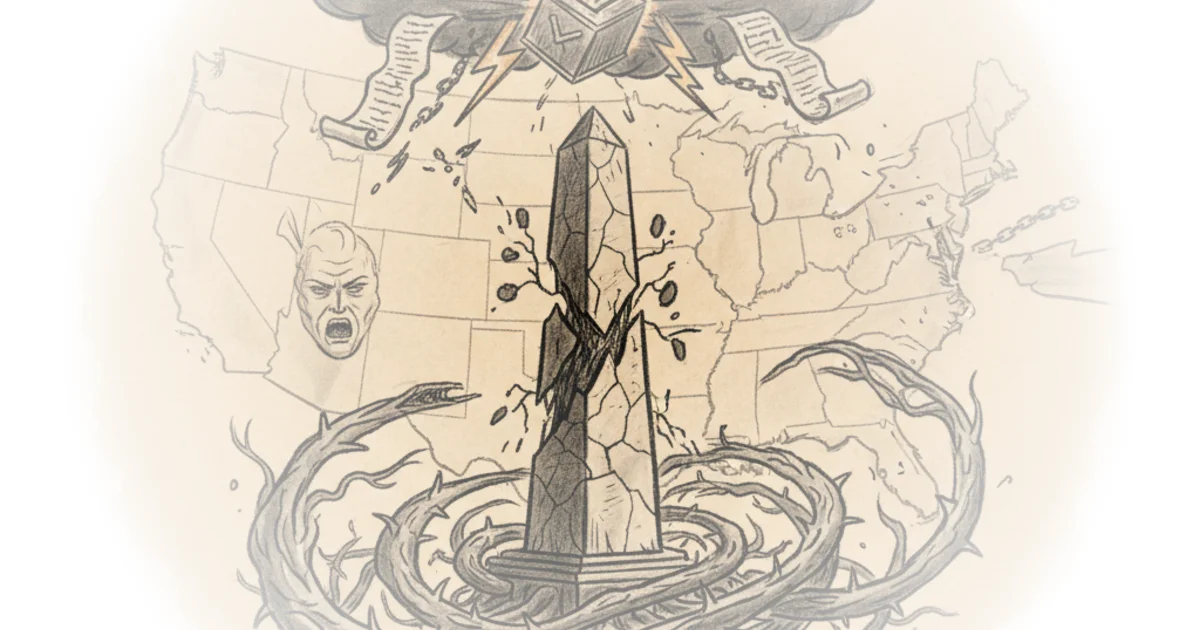
They point out that the very idea of an "indivisible" nation is a relatively recent invention, noting that the Pledge of Allegiance, written in 1892, attempts to program Americans into accepting a falsehood. The data supports the editors' claim that this programming is failing: a YouGov poll found that 29% of Republicans and 21% of Democrats would support their state's departure. The piece argues that "the intensity of our division springs from a federal government operating far beyond the limits of the Constitution — fueling a fight for control over powers that were never supposed to exist at the national level." This reframing shifts the blame from partisan animosity to structural overreach, suggesting that the drive for secession is a symptom of a broken federal compact rather than a sudden outbreak of insanity.
The embedded contention that legal and moral questions are rightly and permanently settled by the outcome of a mass-murder contest is absurd on its face.
Critics might note that dismissing the Civil War as merely a "mass-murder contest" risks minimizing the moral imperative to end slavery, which was the central cause of the conflict. However, the editors do not deny the horror of the war; they simply challenge the legal conclusion drawn from it.
The Historical Paradox
To dismantle the "settled" narrative, the article digs into the historical record, revealing a startling contradiction: the United States was born of secession, and early American leaders, including Abraham Lincoln, once championed the right to leave. Stark Realities highlights an 1848 speech by Lincoln, who stated, "Any people anywhere…have the right to rise up and shake off the existing government, and form a new one that suits them better." The piece uses this to illustrate how the political consensus has shifted dramatically over time.
The editors also bring up the abolitionist movement, noting that "slavery-abolitionists themselves championed secession, pushing for northern states to abandon the union" to distance themselves from the institution of slavery. This historical nuance is often lost in modern discourse, which tends to view secession solely through the lens of the Confederacy. The article reminds readers that the flag of the era bore the slogan "No Union with Slavery," proving that the right to separate was once seen as a tool for liberty, not just tyranny.
Yet, the piece acknowledges the turning point: the Supreme Court's 1869 ruling in Texas v. White. The editors explain that Chief Justice Salmon Chase, a Lincoln appointee, wrote the majority opinion asserting that the union was "as complete, as perpetual, and as indissoluble" as the original states. The article critiques this reasoning, noting that Chase had to ignore the fact that only nine of the original thirteen states were needed to ratify the Constitution, effectively destroying the "perpetual" nature of the Articles of Confederation. The editors argue that "Chase's opinion places great weight on the Constitution-preceding Articles of Confederation's statement that 'the union shall be perpetual,'" but that this relies on a "fiction that the United States is a monolithic entity."
The Constitutional Loophole
Moving beyond history, the commentary turns to the text of the Constitution itself. The piece argues that the lack of an explicit secession clause does not mean the right is denied. Instead, it points to the Tenth Amendment, which reserves powers not delegated to the federal government to the states. "Since the Constitution does not expressly deny the states of that power (nor delegate it to the central government), secession is reserved to the states," the editors contend. This interpretation aligns with the original understanding of the federal government as a compact of sovereign entities.
The article quotes historian Brion McClanahan, who argued that "Sovereignty can be delegated, but a delegation assumes the ability to rescind that power." This logic suggests that if states created the federal government, they retain the ultimate authority to dissolve that relationship. The piece also cites John Quincy Adams, who warned that it would be "far better for the people of the disunited states to part in friendship from each other, than to be held together by constraint." This historical perspective adds weight to the argument that peaceful separation is a valid, if tragic, political remedy.
Sovereignty can be delegated, but a delegation assumes the ability to rescind that power.
A counterargument worth considering is that the practical chaos of dissolving a modern superpower, with its integrated economy and military, makes the theoretical right to secede nearly impossible to exercise without catastrophic violence. The editors acknowledge this tension but argue that the current trajectory of federal debt and overreach makes the status quo increasingly unsustainable.
Bottom Line
The strongest part of this argument is its rigorous deconstruction of the "settled" myth, using the very words of Lincoln and the logic of the Tenth Amendment to show that the legal case for secession remains open. Its biggest vulnerability, however, is the assumption that a peaceful, orderly dissolution of the union is politically feasible in an era of deep polarization. The reader should watch for how the upcoming election results in key states like Texas and California might shift the discourse from theoretical debate to concrete political action. The piece serves as a stark reminder that the question of the union's permanence is far from closed.