More Perfect Union delivers a startling thesis: that American foreign policy is no longer just influenced by foreign money, but is actively being auctioned to the highest bidder, with the administration serving as the primary auctioneer. The piece distinguishes itself by tracing a direct, dollar-for-dollar line from Qatari investments in the president-linked real estate and crypto ventures to specific policy shifts, including the deployment of US troops to defend an authoritarian regime. For busy observers of geopolitics, this is not a theory of conspiracy but a documented ledger of transactions that redefines the meaning of "America First."
The Architecture of Influence
The author, More Perfect Union, begins by dismantling the idea that foreign lobbying is a distant, abstract problem. Instead, they ground the argument in tangible assets: a nondescript office building in Idaho and a luxury hotel in New York. The core of the argument is that Qatar has spent billions to embed itself in the American psyche, funding think tanks, universities, and media outlets to soften its image. "They've spent a $4 billion dollars on lobbying and public relations firms in the US," the author notes, highlighting the sheer scale of the financial offensive. This evidence is compelling because it moves beyond vague accusations of corruption to specific, verifiable expenditures that have reshaped the information landscape.
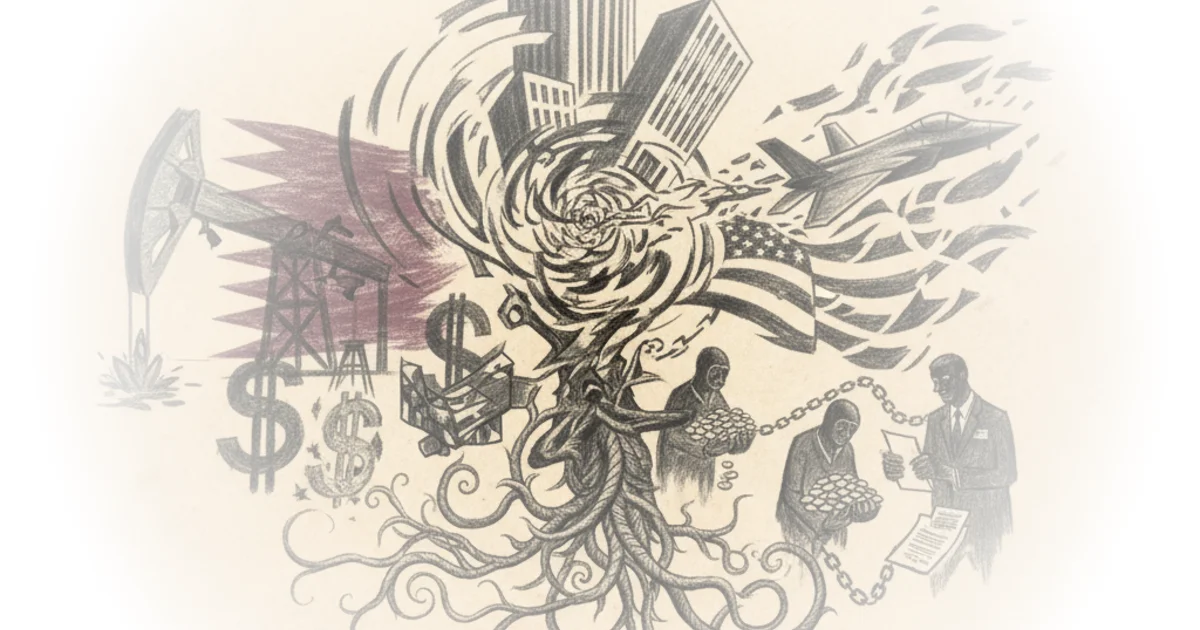
The commentary suggests that this spending was not merely for reputation management but for strategic leverage. The author points out that Qatar owns a piece of the Washington Wizards and nearly 10% of the Empire State Building, creating a web of financial interdependence. "That is until a $50 million investment from the Qatari government after which well here's an employee in their own words," the text recounts regarding a media outlet that suddenly ceased criticizing Qatar. This shift in media tone is a critical piece of the puzzle, demonstrating how capital can directly silence dissent. Critics might argue that media outlets often shift editorial stances for commercial reasons unrelated to foreign policy, but the specific timing and the explicit internal directives cited here make a strong case for targeted influence.
"Qatar views these people as investments. Even if they're not a lobbyist for Qatar today, maybe they can do something useful for Qatar down the line."
This quote encapsulates the author's most chilling insight: the transactional nature of modern diplomacy. The author argues that figures like Pam Bondi, Lee Zeldin, and Kash Patel are not just political appointees but long-term assets in a Qatari portfolio. The piece details how Bondi, while running the Justice Department, issued a memo gutting the enforcement of the Foreign Agents Registration Act, effectively removing the legal guardrails that were supposed to prevent exactly this kind of influence. The author writes, "One of her first days in office as attorney general, she issues a memo that effectively guts FARA enforcement." This is a devastating critique of the current administration's regulatory posture, suggesting a deliberate dismantling of accountability mechanisms.
The Real Estate Connection
The narrative then pivots to the personal finances of the the president family, specifically the role of Steve Witkoff and Jared Kushner. The author connects the dots between the Witkoff Group's financial distress and the Qatari purchase of the Parklane Hotel, framing it as a bailout that bought political access. "In Steve Witkoff, the Qataris found their ultimate champion, somebody who could profit from business deals with them and who could work directly with them on some of the biggest foreign policy issues of today," More Perfect Union writes. This framing is effective because it personalizes the geopolitical stakes, showing how individual greed can override national security interests.
The most damning evidence presented involves the Kushner family's financial troubles. The author recounts how Jared Kushner's building at 666 Fifth Avenue was a "massive financial albatross," leading the family to seek a Qatari bailout. When the initial request was denied, the administration allegedly facilitated a blockade of Qatar by Saudi Arabia and the UAE. However, the dynamic shifted when a Qatari-backed company paid $1.1 billion for a lease on the building just months before a massive mortgage payment was due. "So, at the very least, the Qataris seemed to have learned their lesson," the author observes, implying that the financial rescue was contingent on a change in US foreign policy. This sequence of events suggests a direct correlation between the timing of the financial rescue and the normalization of relations with Qatar.
The piece also touches on the the president family's entry into the cryptocurrency market, noting that the United Arab Emirates spy chief invested $2 billion in a the president-linked crypto exchange. The author warns, "Shortly after he got access to hundreds of thousands of AI chips that Trump's own national security advisers thought he'd turn around and give to China." This detail highlights the potential for foreign investment to compromise national security technology, a risk that goes far beyond simple lobbying.
"What a lot of people don't realize is that US foreign policy is for sale. And it's not for America's benefit and it's not for any American interest. It's solely, it is only for the benefit of Donald Trump and his family members and his inner circles."
This assertion is the emotional and logical climax of the piece. The author argues that the privatization of diplomacy has created a bidding war where foreign regimes outbid each other to secure favorable treatment from the US government. The text notes that this pattern is not new, citing the Clinton Foundation, but argues that the current administration has "become something like the LeBron James of taking money in unethical ways." This hyperbolic comparison serves to emphasize the unprecedented scale and brazenness of the alleged corruption. A counterargument worth considering is that all administrations engage in some level of economic diplomacy, and that distinguishing between legitimate business interests and corrupt influence is often a matter of perspective. However, the specific examples of policy reversals following financial injections make the author's case difficult to dismiss.
The Military Consequence
The final and most alarming implication of this financial web is the potential deployment of US troops. The author connects the dots between the Qatari investment in the Witkoff Group and the announcement of a Qatari Air Force facility at an American base in Idaho. "There's a lot of benefits for Qatar here and very little benefits to the US, frankly," the author states, questioning the strategic value of such an arrangement. The piece culminates in the revelation that the president has pledged to defend Qatar with the full force of the US military, a commitment that the author argues is a direct result of the financial entanglements. "If Qatar gets attacked, US troops will be asked to fight and possibly die to defend the government of Qatar," the text warns. This transforms the issue from a matter of financial ethics to one of life and death for American service members.
The author concludes by noting the irony of the situation: the same administration that campaigned on exposing the Clinton Foundation's foreign ties has built a system where foreign influence is more entrenched than ever. "Ultimately, for all the talk the Trump campaign made about Hunter Biden and the Clinton Foundation, they don't seem interested in changing a system that can make them and their friends very rich," More Perfect Union writes. This final observation underscores the hypocrisy and the systemic nature of the problem, suggesting that the solution is not just about removing individuals but about dismantling the entire framework of privatized diplomacy.
Bottom Line
More Perfect Union constructs a powerful, evidence-rich argument that foreign influence on US policy has evolved from subtle lobbying to a direct, transactional purchase of government services and military protection. The piece's greatest strength is its ability to link specific financial transactions to concrete policy outcomes, making the abstract concept of corruption tangible and urgent. Its biggest vulnerability lies in the reliance on a narrative of intent that, while supported by circumstantial evidence, lacks a "smoking gun" document explicitly stating a quid pro quo. Readers should watch for how the administration handles the Foreign Agents Registration Act in the coming months, as the enforcement (or lack thereof) will serve as the ultimate test of the author's claims.