Hank Green doesn't just recount the history of smoking; he exposes the deliberate machinery of doubt that powerful industries use to stall scientific truth long after the evidence is settled. This piece is essential listening because it reframes the public's confusion not as a failure of intelligence, but as a predictable outcome of strategic manipulation designed to exploit our cognitive biases. In an era where climate change and vaccines face similar manufactured controversies, understanding the blueprint of the tobacco industry's playbook is no longer just history—it is a survival skill.
The Architecture of Doubt
Green begins by dismantling the assumption that scientific consensus arrives quietly. While most discoveries "hums along quietly," he notes that when science challenges a "hierarchy or a choice people make in their lives," the backlash is immediate. The author effectively traces the journey from the 1920s, when lung cancer was a medical curiosity, to the 1964 Surgeon General's report. He describes how scientists slowly built a case using four distinct lines of evidence: observational data, animal experiments, biological mechanisms, and chemical analysis. Green writes, "Each study was like a pebble added to a pile of evidence," illustrating the cumulative nature of scientific truth. This framing is crucial because it counters the modern tendency to dismiss a single study as inconclusive without seeing the mountain it helps build.
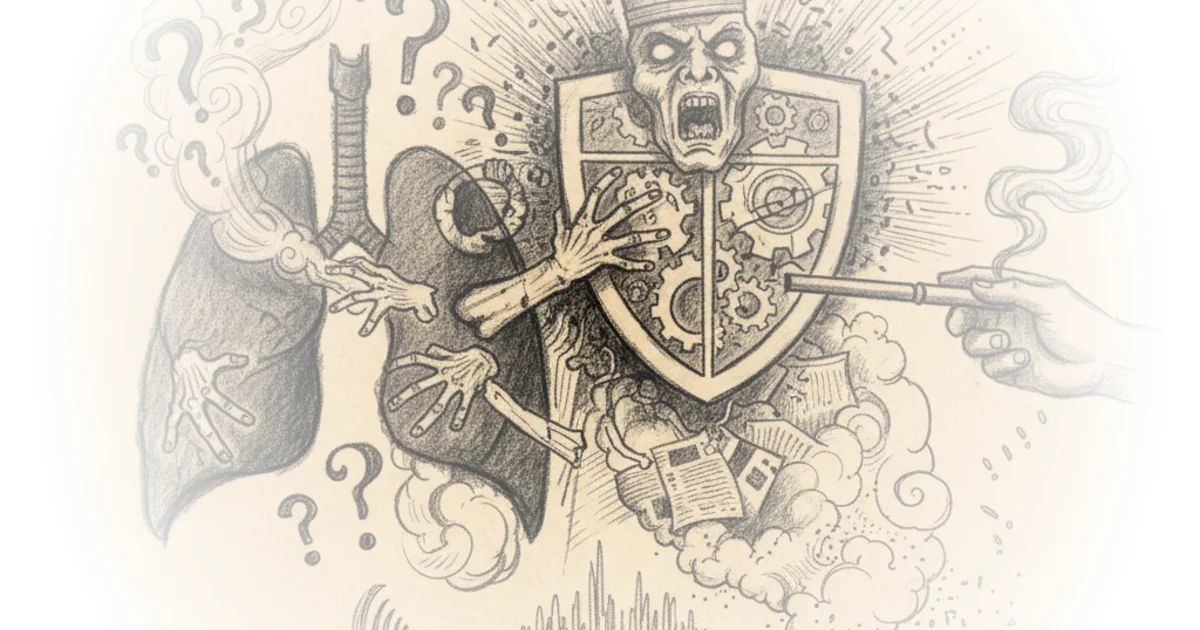
However, the real power of the commentary lies in how it details the industry's counter-offensive. Green points out that by the 1950s, tobacco companies knew the risks but pivoted their strategy from claiming safety to claiming uncertainty. "Instead of, 'Our cigarettes are better for you,' the ads became, 'We don't know yet if cigarettes are bad for you,'" he explains. This shift was not an honest inquiry but a calculated move to manufacture a controversy where none existed. The author highlights a chilling 1969 internal memo from Brown and Williamson that admitted, "Doubt is our product since it is the best means of competing with the body of fact that exists in the mind of the general public." This quote serves as the smoking gun of the entire narrative, proving that the public debate was a fiction created to protect profits.
Doubt is our product since it is the best means of competing with the body of fact that exists in the mind of the general public.
Critics might argue that Green oversimplifies the public's reaction by attributing it entirely to industry manipulation, ignoring the genuine difficulty laypeople face in interpreting complex data. Yet, the text acknowledges this by noting that the industry "prayed upon people's cognitive biases," exploiting the natural human tendency to reject information that contradicts deeply held habits or values. The reference to the 1998 Tobacco Master Settlement Agreement, which finally forced the industry to pay billions, underscores that while the science was settled decades prior, the political and economic machinery required immense pressure to turn the tide.
The Limits of Science and the Power of Consensus
Green pivots from the history of deception to a broader lesson on how we should consume science news today. He argues that the public often mistakes the nature of scientific debate, confusing the rigorous, good-faith exchange of evidence among experts with the adversarial shouting matches seen in the media. "In science, challenging or debating an idea has a very different meaning than it often has in everyday life," Green asserts. He clarifies that while individual studies are just "one pebble of evidence," a scientific consensus represents a high bar of skepticism that has already been cleared. This distinction is vital for busy readers who may feel overwhelmed by conflicting headlines; Green advises them to "follow the scientific consensus" rather than getting lost in the noise of outlier studies.
The author also addresses the inevitable friction between facts and values. Even when the mechanism of cell mutation is proven, Green notes, "Science can't tell us what to do with that knowledge." He uses the debate over secondhand smoke bans to illustrate that the conflict often shifts from the science itself to societal values: "What's more important? A person's freedom to make their own choices with their own body, or a person's freedom to protect their body from the choices someone else is making?" This nuance prevents the commentary from sounding preachy; it acknowledges that while the facts are clear, the policy response remains a democratic choice. A counterargument worth considering is that this distinction can be weaponized by bad actors to delay action, but Green's framework helps readers identify when a value-based debate is being used as a cover for ignoring established facts.
Bottom Line
The strongest element of this piece is its ability to transform a historical case study into a practical toolkit for navigating modern misinformation, proving that manufactured doubt is a repeatable tactic rather than a unique anomaly. Its only vulnerability is the assumption that recognizing these tactics is enough to overcome the deep-seated cognitive biases they exploit, a hurdle that remains difficult even for the most informed audience. Readers should watch for this same playbook in emerging scientific debates, looking specifically for when the conversation shifts from evidence to manufactured uncertainty.