Brad DeLong delivers a scathing indictment not merely of flawed economic theory, but of a career built on the deliberate manipulation of financial formulas to curry political favor. While the immediate trigger is a recent dismissal of consumer sentiment data by a top White House economic advisor, DeLong traces this behavior back three decades to the Dot-com bubble, arguing that the current administration's reliance on such figures is the culmination of a long-standing pattern of intellectual dishonesty.
The Architecture of a Lie
DeLong anchors his critique in a specific historical failure: the 1998 book Dow 36,000. He argues that this was not an honest error but a calculated distortion. "Back before 2000, Kevin Hassett and James Glassman spent their days telling lies about what bog-standard present-value finance calculations said was then the 'fundamental' value of the stock market," DeLong writes. The book predicted the Dow Jones Industrial Average would quadruple almost immediately based on a zero equity risk premium—a concept explored in depth by financial historians who note that assuming no risk for stocks over bonds is mathematically equivalent to claiming gravity does not exist.
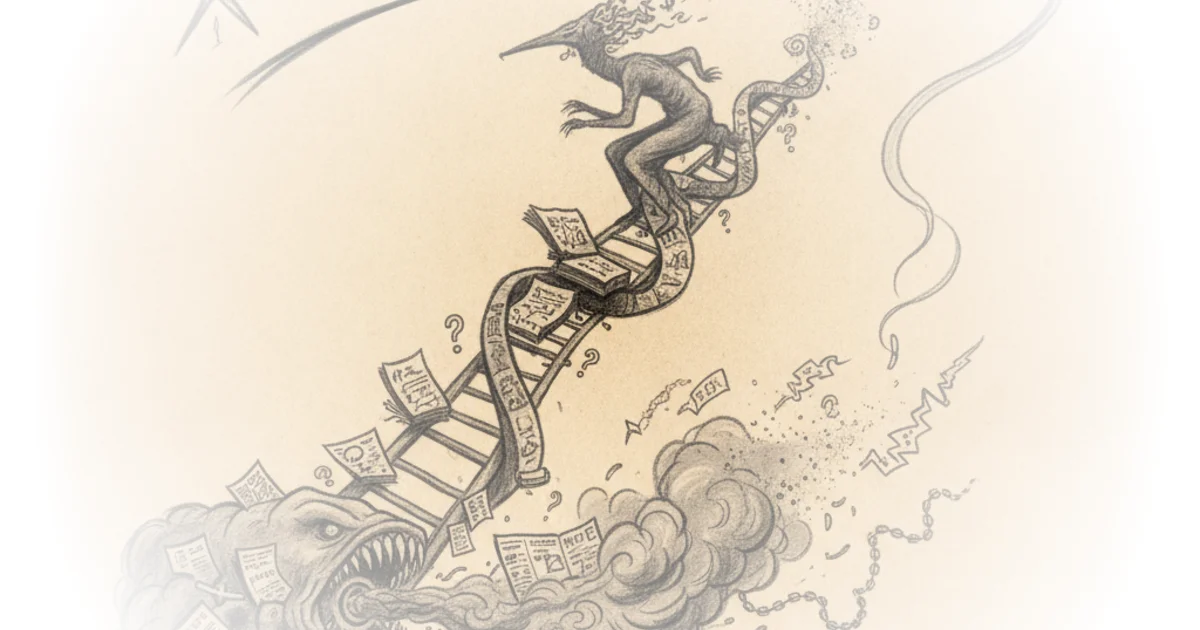
The core of DeLong's argument is that Hassett understood the mathematics perfectly but chose to ignore them. "There is no 'not understood'. Hassett understood and understands the Gordon fundamental-valuation finance equation very well," he asserts. Instead, DeLong claims the authors double-counted earnings, treating retained profits as both immediate cash flow for investors and as capital for future growth simultaneously. "THIS IS NOT SUBJECT TO DEBATE. THIS IS 2+2=5. IT IS A LIE," DeLong emphasizes, stripping away any academic ambiguity to label the act as malevolent.
It is a lie to claim that the total resources a company has to deploy for payouts and for investment are payouts, and should be valued as payouts, plus assuming growth will continue.
This framing is effective because it moves the conversation from "different economic schools of thought" to "fraudulent accounting." However, critics might note that while the Dow 36,000 thesis was spectacularly wrong, attributing every subsequent policy stance solely to a desire for personal gain oversimplifies the complex incentives within think tanks like the American Enterprise Institute. Yet, DeLong's evidence of the immediate market crash following the book's release—where investors who followed the advice lost 20% to 40% rather than gaining 300%—provides a stark empirical rebuttal to the theory.
The Incentive Structure for Dishonesty
The commentary shifts from technical finance to the sociology of power. DeLong suggests that Hassett's willingness to ignore basic math was rewarded because it served a political master. "He learned the lesson that telling lies, as long as the lies were to the tastes of plutocrats wanting lower taxes, Republican politicians wanting validation for policies they were proposing without caring whether they were actually in the national interest or not... got him promotions," DeLong observes.
This dynamic is illustrated by a recent exchange where an advisor dismissed record-low consumer sentiment as merely a "political survey" reflecting Democratic feelings rather than economic reality. DeLong contrasts this with the rigorous work of economist Steve Durlauf, who defended the historical validity of the University of Michigan Consumer Sentiment Index. "The University of Michigan Consumer Sentiment Index was started in 1946 by George Katona. It is a standard source of information on the state of the economy and the product of decades of scholarly effort," DeLong notes, highlighting the absurdity of dismissing decades of data to suit a narrative.
DeLong invokes Plato's Republic to describe the psychological toll on the advisor, suggesting that such a person becomes a slave to their own cravings for power. "His soul [must] be filled with relentless groveling and no choice," he writes, quoting the ancient philosopher to paint a picture of an individual whose moral compass has been entirely subordinated to careerism.
Such a person is far and away the most wretched one possible... doomed to be perpetually hungry, tormented by cravings he can never satisfy.
While the Plato analogy is dramatic, it serves to underscore DeLong's point that the damage extends beyond bad policy to the degradation of the advisor's own humanity. The argument holds weight because it connects the abstract math of the 1990s to the tangible political rhetoric of today, showing a consistent thread of prioritizing ideology over evidence.
Bottom Line
DeLong's strongest contribution is his refusal to treat bad economics as merely "wrong" but rather as a deliberate tool for political advancement, linking past financial bubbles to current policy distortions. The piece's vulnerability lies in its unyielding focus on individual malice, which may obscure the broader institutional failures that allow such advisors to rise regardless of their track record. Readers should watch how the administration continues to frame economic data when it contradicts their narrative, as this article suggests a long history of dismissing inconvenient truths rather than correcting course.