This piece from Works in Progress delivers a startling biological verdict: the very breeding programs designed to create the perfect racehorse may have genetically engineered a dead end. By weaving together 55 million years of evolutionary history with modern genomic data, the article argues that we have reached the "upper limits of biology," where the pursuit of speed has sacrificed the genetic diversity required for future adaptation. For anyone interested in the intersection of artificial selection and long-term species viability, this is not just a history of horses; it is a warning about the fragility of optimized systems.
The Paradox of Perfection
The article opens with a visceral image of dominance that has lasted half a century. In June 1973, Secretariat ran the Belmont Stakes so fast that "no horse has matched him since." The piece notes that fifty years later, despite billions of dollars poured into breeding and training, "Secretariat's record still stands." This stagnation is the central paradox. Works in Progress argues that "breeders have spent centuries trying to create a faster horse, but in doing so, they may have bred away the very genetic diversity that would allow the horse to keep improving, or even to remain robust."
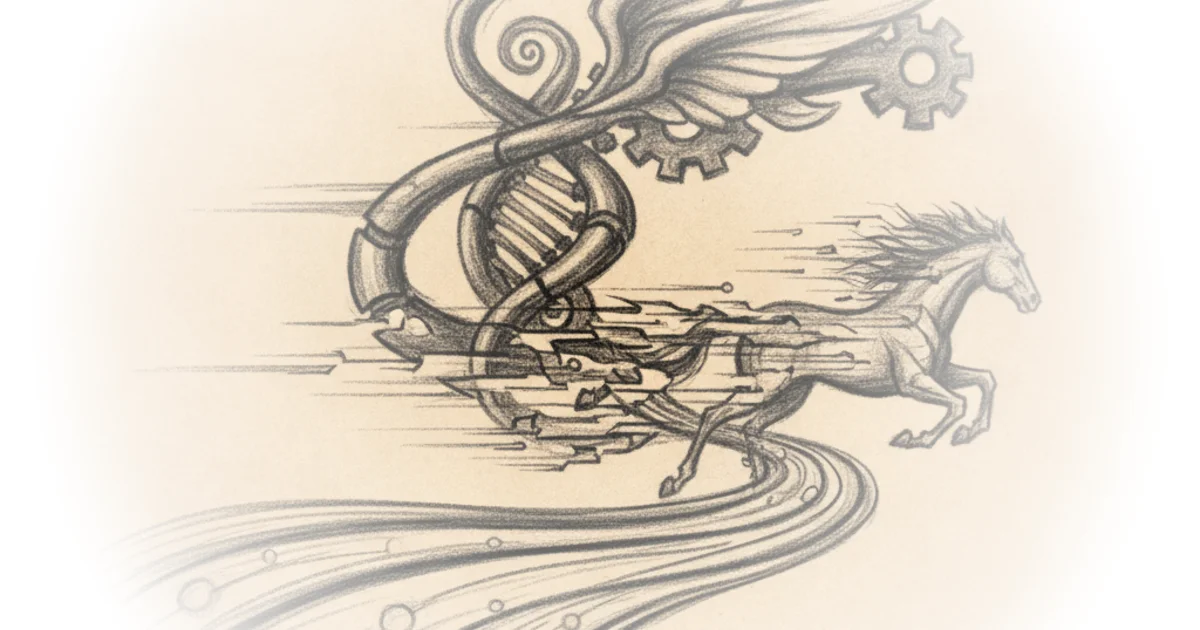
This framing is powerful because it shifts the narrative from human ingenuity to biological constraint. We often assume that more data and more capital will yield continuous improvement. The article suggests otherwise, implying that the thoroughbred industry has hit a ceiling not because of a lack of effort, but because of a lack of raw material. The genetic pool is so narrow that the "extraordinary diversity in form and performance" we see today is actually a mask for a dramatic narrowing of the gene pool.
"The result is extraordinary diversity in form and performance, but also a dramatic narrowing of genetic diversity."
Critics might argue that modern gene editing could bypass these natural limits, but the article's reliance on deep evolutionary timeframes suggests that such shortcuts ignore the fundamental architecture of the species. The focus on the "paradox" forces the reader to reconsider what "success" means in breeding: a single record-breaking animal versus a resilient, adaptable population.
From Forest Dweller to Single-Toed Machine
To understand how we got here, the piece takes a necessary detour into the deep past, tracing the horse from a "terrier-sized, multi-toed forest dweller" to the modern galloping machine. The article highlights the fossil record of Hyracotherium, noting that it "stood only 14 inches tall, closer to a terrier than a modern horse," with four toes on the front feet. This historical context is essential; it reminds us that the single hoof is a relatively recent innovation, perfected over millions of years as grasslands replaced forests.
The piece explains that "life on the plains favored animals able to run efficiently over long distances," leading to a gradual reduction in toes. By the time of Hipparion, about 23 million years ago, the middle toe carried most of the weight. The article draws a compelling parallel to modern athletics, noting that the rigid hoof helps "store and release energy like a spring, much like the shoes a human sprinter might wear."
This evolutionary streamlining was a slow, natural process. However, the article points out a crucial shift: "Only recently has human ambition taken over, breeding animals for speed, endurance, and docility." The contrast between the millions of years of natural selection and the few thousand years of human intervention is stark. While natural selection favored a broad range of traits for survival, human selection has aggressively targeted specific performance metrics, often at the expense of other biological functions.
The Genetic Bottleneck of Domestication
The narrative then pivots to the moment human control truly began, roughly 4,200 years ago in the Pontic-Caspian steppes. Works in Progress reports that genetic analysis reveals a sudden acceleration in the "generational clock," which began to "tick twice as fast, halving relative to wild horses, suggesting deliberate breeding." This is a sophisticated use of genomics to pinpoint the exact moment of domestication, moving beyond archaeological guesswork.
The article identifies specific genetic targets that early breeders likely selected for. One region near the ZFPM1 gene, linked to "mood, fear, and aggression," suggests a drive for docility. Another, near GSDMC, points to a selection for "stronger, more resilient backs" to support riders. The piece argues that "as horseback riding spread, horses that could bear weight without developing spinal pathologies would have been more desirable."
This section is particularly insightful because it reveals the hidden costs of our preferences. The article notes that while the Botai people in Kazakhstan were the first to domesticate horses, their lineage died out, and their horses returned to the wild. The modern horse descends from a later, different lineage (DOM2) that spread rapidly, replacing other wild populations. The piece notes that by 1500–1000 BC, "almost all had been either absorbed or replaced." This rapid expansion came at a cost: the extinction of wild lineages like the tarpan and the near-extinction of Przewalski's horse, which "stem from just 15 individuals captured around the year 1900."
"The tarpan horse, which roamed Eastern Europe, became extinct in 1909. By 1969, Przewalski's horse was declared extinct in the wild."
The article also touches on the aesthetic choices that shaped the genome, such as the preference for leopard spotting despite the risk of night blindness. "Its prevalence in certain ancient populations suggests breeders made deliberate choices, where aesthetic or symbolic value outweighed the trait's practical drawbacks." This is a sobering reminder that human values often override biological fitness. We bred for beauty and status, sometimes knowingly introducing defects, a pattern that echoes in modern breeding programs.
The Medieval Misconception and the Modern Reality
One of the most effective moves in the piece is the debunking of the medieval warhorse myth. Contrary to the popular image of a massive, towering beast, archaeological evidence from London shows that medieval horses were "roughly the size of a sturdy modern pony," standing around 13 to 14.2 hands high. The article explains that "medieval riders valued instead animals that were compact (meaning cheap to feed), strong, and agile enough to handle long distances, uneven terrain, and the demands of warfare."
This historical correction underscores the shift in breeding priorities. In the Middle Ages, utility and economy drove selection. Today, the drive is for extreme specialization. The piece notes that while medieval horses were diverse in function, modern breeding has created a "narrow pool of stallions" that has concentrated paternal lineages. The result is a species with high mitochondrial diversity (from mares) but extremely limited variation in the Y chromosome.
This genetic bottleneck is the core of the article's warning. The piece argues that the "paradox is not confined to the racetrack." The same forces that created the perfect racehorse are at work in other domains of human intervention. By focusing on a single metric—speed or size—we risk creating a population that is fragile and unable to adapt to new challenges.
"The paradox is not confined to the racetrack."
Bottom Line
Works in Progress has crafted a compelling argument that the pursuit of biological optimization through selective breeding carries an inherent risk of stagnation. The strongest part of this piece is its use of deep time and genomic data to show that the "upper limits of biology" are not theoretical but already being reached in the thoroughbred population. The biggest vulnerability, however, is the assumption that natural selection is the only path to resilience; modern science may yet find ways to reintroduce diversity through genetic engineering, though the article rightly suggests this is uncharted and risky territory. The reader should watch for how this narrative of "optimization leading to fragility" plays out in other fields, from agriculture to artificial intelligence, where the drive for peak performance may be eroding the very foundations of stability.