Tim Mak's reporting from the Kherson region exposes a grotesque evolution in modern warfare: the transformation of First Person View (FPV) drones into instruments of what he terms "human safaris." This is not merely a tactical shift; it is a psychological weaponization of the battlefield that turns civilian movement into a hunting ground, a reality Mak illustrates with chilling specificity. While military analysts often focus on the cost-efficiency of a $400 drone taking out a million-dollar tank, Mak forces the reader to confront the intimate horror of a drone operator watching a victim run in real-time, a dynamic that fundamentally alters the nature of civilian survival.
The Anatomy of a Hunt
Mak centers his narrative on Yana, a former hospital laboratory head, whose testimony dismantles the abstraction of "collateral damage." He writes, "You can tell by the sound whether the FPV is empty or loaded. If the sound is light and monotonous, it means there is something light inside, perhaps a self-igniting mixture or some kind of grenade." This sensory detail grounds the conflict in immediate, terrifying reality for the reader. The author argues that the very design of these drones—their speed, their camera feeds, and their ability to loiter—creates a scenario where escape is mathematically impossible. As Mak puts it, "If you can see it, it's already too late. Running is not an option, as the drone can reach speeds of 150 km/h or more."
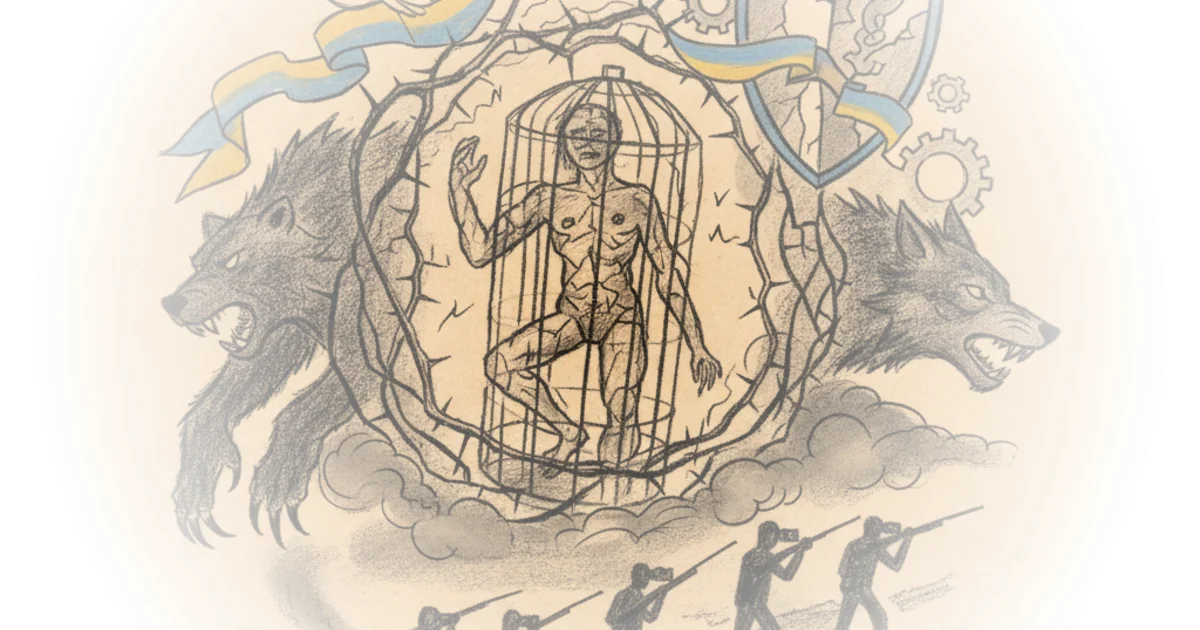
The piece draws a sharp distinction between traditional artillery and this new form of targeting. Unlike a mortar strike, which might be argued as an area-of-effect weapon with potential for error, the FPV drone's camera feed implies intent. Mak notes that the operator can maneuver to pursue a target, making it "hard to argue that the strikes aren't deliberate." This framing is crucial; it shifts the legal and moral conversation from accidental tragedy to calculated execution. The author highlights the cruelty of this dynamic by describing how drones often wait for rescue attempts, turning the act of saving a life into a secondary target. "They don't care who comes: a child, a woman, a social worker, a doctor, or even a dog," Mak writes, illustrating a systematic disregard for human life that transcends standard rules of engagement.
"A drone can land somewhere in the bushes, detect a person walking or a car driving by, and suddenly take off. It stares at you, you stare at it. There's nothing you can do."
Critics might argue that in the fog of war, distinguishing between combatants and civilians near the front line is inherently difficult, and that targeting roads is a legitimate military strategy to disrupt logistics. However, Mak's evidence of drones specifically targeting elderly men under white flags and waiting for ambulances suggests a pattern of behavior that exceeds tactical necessity and enters the realm of terror.
The Failure of Defense
The commentary then pivots to the desperate, often improvised, attempts at survival. Mak details how civilians and soldiers alike are trying to counter the threat with anti-drone nets and electronic warfare, yet faces a bureaucratic and logistical nightmare. He quotes a Ukrainian serviceman who reveals a stark disparity in protection: "Right now, my biggest concern is about the Druzhkivka-Kostiantynivka highway. There are nets installed there, but they are made of rope, which burns in two seconds. There are metal ones in storage that could save many lives. But for some reason, no one wants to install them." This quote exposes a critical vulnerability in the defense strategy, suggesting that the lack of effective countermeasures is not due to a lack of technology, but a failure of prioritization.
Mak contrasts this with the official narrative from the Kherson Regional Military Administration, where a deputy head claims a 96% neutralization rate. The author juxtaposes this statistic with the lived experience of Yana, who notes, "It's good that they [local authorities] are putting up nets, but they should have done it sooner." This tension between official optimism and on-the-ground reality is a recurring theme. The piece also touches on the rapid technological escalation, noting that Russian forces are now deploying fiber-optic drones that cannot be jammed, rendering civilian interceptors useless. "You can hear it [the drone] is above you post factum. At that moment, there's no point in running," Yana says, a sentiment that underscores the hopelessness of the current defensive posture.
The Human Cost of Stagnation
The broader context of the article reveals a war of attrition where civilians are trapped between the front lines and the failure of international support. Mak weaves in the grim reality of the "human safari" extending beyond Kherson, noting that in the Dnipropetrovsk region, attacks have doubled compared to the previous year. The author does not shy away from the psychological toll, quoting Yana's reflection on displacement: "Who needs us? To live as homeless people in someone else's house when I have my own?" This question cuts through the geopolitical maneuvering, reminding the reader that the war is destroying the very fabric of society, leaving people with nowhere to go and no safety to return to.
The piece also briefly touches on the global implications, noting that authoritarian regimes and criminal organizations are studying these tactics. This suggests that the "human safari" is not just a localized tragedy but a preview of future conflicts worldwide. However, the focus remains firmly on the immediate suffering of those on the ground, where the sound of a drone is the only warning they get before their world ends.
Bottom Line
Tim Mak's reporting succeeds by refusing to let the reader look away from the intimate brutality of drone warfare, effectively arguing that the "human safari" represents a new, terrifying category of war crime defined by intent and surveillance. The piece's greatest strength is its reliance on the visceral testimony of civilians like Yana, which exposes the hollowness of official statistics and the catastrophic gap between available technology and its deployment. The most urgent takeaway is that without immediate, large-scale implementation of proven defenses like metal anti-drone nets, the current trajectory will continue to turn civilian roads into hunting grounds with no end in sight.