In a cultural landscape drowning in algorithmic noise, Justin E. H. Smith offers a startlingly original diagnosis: our inability to distinguish truth from fiction isn't a new failure of human cognition, but an ancient, cosmic inheritance. The piece, a translated interview from a Dutch fashion magazine, posits that the very capacity for storytelling—and the hallucinations that plague our large language models—stems from the Oort Cloud itself acting as a "natural LLM." This is not merely science fiction; it is a metaphysical framework that reframes the current AI crisis as a collision between human imagination and extraterrestrial data processing.
The Cosmic Source of Hallucination
Smith, writing under the guise of the elusive "Justin Smith-Ruiu," constructs a narrative where the boundary between reality and fiction is porous. He suggests that the Oort Cloud, a distant shell of icy bodies surrounding our solar system, has functioned for billions of years as a supercomputer. "The Oort Cloud has been functioning for billions of years as a sort of 'natural LLM'," Smith asserts, claiming that "narraton particles" emitted from this cloud are the true source of humanity's ability to "present as true what is in fact false." This is a bold, almost audacious move. By attributing our propensity for lying and storytelling to a celestial mechanism, Smith bypasses the usual debates about human nature to suggest a biological and technological determinism rooted in astrophysics.
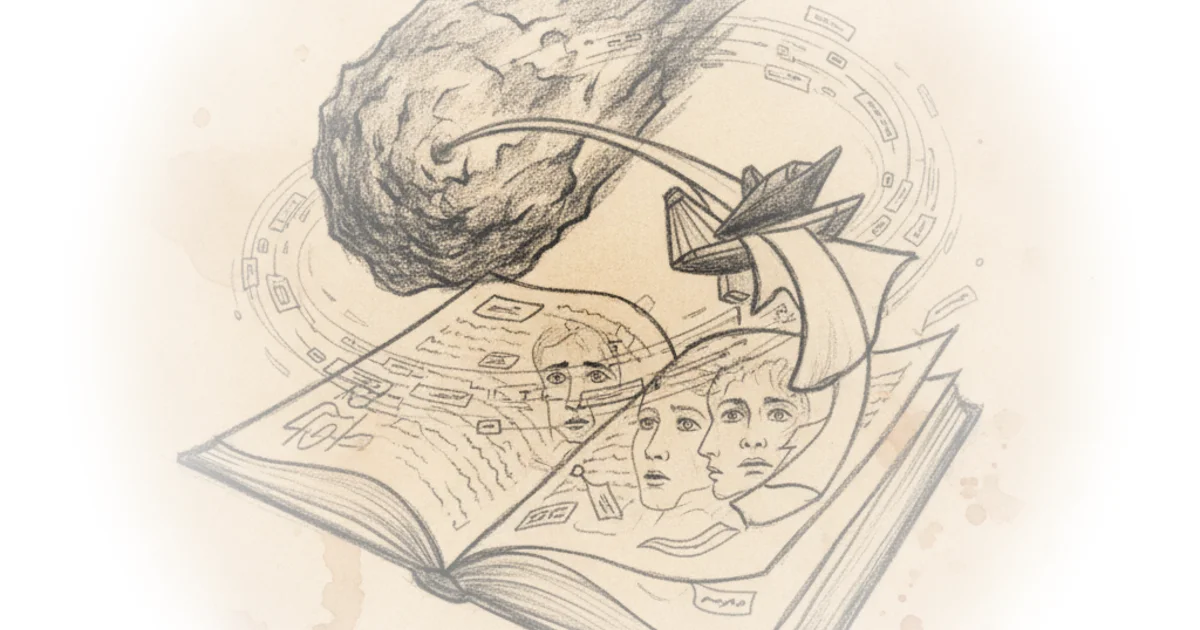
The argument gains a strange, eerie resonance when viewed against the backdrop of recent unexplained health incidents. Just as the "Havana syndrome" incidents were once dismissed as mass psychogenic illness before being linked to directed energy weapons or other covert technologies, Smith's narrative implies that the "narraton particles" might be the unseen force behind such phenomena. He casually brushes off the connection, noting that "people love to speculate," before adding a chilling twist: "The Oort Cloud is. Responsible. For their overly fecund imaginations." This refusal to separate the cosmic from the terrestrial creates a unified field theory of misinformation, where the source of our confusion is literally written in the stars.
"The greatest discovery of the 20th century... was not nuclear fission or relativity theory or quantum mechanics... but the Oort Cloud has been functioning for billions of years as a sort of 'natural LLM'."
The Death of Sincerity in Language
Smith's critique of contemporary language is equally sharp, though it moves from the cosmic to the mundane. He argues that the degradation of meaning began long before the advent of generative AI, tracing it back to the commercialization of speech. He illustrates this with a visit to a Marks & Spencer in London, where he observes the absurdity of marketing language: "The raspberries are advertised as being 'jammy', while the raspberry jam is said to be 'nothing but raspberries'." This circular logic, he argues, has paved the way for the "total machine takeover of language."
He contends that the "unleavened bread of sincerity and truth" has been forgotten, replaced by a "slop" of AI-generated content that is both mass-produced and inscrutable. "In the 21st century, with the appearance of 'slop', mass commercial entertainment is making itself inscrutable," Smith writes. This observation is particularly potent. While critics often blame AI for the loss of nuance, Smith suggests that AI is merely the latest iteration of a centuries-long trend where language has been stripped of its referential power to serve commerce and attention. The "slop" is not a bug; it is the logical conclusion of a system that prioritizes engagement over truth.
Critics might argue that Smith's dismissal of the "theft" argument regarding AI training data is too glib. He claims that "such 'theft' is already at the basis of so many vernacular art forms," comparing AI generation to hip-hop sampling or the cut-up techniques of William S. Burroughs. While this defense has merit in the context of artistic evolution, it risks minimizing the economic and ethical harms faced by the original creators whose work is ingested without consent. Smith's focus on the aesthetic novelty of the output—asking, "Where exactly is Tung Tung Tung Tung Tung Tung Tung Sahur in the pre-AI training data?"—sidesteps the question of whether the process of creation is just.
"Anyone who tries to come down dogmatically one side or the other of such a complex historical transformation is just an idiot."
Dialectics of the Machine Age
Ultimately, Smith refuses to take a binary stance on the threat of artificial intelligence. He embraces the contradiction, acknowledging that new technologies are both a "grave threat to meaning" and a "vehicle for the vanguard exploration of new creative potentials." He quotes Leonard Cohen to summarize this duality: "Did some good, did some harm." This dialectical approach prevents the piece from collapsing into simple Luddism or techno-optimism. Instead, it presents the AI revolution as a historical inevitability that demands a new kind of philosophical engagement.
The interview's framing is itself a piece of performance art. Smith-Ruiu claims the work was delivered via an "Inter-World Transfer Protocol" (IWTP) from a counterpart in another possible world. Whether this is a metaphor for the way ideas feel alien in the age of AI or a literal claim about multiverse theory, it forces the reader to question the nature of authorship. In a world where AI can mimic human style perfectly, the question "Who wrote this?" becomes as relevant as "What does this mean?" Smith's answer is that the author might not even be from this world, and perhaps that is the only way to understand the strange, hallucinatory quality of our current moment.
Bottom Line
Justin E. H. Smith's interview is a masterclass in using speculative fiction to diagnose a real-world crisis, successfully arguing that the confusion of the AI age is a continuation of a long historical drift toward incoherence. Its greatest strength is the refusal to simplify the problem, instead presenting the Oort Cloud as a metaphor for the overwhelming, alien nature of the data we now inhabit. However, its reliance on a playful, almost conspiratorial tone may alienate readers seeking concrete policy solutions to the very real harms of algorithmic generation. The piece is less a roadmap for the future than a mirror reflecting the absurdity of our present.