Sabine Hossenfelder cuts through the hype of interplanetary colonization not by dismissing the dream, but by rigorously auditing the bill. While the public debate often oscillates between blind techno-optimism and cynical dismissal, Hossenfelder offers a rare third path: a cold-eyed assessment that admits the moral necessity of a backup plan for humanity while exposing the physical and economic impossibility of executing it today. For the busy professional weighing the future of civilization, this piece is essential because it reframes the Mars debate from a question of "can we?" to a stark calculation of opportunity cost.
The Illusion of Mass Migration
Hossenfelder begins by dissecting the scale of the proposed undertaking, noting that Elon Musk's vision requires moving "several million tons of cargo" to establish a city of one million inhabitants. The author highlights Musk's confidence that this could be achieved within two decades, a timeline Hossenfelder treats with skepticism. She notes that Musk envisions a future where "almost anyone could afford it," framing the endeavor as a democratic migration rather than a government-led expedition. However, Hossenfelder points out the disconnect between this vision and the harsh reality of space travel, where the trip takes seven to nine months and relies on technology that is "almost guaranteed" to fail in novel ways.
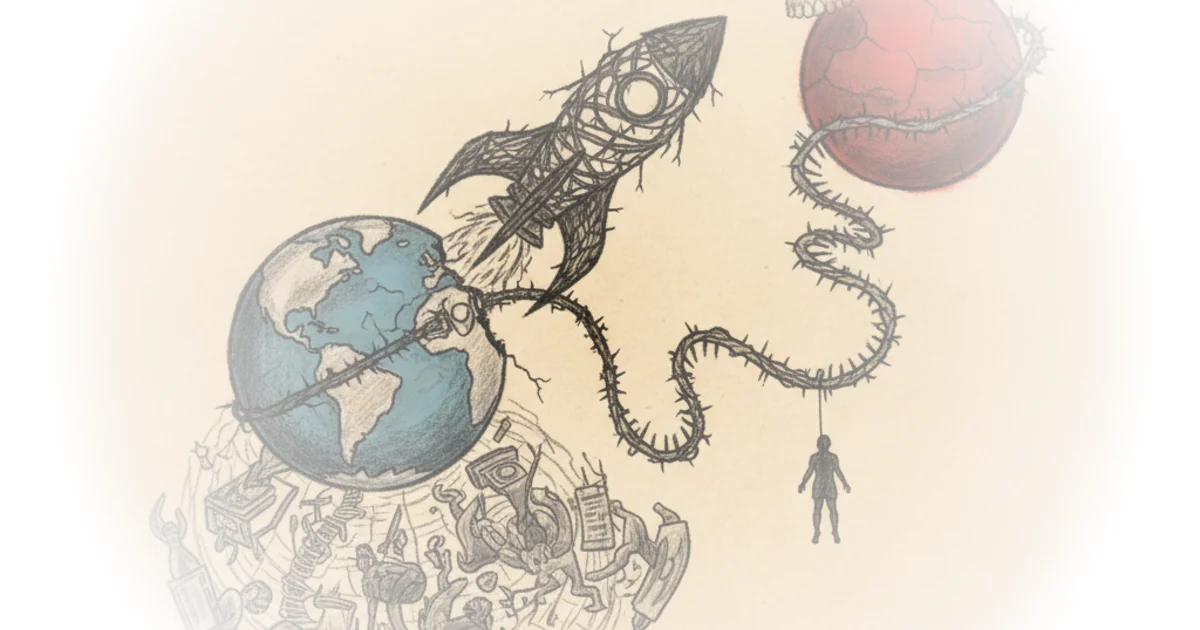
The commentary effectively uses the contrast between Musk's ambition and the views of other prominent scientists to ground the argument. Hossenfelder cites Neil deGrasse Tyson's assessment that such a venture would only happen if it were "geopolitically expedient," suggesting that without a national security imperative, the investment return is nonexistent. This framing is crucial because it shifts the conversation from technological capability to political will. Hossenfelder writes, "The history of really expensive things ever happening in Civilization has in essentially every case been led geopolitically by Nations." This observation dismantles the idea that a private entrepreneur can single-handedly fund a civilization-scale project without state backing.
"The idea of mass migration to avoid the Earth's problems... is a dangerous illusion."
This quote, attributed to Martin Rees in the text, is wielded by Hossenfelder to underscore the futility of using Mars as an escape hatch. The argument lands because it refuses to entertain the fantasy that we can simply move our problems to another planet. Critics might note that this perspective underestimates the psychological drive for exploration, which has historically defied economic logic. Yet, Hossenfelder's point remains that without solving the fundamental issues of radiation and atmospheric retention, the "escape" is merely a slower death sentence.
The Physics of Terraforming
Moving beyond the logistics of transport, Hossenfelder tackles the most significant scientific hurdle: the environment itself. She explains that Mars lacks a magnetic field, meaning any atmosphere we create would be stripped away by solar wind. The author details the absurdity of the proposed solution, which involves running electric currents through superconducting wires "more than 3,000 kilometers long" to generate a magnetic shield. Hossenfelder's analysis suggests that terraforming is not just difficult; it is "way beyond the economic capacity that humans currently have on Earth."
The piece argues that for the foreseeable future, any Martian settlement would be confined to enclosed shelters, living in a state of perpetual dependence on fragile technology. Hossenfelder notes that the average temperature is "-60° C" and the atmosphere is unbreathable, making the idea of "greening Mars" a distant fantasy. She writes, "Basically this means that for at least the next few hundred if not thousand years people on Mars would be living in enclosed shelters." This sobering reality check serves to puncture the romanticized narrative of a new frontier, replacing it with the claustrophobic reality of a life-support system that cannot fail.
The author also addresses the scientific utility of human presence, arguing that for geological or biological study, robots are superior because they do not risk contaminating the planet. "If you want to study Mars for its geology or history or early traces of life not only do you not need people there you might actually not want them there," Hossenfelder writes. This is a compelling argument for the scientific community, which often feels sidelined by the spectacle of private spaceflight. A counterargument worth considering is that human intuition and adaptability in unexpected situations might still offer unique scientific value that robots cannot replicate, but Hossenfelder's emphasis on contamination risks is a strong, evidence-based point.
The Moral Calculus of Long-Termism
Perhaps the most profound section of the commentary addresses the philosophical underpinnings of the Mars project. Hossenfelder identifies Musk's motivation as rooted in "long-termism," a philosophy that prioritizes the distant future over present suffering. The author explains that this mindset leads to a "big moral issue because it's discounting the suffering of people in the present in exchange for the very uncertain Prospect of people flourishing in the future."
Hossenfelder acknowledges the validity of the existential risk argument, noting that threats like asteroid impacts or super-volcano eruptions are real and that a multi-planetary species would provide a "genetic backup." She concedes that "populating Mars is a really good plan to mitigate existential risks," but questions the timing. The crux of her argument is that the resources poured into Mars could be better spent on technologies that would make life on Earth safer and the eventual journey to Mars easier. "There'll be less left to develop Technologies like nuclear fusion artificial intelligence genetic engineering or bionics," she argues, all of which would "make moving to Mars later dramatically simpler and almost certainly cheaper."
"I arrive at the conclusion that moving to Mars is a good idea but it's too early."
This conclusion encapsulates the piece's nuanced stance. It avoids the trap of being a simple naysayer while refusing to endorse the current trajectory. The argument is effective because it aligns with the reader's desire for progress while demanding a more strategic approach. It suggests that the administration or private sector should focus on solving the "localized planetary problems" first, rather than betting the farm on a premature exodus.
Bottom Line
Sabine Hossenfelder's commentary succeeds by refusing to choose between the dream of Mars and the reality of Earth, instead exposing the dangerous gap between the two. The strongest part of her argument is the rigorous deconstruction of the economic and physical feasibility of terraforming, which strips away the marketing gloss to reveal a project that is centuries away from viability. Her biggest vulnerability is the assumption that the long-termist philosophy is inherently flawed, rather than simply misapplied; however, her call to prioritize technologies that benefit the present remains a powerful, actionable insight. The reader should watch for how the administration balances these existential risks against the immediate demands of climate change and economic stability, as the debate over Mars is ultimately a debate about where we choose to invest our collective survival.