In a media landscape often defined by passive acceptance of technological disruption, Brian Merchant delivers a rare and vital victory story: journalists successfully using collective bargaining to halt the reckless deployment of artificial intelligence. This isn't just about headlines; it is a legal precedent that reasserts human oversight as a non-negotiable baseline for ethical reporting, proving that union contracts can serve as the most effective firewall against corporate overreach.
The Arbitration Precedent
Merchant frames the recent ruling against Politico not merely as a labor dispute, but as a critical defense of journalistic integrity. He details how management, owned by the multinational conglomerate Axel Springer, deployed AI tools without warning during major political events, resulting in "obvious errors" and "factual errors" that damaged the publication's credibility. The core of the argument rests on the union's ability to leverage a specific clause in their collective bargaining agreement that mandated notice and human oversight.
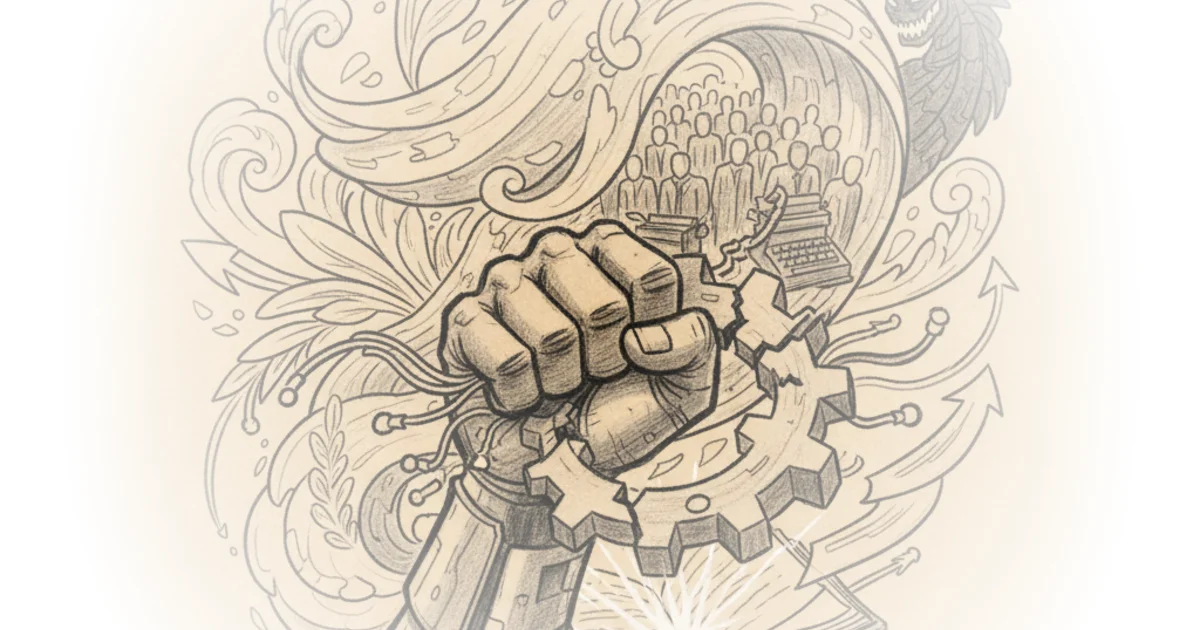
Merchant writes, "If the goal is speed and the cost is accuracy and accountability, AI is the clear winner. If accuracy and accountability is the baseline, then AI, as used in these instances, cannot yet rival the hallmarks of human output, which are accuracy and reliability." This quote cuts through the industry's obsession with efficiency, forcing a confrontation with the reality that automation often sacrifices truth for velocity. The arbitrator's confirmation that the AI-generated reports contained "erroneous and even absurd" materials validates the union's fears, transforming abstract concerns about technology into concrete evidence of negligence.
"This ruling is a clear affirmation that AI cannot be deployed as a shortcut around union rights, ethical journalism, or human judgment."
The significance of this victory is amplified by the historical context Merchant weaves in. Just as the Luddite movement of the 19th century was not a rejection of technology itself but a protest against the manner in which machines were used to degrade working conditions, this modern struggle is about control. Merchant notes that the PEN Guild is not "kneejerk anti-AI reactionaries," but rather advocates for a system where technology serves the journalist, not the other way around. This distinction is crucial; it reframes the narrative from fear of the machine to a demand for democratic governance over its use.
Critics might argue that demanding human oversight for every AI interaction could stifle innovation or slow down the news cycle in an era of real-time reporting. However, Merchant effectively counters this by pointing out that the alternative—unfettered AI use—risks running the site's "readership and reputation into the ground." The argument holds that speed without accuracy is a liability, not an asset.
The Broader Ecosystem of Resistance
Beyond the specific win at Politico, Merchant expands the scope to a wider movement of resistance across creative industries. He highlights the upcoming legislative hearing in California regarding the AI Copyright Transparency Act, noting that "AI models have been built upon a foundation of mass copyright theft." This connects the dots between the newsroom and the art world, suggesting a unified front against an industry that treats human creativity as raw material to be mined without consent.
Merchant also brings in the perspective of Nathan Grayson, co-founder of the worker-owned publication Aftermath, to illustrate the stakes in the video game industry. Grayson describes a landscape where executives are "shoohing AI into every element of its business," often claiming it is for behind-the-scenes work while players discover AI-generated art in final products. Merchant uses this to underscore a recurring theme: the disconnect between corporate promises and the reality of implementation.
As Merchant puts it, "Things might look bleak right now, but there are more of us than there are of them, and that will always remain true." This sentiment captures the essence of the piece: a call for solidarity among workers who are facing a common threat. The piece also references the "News Not Slop" campaign, a coordinated effort by the NewsGuild to demand that journalism remain "human-first."
However, the argument faces a structural vulnerability. While the Politico ruling is a landmark, it relies on the existence of a strong union contract. In newsrooms and creative sectors where unions are weak or non-existent, workers lack the legal mechanism to force management to the negotiating table. Merchant acknowledges this implicitly by celebrating the union's role, but the solution remains out of reach for the many workers in non-unionized environments who are equally vulnerable to these technological shifts.
Bottom Line
Brian Merchant's piece succeeds by grounding the abstract anxiety of AI in a tangible, legal victory that proves collective action works. The strongest element is the arbitrator's blunt assessment that AI cannot yet match human reliability, a fact that management tried to obscure. The biggest vulnerability remains the uneven playing field, where this level of protection is currently limited to unionized workers, leaving a vast majority of the workforce exposed to the same pressures without the same tools to fight back.