Alan Rossi dares to ask a question that many in the literary world are too afraid to whisper: what if our dystopian novels are no longer warning us, but merely preaching to the choir? In a landscape where the rhetoric of fascism has shifted from abstract fear to tangible policy—book bans, mass deportations, and the rise of nationalist movements—Rossi argues that the very art designed to combat these forces has become stagnant, repetitive, and ultimately ineffective.
The Stalled Narrative
Rossi begins by acknowledging the grim reality facing educators and citizens alike. The political climate has moved beyond mere rhetoric into the realm of action. "Books have been banned," Rossi notes, pointing specifically to South Carolina where parents worry about "sex" and the potential for children to become "gay. Or trans. Or whatever." This trivialization of identity, mixed with the "slow trickle of weirdness, mixed with danger," sets the stage for Rossi's critique. The author observes that while some voters are driven by bigotry, many are simply seeking economic relief, yet the cultural response has often been a disconnect between the severity of the threat and the quality of the artistic response.
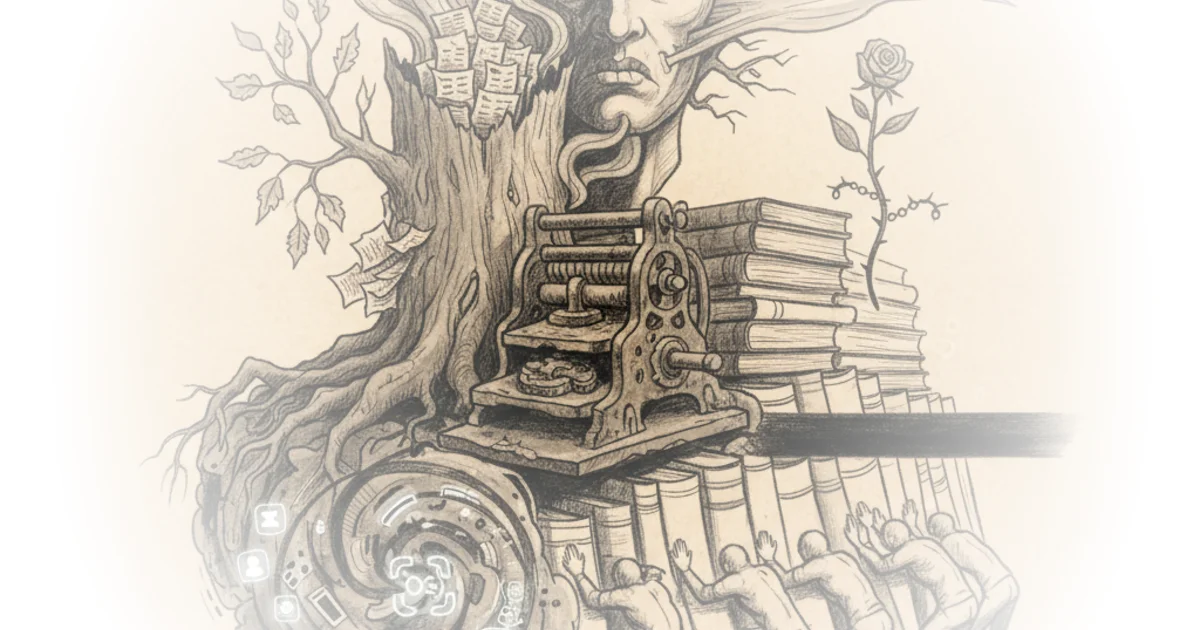
The piece surveys a decade of literature that has predicted civil war and the rise of authoritarianism, citing works like Omar El Akkad's American War and Catherine Lacey's Biography of X. Rossi suggests that these narratives, once prophetic, have now become clichés. "One could say that the rise of fascism is an ever-present threat, and that artists and novelists need to be ever-engaging with this threat," Rossi writes. "One could also say these repeated tales are part of the problem." This is a provocative stance. It suggests that the constant repetition of the same dystopian tropes has dulled their impact, turning urgent warnings into background noise.
The narratives don't seem to be getting through — they're not making an impact. Why is that?
Rossi posits that the failure lies in the approach to empathy. The argument is that "empathy can't be taught — it has to be experienced," and that many current novelists are mistakenly trying to "persuade a reader to believe a certain set of morals" rather than allowing them to discover it. This is a crucial distinction for busy readers who may feel fatigued by didactic storytelling. The author warns that when art becomes a tool for conversion, it risks becoming propaganda.
The Case of Prophet Song
To illustrate this stagnation, Rossi turns a critical eye toward Paul Lynch's Booker Prize-winning Prophet Song. The novel depicts a family in Ireland as a fascist regime takes power, a scenario that Rossi describes as "deadly, deeply, darkly serious." However, Rossi argues that the book's execution undermines its message. The prose, while technically skilled, relies too heavily on cinematic tropes and abstract psychological concepts rather than genuine human interiority.
Rossi dissects a specific passage where the protagonist, Eilish, rushes to leave her office. The author points out the imprecision of the description: "She sweeps her security pass and her belongings into her bag, steps through the office sleeved in one half of her coat." Rossi questions the logic of the scene, asking, "does she ever get her other arm 'sleeved'?" This focus on detail serves a larger point: the prose is trying so hard to be literary that it loses touch with reality. "The imprecision of the prose is astonishing because the prose wants us to think it's so precise," Rossi observes.
The critique deepens as Rossi examines the character of Eilish. Rather than a fully realized person, she becomes a vessel for the author's political message. "Eilish begins as a person and ends as a thing," Rossi writes, noting that her internal monologue often devolves into abstract formulations like "this feeling of possibility giving rise to hope." Rossi argues that this is not how real people think. "This isn't thought, this is literary thought," the author asserts. "I simply don't believe Eilish thinks this way."
The book's political message, which is so simplistic as to be laughable — that fascism is evil — leaves the characters devoid of life.
Rossi contends that the novel reduces complex human beings to "tropes" and "reactions." The antagonists are "voids," and the protagonists are "everyperson" figures stripped of specific psychology. The result is a story that feels like a "domestic thriller dressed in the clothes of literature." While the stakes are high and the plot compelling, the lack of authentic human depth makes the horror feel contrived. Rossi writes, "The sentimentality, the loss of one family member after another... these things so move us and are made to seem so impossible and possible at once that they seem new, that we fail to see that Prophet Song is essentially a domestic thriller dressed in the clothes of literature, with a clear and banal political agenda."
Critics might argue that in times of crisis, the urgency of the message outweighs the nuance of the character study. If a book can wake a reader to the dangers of authoritarianism, does the literary quality matter? Rossi acknowledges that art can awaken people, but questions whether these specific narratives are still doing the work or if they have become part of the problem by repeating themselves without evolution.
The Question of Purpose
The piece concludes by returning to the fundamental question of what art is for. Rossi asks, "What is art for, especially pol..." before the text cuts off, leaving the reader to ponder the unfinished thought. The implication is clear: if art cannot capture the complexity of human experience, it risks becoming mere commentary, suitable for a newspaper column but failing as a work of literature.
Rossi's analysis is a call for a new kind of storytelling—one that moves beyond the predictable tropes of the last decade and engages with the messy, specific, and often contradictory nature of real human psychology. It is a challenge to writers to stop shouting into the void and start creating worlds that feel as real and unpredictable as the one we are living in.
Bottom Line
Rossi delivers a stinging critique of the literary left's reliance on recycled dystopian tropes, arguing that Prophet Song and similar works fail because they prioritize political messaging over authentic human psychology. While the urgency of the subject matter is undeniable, the piece's greatest strength is its insistence that art must do more than warn; it must resonate with the complexity of real life to be effective. The biggest vulnerability of this argument is its potential dismissal of genre fiction's ability to mobilize readers, but the call for deeper, less didactic storytelling is a necessary intervention in the current cultural moment.