George Saunders reveals a creative process that defies the romantic myth of the inspired genius, arguing instead that great art emerges from thousands of microscopic, reactive choices rather than a grand, pre-meditated worldview. In this intimate dialogue with producer Rick Rubin, Saunders dismantles the anxiety of the blank page by reframing writing not as an act of intellectual dominance, but as a humble, iterative reaction to the text itself. For the busy professional seeking clarity in their own craft or leadership, this conversation offers a radical permission slip: stop trying to be smart, and start trying to be present.
The Architecture of Micro-Choices
Saunders challenges the conventional wisdom that successful stories are built on a solid intellectual foundation. He suggests that the most profound narratives often arise when the author surrenders their initial plan to the organic demands of the work. "I sometimes I'll say well I'm starting a story to demonstrate this aspect of my worldview and the story goes no you're not we don't do that here," Saunders admits, describing how the story itself rejects the author's forced agenda. This is a crucial distinction for leaders and creators alike; it suggests that true innovation often requires letting go of the strategic plan in favor of listening to the emerging reality of the project.
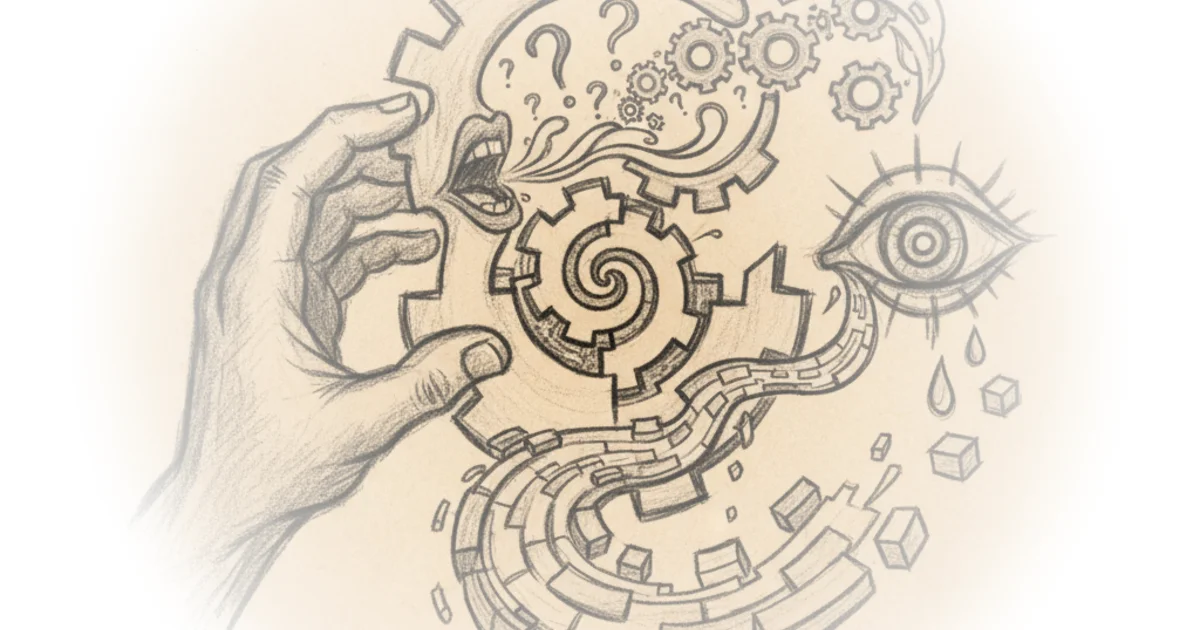
The core of Saunders' argument rests on the cumulative power of small decisions. He posits that greatness is not a single stroke of genius but the result of "creating the optimum the maximum number of choice points." By making thousands of micro-decisions—preferring word A over word B, scene C over scene D—the author embeds a deeper, more authentic version of themselves into the work. "If you're choosing one time Yeah that's only one dollop of you. But if you're choosing a thousand times over the course of the thing, a lot of you is getting in there," he explains. This reframes the creative act from a performance of ego to a process of excavation.
Critics might argue that this approach risks meandering narratives lacking a clear thesis, but Saunders counters that the structure emerges from the accumulation of these choices, not from a rigid outline. He notes that even great writers like the Russian masters likely didn't intellectually know the structural rules they were following; they simply made the right choice at the moment. "I think they laugh at me talking about it as analytically as I do," Saunders jokes, acknowledging the paradox of analyzing an intuitive process. Yet, he insists, "it doesn't mean that it's not still accurate."
If you do that a thousand times in six pages, there's a lot of you in there and it's not this you, it's some other you.
Reaction as the Engine of Creation
Perhaps the most striking claim Saunders makes is that creativity is fundamentally an act of reaction, not generation. He describes his process as "crank[ing] out some crap this morning" and then, the next day, reacting to it with a pencil in hand. "That seems to me where creativity actually happens. Not so much in that first," he asserts. This shifts the burden of perfection away from the initial draft, transforming the messy first attempt into raw material for refinement. For the anxious creator, this is a powerful antidote to paralysis.
Saunders connects this reactive process directly to the reader's experience. When a writer reacts to the text, they are essentially simulating the reader's reaction. "The reader now you have a sentence that's a little wobbly on its feet. The reader notices. So what do you do with the reader noticing? That's that's the reaction too," he observes. This creates a feedback loop where the writer anticipates and respects the reader's intelligence. He advocates for a specific type of trust: "let's pretend that my reader is actually 12% smarter than me. Make cuts on that basis." This approach fosters a relationship of intimacy and respect, where the writer does not condescend to explain every detail but trusts the reader to fill in the gaps.
Rubin draws a parallel to music production, noting that in the studio, the goal is to find the moment that makes him "lean forward and want to hear what happens next." Saunders agrees, emphasizing that specificity is key to this engagement. "If I'm playing for you and I do that, how do you correct me?" Rubin asks, to which Saunders replies that vague criticism like "this is boring" is useless. Instead, one must identify the exact moment of disengagement. "If you push down and say where is it boring and do you have a different word for boring? Then oh it's repetitious on page six. Yes we can fix repetition," Saunders explains. This specificity transforms abstract anxiety into actionable craft.
The Spiritual Dimension of Hard Work
The conversation deepens as Saunders connects his writing process to his spiritual practice in Tibetan Buddhism. He describes the writing process as a "sacramental space of hard work" where a higher version of the self emerges. "I look up and you go whoa that ghost did some good [ __ ] you know," he says, using the metaphor of ghosts to describe the meeting of the writer's and reader's higher selves. "Ghosts coming out of the writer and the reader and they meet up in that beautiful high territory," he elaborates. This is not mystical in a supernatural sense, but rather a profound psychological state achieved through rigorous, focused attention.
Saunders traces this sensibility back to his Catholic upbringing, where he saw Jesus as a kind of novelist who could approach the marginalized with deep empathy. "Jesus was sort of a a novelist in that sense because he could approach this person that other people didn't like and judged and just by be," he trails off, implying that the novelist's job is to extend that same radical empathy to characters. This spiritual underpinning suggests that the technical advice Saunders gives—about making choices, reacting, and trusting the reader—is ultimately about cultivating a state of being that is open to the other.
Critics might find the spiritual language esoteric or difficult to apply to secular contexts, but Saunders grounds it in the tangible reality of the editing desk. He admits that his artistic approaches are not necessarily "true" in a philosophical sense, but they are "anxiety reducing." "I'm trying to get my anxiety down. I'm very anxious person," he confesses. The craft is a tool for managing the self, allowing the "better parts" of the author to surface. This vulnerability makes his advice on structure and style feel less like a rigid set of rules and more like a compassionate guide for navigating the chaos of creation.
Bottom Line
Saunders' most compelling argument is that creativity is a reactive discipline of thousands of micro-choices that bypass the anxious, conceptual mind to access a deeper, more authentic self. While the spiritual framing may not resonate with every reader, the practical application—trusting the reader's intelligence, focusing on specificity over vague critique, and viewing editing as the true site of creation—is universally applicable. The piece's greatest strength is its ability to demystify genius, replacing the myth of the inspired lone wolf with the reality of the hardworking, reactive craftsman. Readers should watch for how this philosophy of "reaction over conception" can be applied not just to writing, but to any complex problem-solving endeavor where over-thinking often leads to stagnation.