In a surprisingly candid response to conspiracy accusations, Stefan Milo lays out the strongest argument against Graham Hancock's ancient civilization theory: if an advanced civilization really taught the world farming, why do we still see such clear geographical divides between crop distributions? And more provocatively - with access to Netflix documentaries, underwater drones, and submarines, why has Hancock never produced a single artifact?", ## The Conspiracy Accusation
Stefan Milo addresses Graham Hancock's claim that he's part of a conspiracy to suppress the truth about ancient history. The accusation came in Hancock's latest video, where he alleged that Milo and his colleagues are grouped together "determined to destroy any hint of disagreement with the mainstream view."
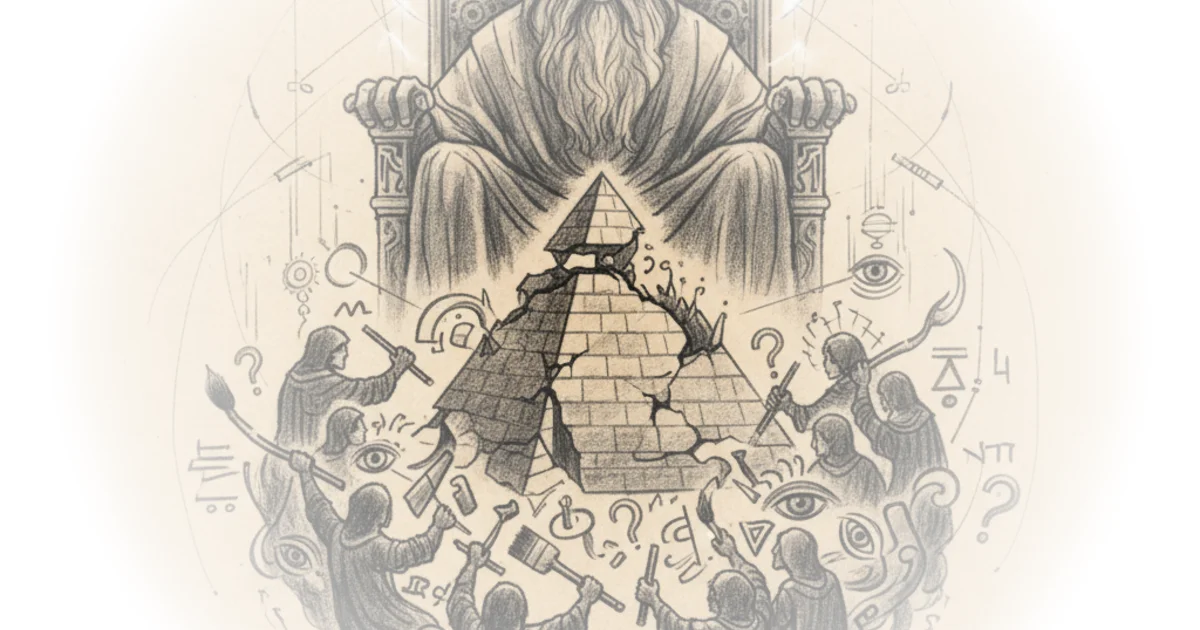
It's a dramatic claim. And as Milo points out, it's not what he actually does. He argues that he's simply disagreeing with Hancock's conclusions - which is different from suppressing evidence.
The Mainstream View Myth
What interests Milo most is how skillfully Hancock presents archaeology as having one unified view. In reality, archaeologists constantly disagree. There's "lots of disagreement, lots of possibilities about all sorts of things that happen in prehistory," because researchers only have a fraction of the evidence left to analyze.
Hancock points to Aboriginal DNA in South America as proof of ancient trans-Pacific voyages. But Milo makes a crucial observation: the modern distribution of people doesn't reflect the distribution of people back in prehistory. Farming communities spread across Asia and Europe, and there could have been many populations with more Australasian DNA that has since been obscured by later movements.
There are multiple explanations for this genetic signal - not just one.
The Evidence Problem
But here's where Milo makes his sharpest point: Hancock's grand claim about a civilization 12,000 years ago that "foretold its doom" and seeded civilization everywhere has no supporting evidence.
"I don't think I've ever seen Graham point to a specific artifact and say this was made by a civilization," Milo says. "Isn't that remarkable? They sailed the world, sailed to all these different places allegedly, and didn't leave behind a single artifact out of all the millions upon millions upon millions of artifacts we have from human history."
When Hancock does point to evidence - like in his Ancient Apocalypse series - it's two vaguely similar pieces of pottery. "This is a ludicrous claim," Milo says.
The Crop Question
The strongest argument against Hancock's theory comes from agricultural geography:
"If this civilization taught everyone to farm, why is there such a clear geographical divide between crops? These people sailing the earth had to eat something, right? They would have brought food with them on these voyages - potatoes, tomatoes, corn, tobacco. But those crops were not present in the old world. They're only present in the new world."
This geographical divide directly contradicts the idea that a single civilization spread farming across the planet.
The Resources Paradox
Milo points out something almost paradoxical: Hancock is uniquely positioned to answer these questions. He has more money than any other researcher. He's had Netflix documentaries, underwater drones, submarine technology for underwater exploration at various sites.
"The idea that he's being silenced is the most ludicrous thing I've ever heard in his life," Milo says. "He's had two Netflix documentaries. He's had a documentary on British TV, countless appearances on the world's largest podcast."
In Malta, where Hancock claimed cart ruts go underwater deep - they could have deployed underwater drones and scanned the site properly. They didn't. And that's the pattern: despite having unprecedented resources, the evidence never comes.
"If you're going to say there was this civilization that taught us everything we need to know and foretold its own doom and seeded civilization everywhere... when I ask for proof, it's just two pieces of pottery. Come on."
The Clovis First Deflection
One rhetorical device Hancock uses is pointing to the "Clovis first" debate in American archaeology - arguing that archaeologists held dogmatically to this theory for too long, which is why they haven't found his civilization.
Milo acknowledges this is partially true. American archaeologists did have a bee in their bonnet about Clovis first - researchers who believed anything outside that were not taken seriously. But here's the catch: "That doesn't affect anyone's view of prehistory" in Asia or Europe. The fact that Clavis first was held on dogmatically has no bearing on whether Hancock's lost civilization exists.
It's a rhetorical device to make his ideas seem more plausible when he actually has no evidence at all.", "counterpoints": "Critics might note that Milo himself keeps an open mind about alternative theories like the Younger Dryas impact hypothesis, which could be seen as similar to Hancock's approach. Additionally, some archaeologists have genuinely been dogmatic about mainstream views - though this doesn't apply to most researchers globally.", "bottom_line": "The strongest argument here is the agricultural geography point: if an advanced civilization spread farming worldwide, we would see crops distributed differently. The biggest vulnerability is that Milo doesn't actually challenge Hancock's core premise about ancient voyaging - he just says there's no evidence for it. The next debate will likely hinge on whether two vaguely similar pieces of pottery constitute proof - and whether Hancock can finally deploy those underwater drones.