Matt O'Dowd tackles the most frustrating gap in modern physics: the stubborn refusal of gravity to play by quantum rules. While many popular science pieces gloss over the mathematical dead ends, O'Dowd leans into the catastrophe, arguing that our current inability to find the "graviton" isn't just a missing puzzle piece—it suggests our entire framework for the universe might be fundamentally broken. This is not a story about a particle hunt; it is a story about the collapse of our most successful theories when pushed to the edge of a black hole.
The Great Divide
O'Dowd begins by establishing the stark contrast between the two pillars of physics. He notes that "Quantum theory gives us the stuff of the universe. Relativity gives us the container." This distinction is crucial because it highlights why the unification effort is so difficult. We have a theory for the actors (quantum mechanics) and a theory for the stage (general relativity), but they operate on incompatible scripts. The former is "fundamentally discreet and random," while the latter is "fundamentally continuous and deterministic." O'Dowd rightly points out that while aesthetics matter to physicists, the real problem is that these theories "actively contradict each other" in extreme environments like the center of a black hole or the instant of the Big Bang.
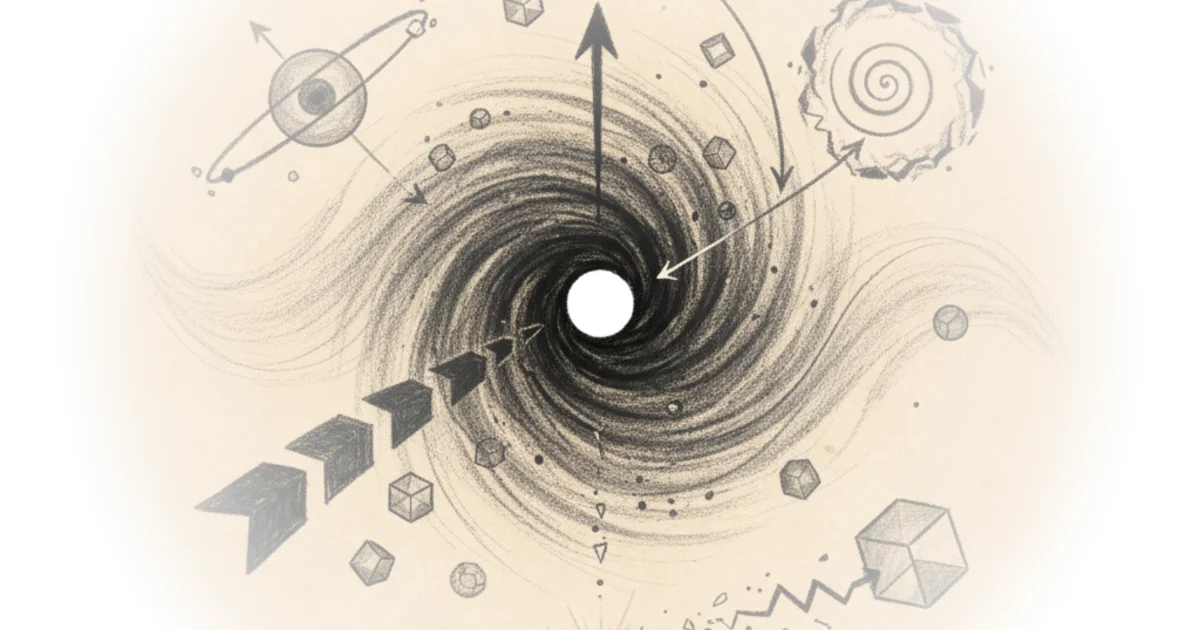
The author's explanation of why we need a "master theory" is compelling because it moves beyond the desire for elegance to the necessity of consistency. If the universe is a single entity, its underlying laws should not fracture into two unrelated systems. As O'Dowd puts it, "It would be weird if the most fundamental layer of reality was actually two unrelated things." This framing forces the reader to understand that the search for the graviton is not an academic exercise in taxonomy; it is an attempt to resolve a logical paradox that threatens to unravel our understanding of reality itself.
The Particle Path
To solve this, physicists have tried to force gravity into the mold that worked for the other three fundamental forces. O'Dowd explains that the quantum revolution began when we realized light is made of particles, or photons, and that "a force... is communicated by these particles." Following this logic, if we can quantize the gravitational field, we should find a mediating particle. He describes the process of treating gravity as a "small fluctuation, a perturbation to an imaginary flat and static background." This approach, known as perturbation theory, works beautifully for electromagnetism, where we can calculate interactions by summing up the exchange of virtual photons.
Applying this same logic to gravity yields a specific prediction: "It's a massless spin 2 boson." O'Dowd details how this particle would inherit its properties from the gravitational field, traveling at the speed of light and mediating the force through the exchange of virtual gravitons. The logic is seductive because it mirrors the success of the Standard Model. "We take a classical field, make some symmetry arguments to guess what other fields might exist, apply quantization rules, and boom, we figure out almost all of the particles and forces that make up our universe." This success makes the gravitational case feel like a missing step rather than a dead end.
If the graviton exists, then gravity has to be quantum and vice versa.
Critics might note that assuming gravity must follow the same quantization path as electromagnetism is a bias born of success, not necessity. Just because the particle model worked for three forces doesn't guarantee it works for the one that defines the geometry of spacetime itself. O'Dowd hints at this by acknowledging that in general relativity, the field is not a thing living on a grid, but the grid itself.
The Catastrophic Failure
The turning point of the piece arrives when O'Dowd admits that the math breaks down under pressure. While the perturbative approach works for weak gravity, it fails spectacularly when gravity becomes strong. The problem lies in "renormalization," the mathematical trick used to cancel out infinite values in quantum field theory. For electromagnetism, this works because the infinities can be absorbed into a finite number of measurements. However, as O'Dowd explains, "When we do this to the gravitational field, everything is also fine... Not so fast." The moment we try to apply this to stronger interactions, the number of infinities explodes.
He describes the situation with stark clarity: "So we're ramping up the strength of our quantum gravity, increasing the complexity of our perturbative expansion, and hoping we can renormalize any infinities to get a sensible theory. And this is where everything goes catastrop[hic]." This is the crux of the issue. The very tool that saved quantum electrodynamics cannot save quantum gravity. The math suggests that to describe the strong gravitational field, we would need an infinite number of measurements to cancel out the infinities, rendering the theory useless for prediction.
O'Dowd's coverage effectively demystifies why string theory and loop quantum gravity have emerged as alternatives; they are attempts to bypass this specific mathematical wall. The author's refusal to sugarcoat the failure of the "easy" solution is what makes this commentary valuable. He doesn't just tell us the graviton is elusive; he shows us why the path to finding it might be a dead end.
Bottom Line
O'Dowd's strongest argument is his clear demonstration that the standard method of quantizing gravity leads to a mathematical catastrophe, proving that a simple addition of a "graviton" to the Standard Model is insufficient. His biggest vulnerability is the lack of a clear alternative path, leaving the reader with the unsettling realization that our current tools cannot solve the universe's biggest puzzle. The next breakthrough will likely require abandoning the particle paradigm entirely, a shift that O'Dowd hints at but leaves for future exploration.