Henrik Karlsson delivers a startling counter-narrative to the romanticized myth of the starving artist, arguing that the true compulsion to create isn't a path to fame, but a biological imperative that persists even in the face of poverty and obscurity. While most cultural coverage fixates on the few who break through, Karlsson turns his gaze to the "lone suns" who burned brightly in isolation, using the life of an unnamed stone sculptor on a remote island to prove that art is often a desperate act of survival rather than a career strategy.
The Constellation of Outsiders
Karlsson frames his investigation not as a biography, but as a search for kinship. Living on an island with his own young family and struggling to balance writing with gallery work, he finds solace in the stories of local artists who were "not part of a scene" but formed a "constellation" of shared struggle. He writes, "It felt good to know that we weren't alone, even if no one Johanna and I knew shared our obsession and were willing to make the tradeoffs we made." This framing is powerful because it shifts the metric of artistic value from external validation to internal necessity. The author suggests that the drive to create is a "cave man desire to populate the earth with your art," a fundamental human need that exists independently of market logic.
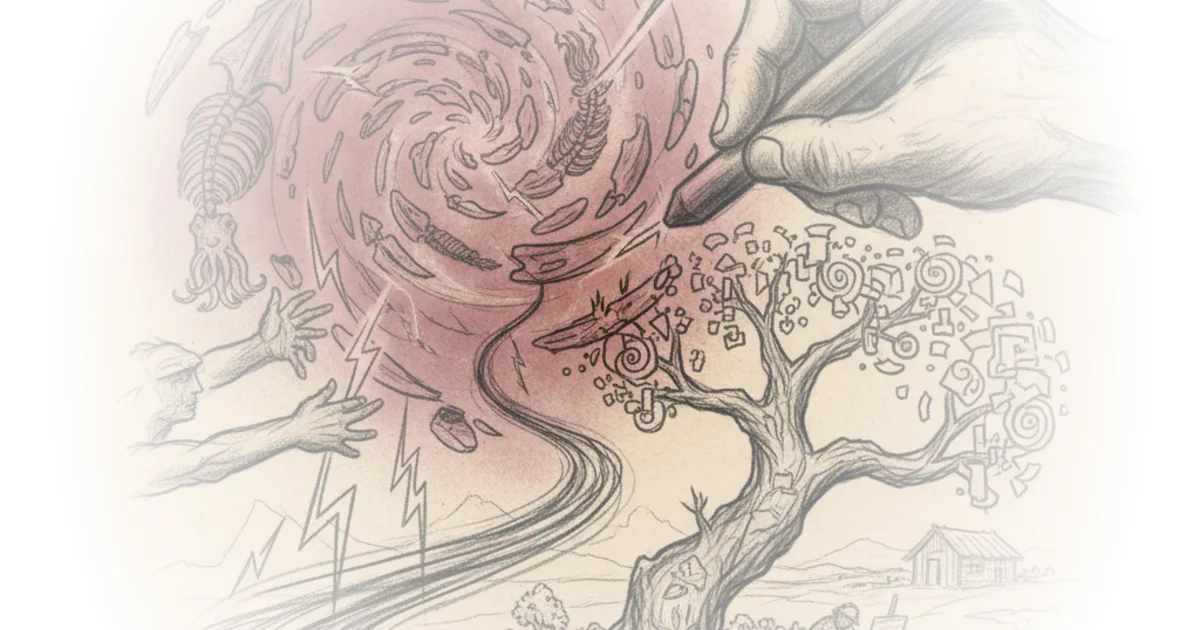
The piece draws a subtle but effective parallel to the historical context of the region, noting how Vincent van Gogh once worked in the nearby Drenthe peat bogs, a landscape of similar desolation and raw potential. Just as van Gogh found his voice in the mud and peat, Karlsson's sculptor finds his in the granite and coal scraps of the island. The author argues that these artists were not failures for lacking fame, but were instead engaged in a profound dialogue with their environment. "The more you work, the more things come to you," the sculptor writes, describing a feedback loop where creation fuels further creation. Karlsson uses this to challenge the modern assumption that art must be a profitable enterprise to be valid.
It is cute when someone calls a plumber and then gets shocked when the American composer Philip Glass appears to fix their toilet. Well, how do you expect artists to pay the rent? But it is cute, precisely, because Philip Glass is Philip Glass and will eventually have his operas playing on every continent.
Critics might argue that this romanticization of poverty ignores the systemic barriers that prevent talented individuals from accessing the resources they need to thrive. By focusing on the "beautiful experience" of a childhood spent in deprivation, the narrative risks glossing over the very real trauma of financial instability. However, Karlsson seems aware of this tension, noting that the sculptor's family survived only through sheer physical labor and self-sufficiency, growing their own food and quarrying their own stone.
The Fecundity of Stone
The essay's most striking section details the sculptor's later years, where he transformed industrial sewage pipes into abstract representations of human sexuality. Karlsson describes the scene with a visceral intensity, noting how the workers at the factory were delighted to participate, seeing their mundane labor elevated into something primal. "The workers were delighted to participate in an art project like that. There was no economic logic in doing what the sculptor did. But it spoke to a deep human need." This observation serves as a potent critique of utilitarian thinking, suggesting that society needs art not for its function, but for its ability to honor the "sense of aliveness that rushes through us."
When Karlsson finally visits the sculptor's abandoned farm decades later, the description of the sculptures—"primordial, like the remains of a forgotten ice age fertility cult"—bridges the gap between the artist's inner world and the landscape itself. He sees a "giant, four-ton penetration" titled The Priest and realizes that the art is not just in the landscape, but of it. The moss, the mushrooms, and the bramble are mirrored in the stone, creating a feedback loop where nature inspires art, and art recharges nature with erotic energy. "The moss, the same moss we have on our farm, here, I felt, was very clearly fornicating, making moss babies," Karlsson writes, capturing the overwhelming sense of life that permeates the site.
This connection to the land echoes the historical context of the region's prehistoric past, where early humans left handprints on cave walls to assert their existence against the void. Karlsson draws a direct line from those ancient silhouettes to the sculptor's stone forms, arguing that both are acts of defiance against oblivion. "The feeling of a hand in 1972 made into an object that will stand for millennia… It is hard not to see a parallel to some of the oldest preserved cave paintings," he notes. The argument here is that art is the only way we can truly say, "We were here; we felt this."
The Cost of the Compulsion
Despite the beauty of the narrative, the piece does not shy away from the physical toll of this compulsion. The sculptor is described as having an "unfathomable capacity for work," rising early and laboring until dusk, often sleeping sitting up like the old stone cutters he apprenticed with. Karlsson writes, "The only thing that could keep him from the stone was if it was so cold that he couldn't be in his workshop. Then he would sit inside and work with clay instead." This relentless drive is portrayed not as a choice, but as a compulsion that overrides comfort and safety.
The author reflects on the sculptor's own words about the physical sensation of the work: "I love the feeling of stone dust between my teeth after a long winter." This detail grounds the abstract concept of artistic drive in a gritty, sensory reality. It suggests that for these outsiders, the pain of the labor is inseparable from the joy of the creation. Karlsson concludes that while the sculptor will not be mentioned in history books, his work remains as a testament to a life fully lived, transforming the land he quarried into a permanent record of his humanity.
Some of his works were sold as public decorations, but many just filled the forests and fields where his children played. Their reason for existing was that he wanted to make them.
Bottom Line
Karlsson's essay succeeds by stripping away the glamour of the art world to reveal the raw, biological engine of creativity that drives people to create even when no one is watching. Its greatest strength is the vivid, sensory immersion into the sculptor's world, which makes the abstract concept of "art for art's sake" feel urgently physical. The piece's vulnerability lies in its potential to romanticize the hardships of the struggling artist, but ultimately, it offers a necessary reminder that the value of art is not determined by its price tag or its audience, but by its capacity to affirm our shared aliveness.