Brian Potter asks a question that upends our romantic view of innovation: why do we wait decades for technologies that were theoretically possible years earlier? The answer isn't a lack of genius, but a failure of connection. By using artificial intelligence to simulate historical invention timelines, Potter reveals that the bottleneck is rarely the laws of physics—it is the human inability to cross-pollinate knowledge across disciplines.
The Gap Between Possibility and Reality
The core of Potter's argument is that technical feasibility is a necessary but insufficient condition for invention. He writes, "Stimulated emission had been known to physicists for over 30 years, and 'regenerative' oscillators... were well known to engineers. Why, then, was Townes's insight so novel?" The answer, Potter concludes, was that in 1951, these two groups simply weren't talking to each other. This reframing is powerful because it shifts the blame from a lack of scientific breakthrough to a lack of institutional or social synthesis.
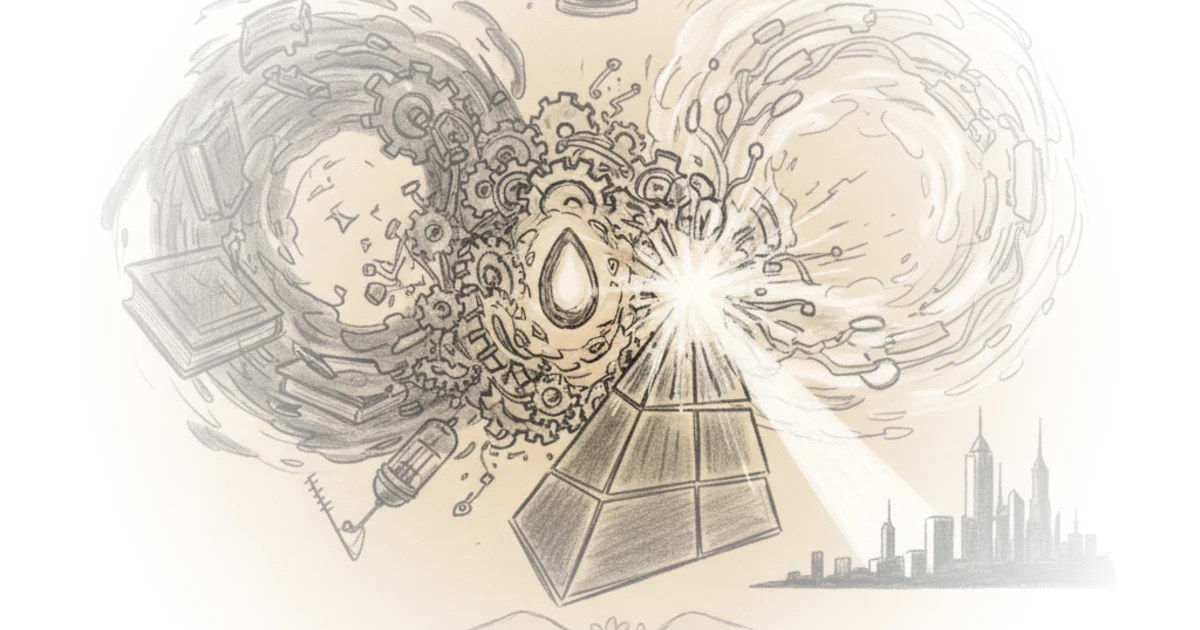
Potter's methodology is as fascinating as his findings. He tasked an AI model with determining when a "working example" of 190 major inventions could have been built, assuming a team of skilled engineers with era-appropriate tools. He defines the constraint clearly: "Could they, using knowledge and technology available at the time, build a working example of the technology in five years?" This approach strips away the economic and marketing hurdles to focus purely on the engineering timeline.
"Knowing how long it takes for an invention to appear once it becomes technically possible can help us answer these sorts of questions."
The results suggest a consistent lag. Potter notes that for the jet engine, the "binding constraint is the maturity of turbomachinery," yet the basic building blocks existed decades before the first flight. He points out that while Parsons's steam turbine and early gas-turbine attempts demonstrated the components were available by the early 20th century, it took until the mid-1920s for compressor efficiency and high-temperature alloys to mature enough for multiple teams to converge on a solution. The delay wasn't a missing scientific discovery; it was the "engineering grind of making it light, reliable, and aircraft-ready."
The Human Element in Machine Analysis
One of the most compelling aspects of Potter's piece is his rigorous verification of the AI's output. He doesn't just take the machine's word for it; he spot-checks historical claims, such as verifying that Galvani published research on electric current in 1791. The AI achieved a 97% accuracy rate on verifiable claims, but Potter is careful to note the limitations. He admits, "I didn't do quite enough to pin down cases like the surgical mask, which are gated almost entirely by conceptions of the problem."
This admission is crucial. It highlights that while we can simulate the hardware, simulating the idea is harder. Potter explains that for inventions like the surgical mask or Morse code, the barrier isn't the tool, but the articulation of the problem itself. "Surgical masks... could have been invented thousands of years ago, but inventing them only makes sense once the germ theory of disease has been articulated." This distinction between building a machine and understanding a concept is where the simulation hits a wall.
Critics might note that relying on an AI to reconstruct historical "plausibility" risks smoothing over the chaotic, serendipitous nature of real history. Potter acknowledges this, flagging inventions that were "serendipitous accidents that couldn't be expected to be recreated earlier," such as Perkin's invention of mauve dye. However, by filtering out these outliers, Potter isolates the systemic delays that are actually solvable.
The Wright Brothers and the Engine Constraint
Potter applies this lens to the Wright brothers, challenging the narrative that their success was purely due to superior aerodynamic insight. He writes, "The Wright Flyer is a clean case where the binding constraint is the lightweight internal combustion engine." While Cayley had laid out flight principles by 1810 and gliders were practical by the mid-19th century, the "hard prerequisite is a roughly 10-hp engine weighing under ~200 lb."
He argues that a motivated team could have assembled a Flyer-equivalent in the late 1880s if they had access to the Otto cycle refinements of the mid-1880s. The historical lag to 1903 reflects the difficulty of the "integrated control problem," not a missing scientific framework. Potter draws a parallel to the earlier work of Samuel Langley, who invested heavily in engine efficiency, and notes that Thomas Edison also recognized that mechanical flight required a high power-to-weight ratio engine that didn't yet exist. The Wrights' genius was recognizing that the engine technology had finally caught up, allowing them to focus on control.
"The historical 1903 date reflects how genuinely difficult the integrated control problem was, not missing prerequisites."
This analysis forces us to reconsider how we fund and structure R&D. If the bottleneck is often the integration of existing technologies rather than the discovery of new ones, then the policy focus should shift from pure basic science to cross-disciplinary collaboration and systems engineering.
Bottom Line
Potter's most significant contribution is the demonstration that technological progress is often a waiting game for human connection, not just scientific discovery. His argument is strongest when it exposes the "binding constraints" of integration, such as the engine for the airplane or the materials for the jet engine. However, the piece's reliance on AI to simulate historical counterfactuals, while rigorously checked, cannot fully capture the chaotic role of serendipity or the specific cultural contexts that prevent ideas from crossing boundaries. The reader should watch for how this "integration lag" manifests in modern challenges, from climate tech to AI safety, where the pieces often exist long before they are assembled into a working whole.