Mehdi Hasan dismantles a popular sports celebrity's political theory with a historical deep dive that most commentators skip: the idea that Black voters can simply "switch" parties to force competition is not just naive, it is historically illiterate. By tracing the actual mechanics of American political realignment, Hasan reveals that parties do not compete for Black votes out of benevolence; they are forced to address Black interests only when Black people withdraw their support and leverage their power elsewhere. This is not a debate about loyalty, but a lesson in how the executive branch has historically been reshaped by Black labor and military service, from the pressure that created Executive Order 8802 to the specific drafting of the Civil Rights Act.
The Myth of the "Switch"
Hasan opens by contextualizing the current moment against the backdrop of Franklin D. Roosevelt's presidency, a period where the Democratic Party was deeply entrenched in white supremacy. He notes that while FDR is often celebrated, his early policies "defended Jim Crow segregation and ignored pleas for an anti-lynching law." The author argues that the New Deal was not a universal safety net but a system that "excluded Black Americans from the most expensive, most progressive economic reform package in the history of the planet." This framing is crucial because it strips away the nostalgia often attached to the New Deal era, reminding readers that Black Americans were not passive beneficiaries but active shapers of policy.
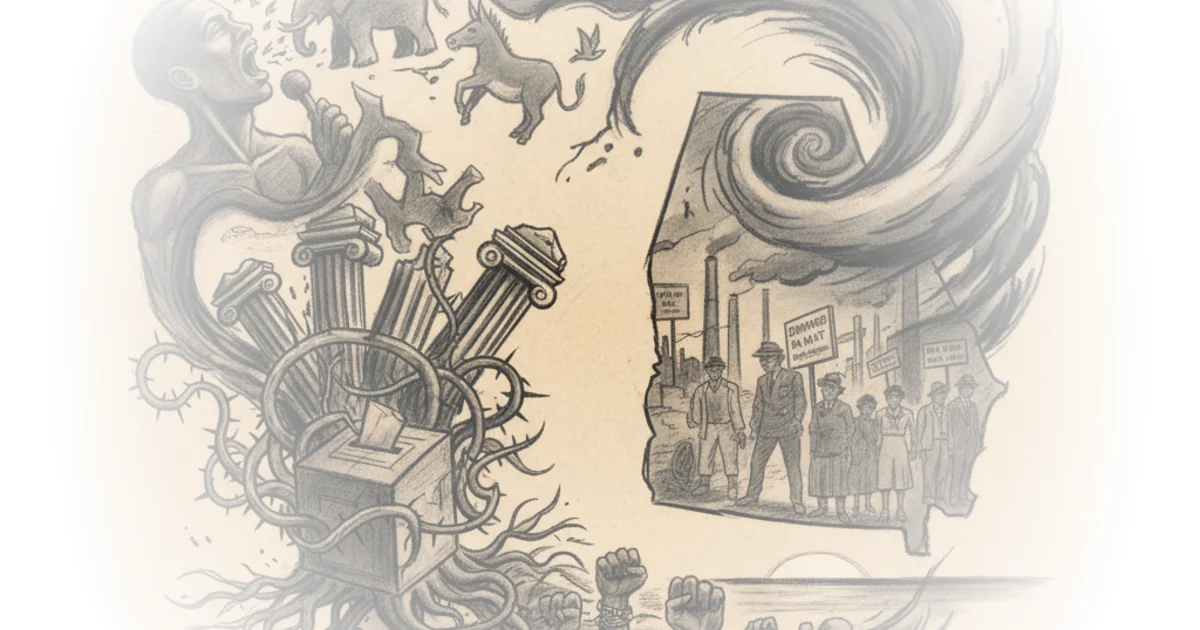
The catalyst for change, Hasan explains, was not a change of heart by the White House, but the threat of mass action. When A. Philip Randolph planned a "Negro March on Washington," the administration finally moved. Hasan writes, "The man most historians consider the most powerful president in U.S. history acquiesced." This moment led to the creation of Executive Order 8802, which desegregated the defense industry, and the recruitment of Black talent for the war effort, including the Tuskegee Airmen. The author points out that "before Executive Order 8802, America didn't have the bombs, the tanks, planes, pilots, or the will necessary to face Nazi Germany." The historical record shows that Black Americans "didn't give their votes to FDR or the Democratic Party. They demanded something in return."
Hasan then pivots to the central target of his critique: ESPN personality Stephen A. Smith. Smith has argued that Black voters should vote Republican to force the party to "compete" for their support. Hasan dismantles this by listing Smith's history of controversial takes, noting that Smith "was wrong when he blamed Trayvon Martin for making white people leery of Black men in hoodies, and not four centuries of racial propaganda." The author argues that Smith's current political theory is merely "narcissistic contrarianism that perpetuates an anti-Black narrative that launders racism as intellectual thought."
Parties have never earned our votes through charity; they have been forced to earn them through the withdrawal of our support.
The Historical Reality of Party Loyalty
The core of Hasan's argument rests on the idea that Black political activism has never been defined by blind loyalty to a party label. He traces the origins of the Democratic Party to its foundation by "white slaveowners to protect slavery," stating bluntly that "people who are willing to rip their country apart to keep their slaves are not 'patriots.'" He contrasts this with the Republican Party, which was originally built to oppose the expansion of slavery. However, Hasan warns against viewing this as a static moral alignment. He explains that as Black elected officials gained power in the GOP, they "remade the GOP in their own political image," leading to a "reverse gentrification" so complete that white liberals fled to form the "Lily White Republicans."
This historical trajectory explains why the parties shifted. When the civil rights movement gained momentum, Southern segregationists like Strom Thurmond and Ronald Reagan moved to the Republican Party, while the Democratic Party began to embrace civil rights. Hasan writes, "Black people stopped giving Republicans their votes" not because of a sudden change in ideology, but because the party platform no longer reflected their political goals. He emphasizes that "the name of the party has always been inconsequential" in the Black political universe; what matters is whether the party's actions align with collective interests.
Critics might argue that the current political landscape is different, suggesting that a unified Black vote for the GOP could genuinely shift the Overton window. However, Hasan counters this by pointing to the immediate aftermath of the 1876 election, where a high turnout of Black Republican voters resulted in a deal that "ushered in a century of Jim Crow." The author argues that the GOP "never wanted Black people to have political power; it wanted Black voters." When Black voters used the party to gain actual power, white voters left. This pattern repeats: "When the Democratic Party accepted the inevitable end of Jim Crow, white people left the party."
The Cost of the "Grand Theory"
Hasan brings the argument into the present by examining the recent election results and the subsequent actions of the executive branch. He notes that despite Donald Trump winning around 15% of the Black vote in 2024, the administration did not become more inclusive. Instead, the author observes, "the party leaders created a right-wing blueprint for the executive branch that sought to roll back gains from the Civil Rights movement." Hasan cites specific policy moves, such as budget proposals that "defunded the Minority Business Development Agency and clawed back money that Congress set aside for Black farmers."
The author highlights the appointment of Pete Hegseth as Secretary of War, noting that he "purged the armed forces of Black leaders and reinstated the names of white supremacists to military bases." Hasan argues that these actions demonstrate that the goal of the current administration is not to compete for Black votes, but to "become the most racist administration ever." He sarcastically notes that Smith might call this "competing," but the evidence suggests otherwise. The author writes, "It's almost like their goal is to become the most racist administration ever. Or, as Smith calls it: 'Competing.'"
The piece concludes by returning to the power of Black agency in shaping policy. Hasan recounts the story of Hobart Taylor Jr., who was handed a draft of the order establishing the President's Committee on Equal Employment Opportunity by Lyndon B. Johnson. Taylor, a Black attorney, reviewed the draft and told Johnson, "I'd do a lot of things differently if I were doing it." Johnson's response was to ask, "Would you write it the way you want it?" This anecdote serves as the ultimate rebuttal to Smith's theory: Black people do not need to vote for a party to get their interests addressed; they need to be in the room where the decisions are made, and they need the leverage to force that access.
Bottom Line
Mehdi Hasan's piece is a powerful corrective to the notion that political leverage comes from switching party allegiance; the strongest part of his argument is the historical evidence showing that parties only address Black interests when Black people withdraw their support and demand change. The argument's vulnerability lies in its reliance on historical precedents that may not fully account for the unique, polarized dynamics of the current media ecosystem, but the core lesson remains clear: political power is not given, it is taken through organized pressure. Readers should watch for how the current administration's policy rollbacks will impact Black communities, regardless of the rhetoric used to justify them.