In a field often obsessed with single-letter DNA changes, this piece from GWAS Stories delivers a startling revelation: the evolution of human skin color wasn't driven by a simple mutation, but by a 3,300-base-pair "jumping gene" that inserted itself into our genome twice. This isn't just a story about biology; it is a forensic account of how mobile genetic elements have acted as the primary editors of human history, rewriting our appearance and our health risks in ways that have remained invisible to standard genetic screens for over a decade.
The C-Value Paradox and the Hidden Genome
The article begins by dismantling a long-standing biological confusion: the disconnect between an organism's size and the size of its genome. GWAS Stories notes that "larger animals have smaller genomes, whereas some plants, insects and even some unicellular organisms... have humungous genomes." This phenomenon, known as the 'C-value paradox,' is explained not by complexity, but by the presence of "graveyards" of repetitive elements. The piece argues that "more than 45% of the human genome are repeat elements filled with transposons, aka, jumping genes," which are not junk but active drivers of evolution.
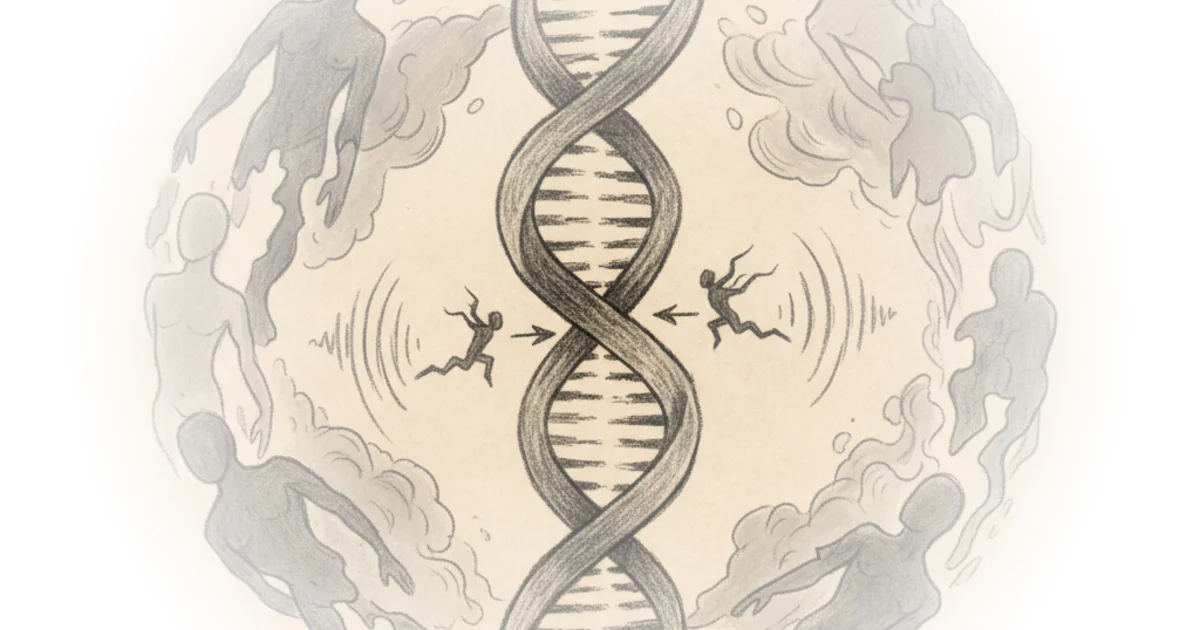
This framing is crucial because it shifts the reader's perspective from static DNA to a dynamic, editing genome. The article highlights recent breakthroughs in understanding how these elements move, noting that researchers recently uncovered a mechanism where a "bridge RNA" allows these elements to target specific DNA sites. While the piece briefly touches on gene editing applications, it wisely pivots back to human evolution, asserting that these mobile elements are "one of the major drivers of human evolution."
The ASIP Locus Mystery
The core of the coverage focuses on a specific gene, ASIP, which encodes the agouti signaling protein. This protein acts as a switch in skin cells, competing with melanocyte-stimulating hormone to determine whether the body produces dark eumelanin or lighter pheomelanin. GWAS Stories reports that while scientists have long known that variations near ASIP are linked to skin color, freckling, and red hair, "the causal variant at this locus have remained unknown." For years, studies in European populations confirmed the link, yet the specific genetic change was elusive. Conversely, GWAS studies in African and East Asian populations failed to find a signal, suggesting the mechanism was unique to European ancestry.
The piece effectively builds suspense around this missing link, noting that a 2016 study identified the ASIP region as a hotspot for positive selection in Europeans. The mystery was why a variant with such a massive effect on survival and appearance had been missed by the most advanced genetic tools of the time. The answer, as the article reveals, lies in the nature of the variant itself. It wasn't a point mutation; it was a structural variant so large and complex that it hid in plain sight.
"The fact that the effect of such a common, large polymorphism (3.3 kb) could remain unnoticed for 15 years... speaks to the importance of fully integrating structural variants into genetic association analyses."
A Tale of Two Insertions
The narrative takes a dramatic turn when GWAS Stories details the work of Po-Ru Loh and Steve McCarroll at the Broad Institute. By analyzing long-read sequencing data, the team discovered that the ASIP gene had been invaded by a mobile element called SVA. The story unfolds in two distinct evolutionary chapters. First, roughly 500,000 years ago, an SVA element jumped into the gene, disrupting its function and reducing the production of light pigment. This resulted in darker skin, which provided a survival advantage as early humans lost their body hair and faced intense sun exposure. The piece explains that this mutation was so beneficial it became "fixed in the lineage," meaning every human today carries this first insertion.
The second chapter occurred much later, after humans migrated out of Africa. A second SVA element, SVA F1, inserted itself into the same spot but in the opposite direction. This second jump "somehow... releasing the ASIP expression block caused by SVA F." The result was a reactivation of the gene, leading to lighter skin pigmentation. This adaptation offered an evolutionary advantage in the low-sunlight environments of northwestern Europe, allowing the population to synthesize vitamin D more efficiently. The article notes that this allele rapidly rose to high frequency in these populations but remains "almost absent in Asians and African populations."
Critics might note that while the evolutionary advantage of lighter skin in northern latitudes is well-established, the piece simplifies the complex interplay of other genetic factors that contribute to skin color diversity. However, the specific mechanism of the double insertion provides a compelling, concrete explanation for a specific subset of human variation that had previously been a statistical ghost.
The Evolutionary Trade-Off
The coverage concludes with a sobering look at the cost of this evolutionary adaptation. The same genetic switch that allowed humans to thrive in northern Europe has left a legacy of increased vulnerability. GWAS Stories reports that carrying the SVA F1 allele increases the risk of skin cancer by 1.2 times for one copy and 1.4 times for two copies. This is a stark reminder that evolution is not about perfection, but about survival in a specific context. The piece argues that "the benefit came at a cost," illustrating how a trait selected for survival in one environment can become a liability in another.
This analysis is particularly effective because it connects ancient history to modern health crises. It moves beyond the abstract concept of "natural selection" to show how a specific molecular event 50,000 years ago directly influences cancer rates today. The article suggests that the human genomics field has "ignored structural variants for a long time," and that there are likely "a whole lot of similar evolutionary stories buried within the noncoding genome waiting to be told."
Bottom Line
The strongest part of this argument is its demonstration of how standard genetic tools can miss the most significant drivers of human evolution simply because they are looking for the wrong type of variation. The piece's biggest vulnerability is its brief treatment of the broader implications for non-European populations, who may harbor their own unique structural variants that have yet to be discovered. Readers should watch for the next wave of genomic research that integrates structural variants, as it promises to rewrite our understanding of human history and disease risk.