Kings and Generals reframes the Wars of the Roses not as a mere dynastic squabble, but as the inevitable structural collapse of a state where noble power outstripped royal authority. While many historical accounts focus on the heraldic badges of York and Lancaster, this documentary zeroes in on the specific economic and military machinery that made civil war unavoidable: the creation of massive duchies that birthed a class of nobles with private armies larger than the king's.
The Seeds of Bastard Feudalism
The narrative begins by tracing the roots of the conflict to the Hundred Years' War and the reign of Edward III. Kings and Generals writes, "For the first time in English history, he created duchies for them, making his sons the biggest land owners in the country." This move, intended to strengthen the crown, paradoxically forged a new class of nobility with both the claim and the military capacity to seize the throne. The authors argue that this era ushered in what is controversially known as "bastard feudalism," a system where loyalty shifted from the monarch to individual lords.
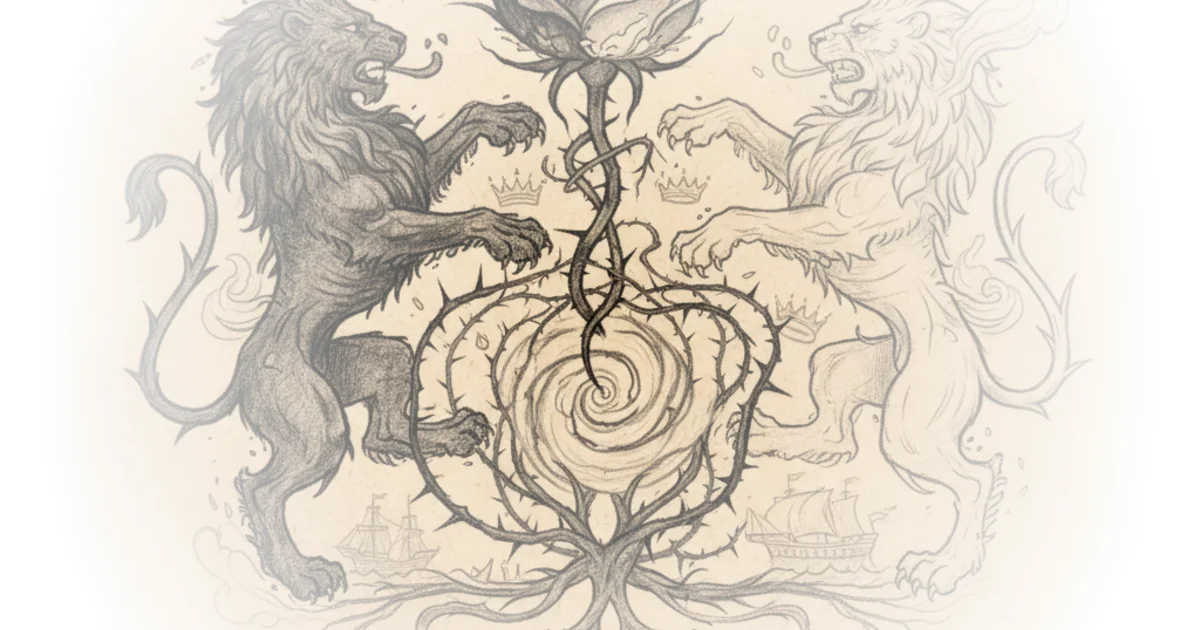
The documentary posits that the loss of French territories was the catalyst that turned these powerful dukes into domestic threats. As Kings and Generals puts it, "The H 100red Years War impoverished England. The losses in France were hard to swallow. And the nobles who had lost their land on the continent were unhappy." This economic grievance is crucial; it transforms the conflict from a legal dispute over succession into a fight for survival by a warrior aristocracy that had lost its external outlet for plunder and prestige.
Critics might argue that the documentary oversimplifies the complexity of medieval succession laws by focusing so heavily on military might, yet the evidence of private retinues suggests that legal claims were secondary to who could field the largest force.
"This era was characterized by the loyalty of the soldiers being to their lords rather than the king."
The Collapse of Central Authority
The commentary shifts to the reign of Henry VI, portraying him not just as a weak king, but as a figurehead whose mental incapacity created a power vacuum that the nobility eagerly filled. Kings and Generals notes that when the king suffered a mental breakdown in 1453, "it is clear that Henry V 6th lost the remainder of his political power." The authors describe how the Nevilles and Percy families used this lack of central power to renew ancient feuds, with the Duke of York stepping in as the only viable alternative to restore order.
The documentary details the First Battle of St. Albans with tactical precision, highlighting how the Yorkists exploited urban terrain to break the Lancastrian lines. Kings and Generals writes, "Due to its unexpected and swift nature, the attack succeeded at first with the Yorkists pushing onto the city streets." However, the narrative quickly pivots to the tactical brilliance of the Earl of Warwick, who executed a flanking maneuver that turned a stalemate into a rout. The authors emphasize that the battle was decided not by the sheer number of troops, but by the initiative of commanders who could adapt to the chaos of narrow streets and market squares.
This focus on tactical agency is compelling, though it occasionally downplays the role of political maneuvering that preceded the fighting. The documentary suggests that the battle was a military inevitability, whereas political historians might argue that the failure of negotiations was the true turning point.
The Bloodiest Day on English Soil
The climax of the piece arrives at the Battle of Towton, where the documentary paints a grim picture of a conflict driven by desperation and weather. Kings and Generals describes the conditions vividly: "At dawn on the 29th of March, both armies found themselves in a snowstorm." The authors argue that the wind direction was the deciding factor, rendering Lancastrian archery useless while allowing Yorkist arrows to rain down with devastating effect.
The narrative captures the brutality of the engagement, noting that the Lancastrians were forced to charge down from high ground into a hail of arrows. Kings and Generals writes, "Sources claim that 20,000 Lancastrians and up to 10,000 Yorkists were killed, making Toutton the bloodiest battle fought on English soil." This staggering casualty count underscores the authors' central thesis: the Wars of the Roses were not a polite dispute among cousins, but a total war that nearly annihilated the English nobility.
The documentary's strength lies in its ability to humanize the strategic decisions. By detailing the rashness of the Duke of York's sortie at Wakefield and the tactical errors at Towton, Kings and Generals shows how individual miscalculations compounded structural failures. A counterargument worth considering is whether the documentary places too much weight on the weather and tactics, potentially obscuring the deeper ideological shifts regarding the nature of kingship that were occurring during this period.
Bottom Line
Kings and Generals delivers a powerful analysis by grounding the Wars of the Roses in the material reality of land ownership and military capacity rather than abstract dynastic claims. The strongest part of their argument is the connection between the loss of French lands and the internal fracturing of English society, a link that explains why the conflict was so intractable. However, the piece's biggest vulnerability is its tendency to treat the war as a series of tactical puzzles, occasionally glossing over the complex legal and religious justifications that the nobles used to legitimize their rebellion. Readers should watch for how these structural pressures continue to influence the narrative of English governance in the decades that followed.