While the headlines focus on a costly recall, Asianometry reveals a deeper, more dangerous truth: the very chemistry that powers the electric revolution is inherently prone to catastrophic failure. This isn't just a manufacturing glitch; it is a fundamental trade-off between range and safety that the entire industry is currently struggling to balance.
The Chemistry of Fire
Asianometry begins by dissecting the specific technical failure behind the General Motors Chevrolet Bolt recalls, which have cost the automaker $1.8 billion. The core issue lies in the battery's composition. "The 2017 Chevy Bolt... has a 60 kilowatt hour... lithium ion battery pack," the author notes, explaining that its "nickel-rich architecture allows the car to go further and accounts for a fifth of the car's total cost." This drive for higher energy density is the industry's double-edged sword. By packing more energy into the cells to satisfy consumer demand for range, manufacturers are walking a "bouncing rope" where adding more nickel increases the risk of thermal instability.
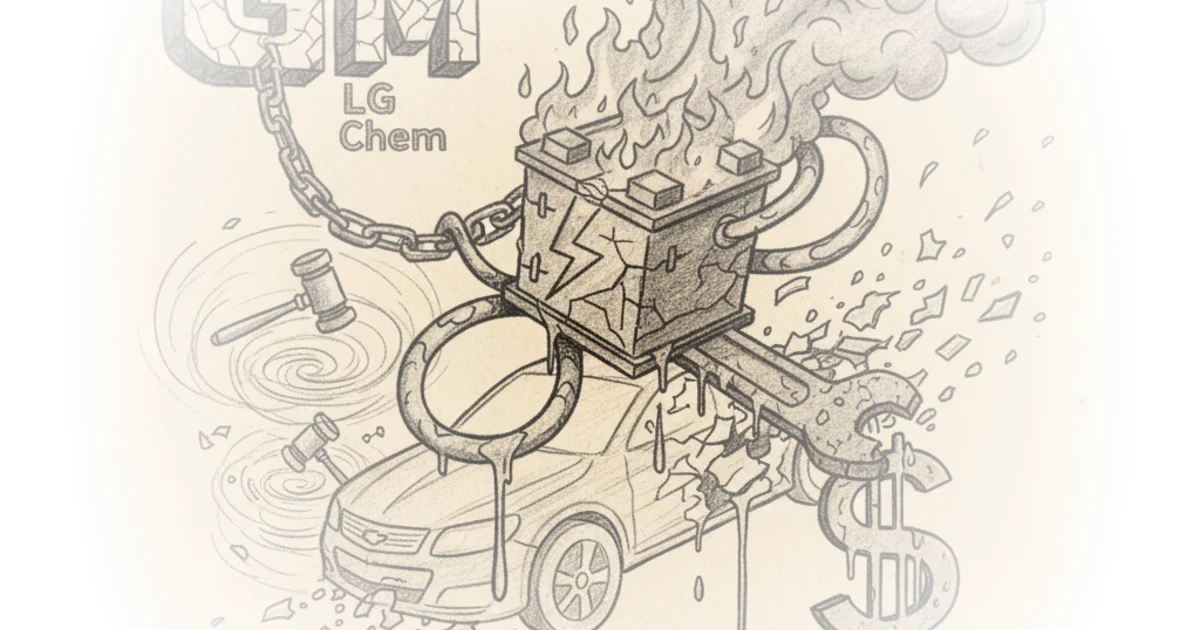
The author's explanation of the failure mechanism is particularly compelling. They describe a chain reaction known as thermal runaway, where heat triggers chemical changes that generate even more heat. "When the temperature gets too high... the solid electrolyte interface layer or the SEI breaks down," Asianometry writes. Once this protective layer fails, the electrolyte reacts with the anode, causing a cascade that leads to an internal short circuit. This technical breakdown is not merely a statistic; it is a physical reality that turns a car into a fire hazard. The author rightly points out that "manufacturers walk a bouncing rope" because the materials that make cars go further are the same ones that make them burn hotter.
Manufacturers walk a bouncing rope adding more of these materials can increase how long the battery can discharge energy or how much energy it can discharge but doing that can also lead to thermal instability and really bad fires.
The Myth of Rarity and the Reality of Intensity
A common defense of electric vehicles is that they catch fire less often than gas cars. Asianometry addresses this directly, noting that while battery fires are rare—occurring at a rate of roughly 1 in 40 million—they dominate the news cycle because of their severity. The author cites data showing 190,000 conventional vehicle fires in the US in 2019, yet electric vehicle fires garner disproportionate attention. "EV battery fires tend to make the news because they are relatively rare," Asianometry observes, but adds a crucial caveat: "there is some automobile insurance data that shows that EVs tend to have a lower rate of vehicle fires and of course it is also necessary to counterpoint that EV owners tend to be wealthier and thus possibly are better or more careful drivers." This nuance is vital; it suggests that safety statistics may be skewed by the demographics of early adopters rather than just the technology itself.
The real danger, however, is not the frequency but the difficulty of suppression. Unlike a standard car fire, an electric vehicle fire is a chemical reaction that does not require external oxygen. "One example in the city of Fort Lauderdale... took between seven hundred and fifty to one thousand one hundred liters of water," the author explains, noting that in some cases, suppression takes over ten thousand liters and sixty minutes. The situation is further complicated by the risk of reignition. "The battery in the Fort Lauderdale car fire reignited as the burnt vehicle was being towed away," Asianometry writes, highlighting that these fires can flare up days after the initial incident. This creates a unique logistical nightmare for first responders and salvage yards alike.
Critics might argue that focusing on these extreme cases creates unnecessary fear, given that internal combustion engines also present significant fire risks. However, the author's emphasis on the unique chemical nature of lithium-ion fires—specifically the release of hydrogen fluoride and the potential for reignition—suggests that the risk profile is fundamentally different, not just statistically different.
The Path Forward: Safety vs. Range
The recall of the Bolt has forced a reckoning between General Motors and its battery supplier, LG Energy Solution. While GM attempts to pass costs to LG, the author notes that "the two companies are so intimately tied together now that they have no choice but to work together through this divorce is not an option." This interdependence highlights a broader industry dilemma: the push for higher performance has outpaced the safety engineering required to contain it.
Asianometry suggests that the industry may be pivoting back toward safer, albeit less energy-dense, chemistries. "Whether actual or perceived safety risks with these nickel-rich battery chemistries are going to have car makers opting for lithium-iron phosphate batteries," the author asks. This chemistry, used by companies like BYD and Tesla in certain markets, is "safer when it comes to thermal runaway" but suffers from lower range. The author sees this as a potential inflection point: "Tesla using lithium iron phosphate in some of their Chinese Model 3s might be an indication that these chemistries are getting good enough."
The author also details the engineering compromises being made to mitigate these risks, such as adding firewalls between cells or using ceramic-coated separators. However, these solutions come at a cost. "Enlarging the space between the cells... reduces energy density and cuts down on the vehicle's range," Asianometry writes. "Customers might be less willing to buy such a car so trade-offs." This is the crux of the industry's current struggle: the market demands maximum range, but physics demands maximum safety, and the two are currently at odds.
There is no doubt that this recall is a hit to LG Energy. The company prides itself on its advanced chemistries and industry standard pouch designs for its battery cells.
Bottom Line
Asianometry's analysis succeeds in moving the conversation beyond simple recall statistics to the fundamental chemical trade-offs defining the electric vehicle era. The strongest part of the argument is the detailed breakdown of thermal runaway, which effectively explains why these fires are so difficult to control. The biggest vulnerability lies in the assumption that a shift to lithium-iron phosphate is a panacea; while safer, it may not meet the range expectations of the broader global market. Readers should watch for how quickly manufacturers pivot to safer chemistries versus how long they continue to chase range at the expense of safety.
There is no doubt that this recall is a hit to LG Energy. The company prides itself on its advanced chemistries and industry standard pouch designs for its battery cells. Whether or not there might be something actually fundamentally wrong with LG's pouch design as Elon seems to imply in a tweet that's harder to say issue that is more interesting to consider is whether actual or perceived safety risks with these nickel-rich battery chemistries are going to have car makers opting for lithium-iron phosphate batteries.