This piece presents a radical reimagining of American governance, arguing that the Supreme Court has just dismantled nearly a century of administrative law to restore absolute presidential control over the executive branch. It is not merely a legal summary; it is a manifesto for the "unitary executive," claiming that the First Congress implicitly endorsed this theory in 1789 and that any independent agency is now constitutionally suspect. For listeners tracking the future of federal power, the stakes are immediate: if the Court's new logic holds, the President gains the authority to fire almost anyone in the government at will, fundamentally altering how laws are enforced and regulations are made.
The Death of Independence
The article opens with high praise for Chief Justice Roberts' majority opinion in Trump v. Slaughter, framing it as a definitive correction of historical error. Reason reports that the Court "correctly overruled its 91-year-old precedent in Humphrey's Executor v. United States (1935), consigning that erroneous nine-page opinion to the ashbin of history." This is a bold claim, suggesting that the legal architecture protecting agencies like the Federal Trade Commission has been built on a false foundation for nearly a century. The piece argues this was "a triumph of originalism and textualism over the so-called pragmatism offered by the three dissenters," prioritizing the text of Article II's Vesting Clause over the practical realities of modern governance.
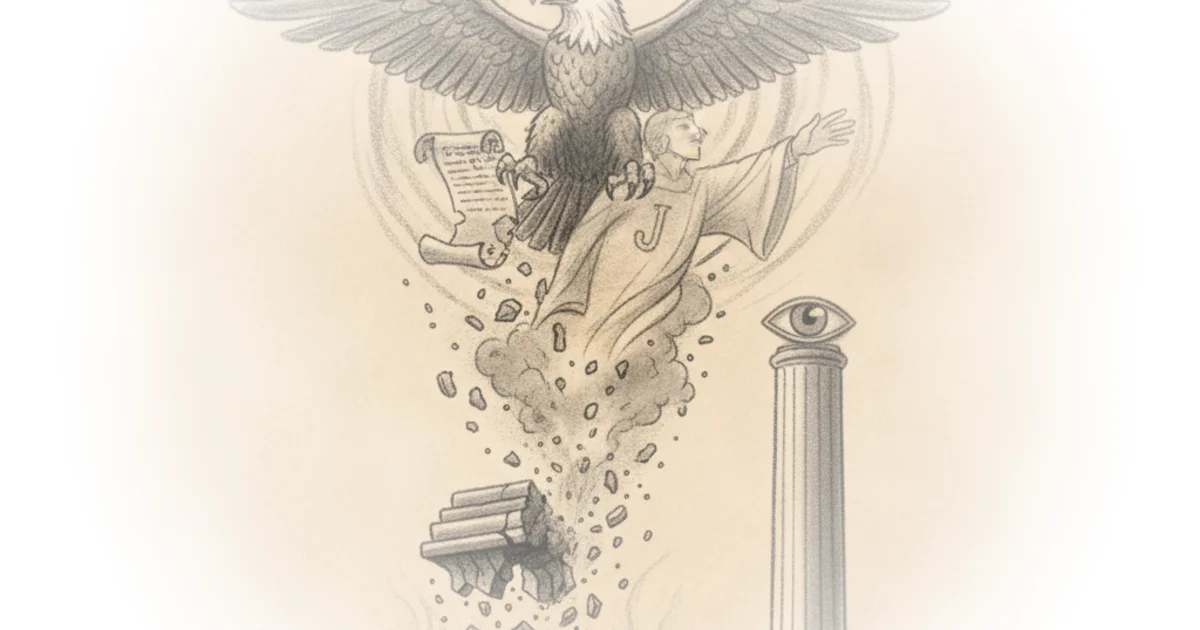
The commentary leans heavily on historical precedent to justify this shift, noting that the opinion "rightly endorsed Chief Justice William Howard Taft's account of the Decision of 1789 in Myers v. United States." This reference is crucial: it anchors the argument in the very first session of Congress, implying that the Founders themselves rejected the idea of independent commissioners. The piece asserts that this historical continuity is unbroken, stating that "our first seven presidents... had all been believers in the theory of the unitary executive." By linking the current ruling to George Washington and Andrew Jackson, the argument attempts to neutralize claims that this is a modern political invention.
However, this historical framing glosses over the evolution of the administrative state. Critics might note that while the early republic was small, the complexity of the 20th century necessitated agencies insulated from direct political pressure to ensure stability and expertise. The piece dismisses these concerns by arguing that "policy arguments... should play no role at all in constitutional interpretation when the original public meaning of the constitutional text is clear." This strict adherence to originalism ignores the functional necessity of independent regulators, a tension that will likely define the next decade of legal battles.
It cleanly overruled the dreadful Humphrey's Executor opinion instead of obliquely distinguishing it out existence, as the Court has done with some other flat-out wrong precedents.
The Money Supply Exception
Perhaps the most fascinating twist in the argument is its attempt to carve out a specific exception for the Federal Reserve. While demanding total presidential control over most executive officers, the piece concedes that "officers who control the money supply" must remain independent to prevent reckless inflation or deflation. It cites the Great Depression and the 2008 financial crisis as evidence that political interference can be dangerous, yet paradoxically uses these events to argue for a specific structural fix rather than general independence.
The article details how President Franklin D. Roosevelt's intervention with Executive Order 6102 was "essential in pulling the U.S. out of the devastating deflation," and similarly praises Ben Bernanke's actions during the Great Recession. Yet, it concludes that these successes were possible only because of "staggered terms on an independent Federal Reserve Board." The piece argues that this exception is narrow: "An exception to unlimited presidential removal power makes sense with respect only to the Federal Reserve Board's role in controlling the money supply." This creates a bizarre legal dichotomy where a President can fire a regulator for environmental policy but not for monetary policy, despite both being executive functions.
The logic here is precarious. If the Constitution grants the President "unlimited power to remove at will principal and superior officers," as the piece claims Roberts affirmed, why does the Federal Reserve get special treatment? The article admits this requires "unpacking the many things" the Fed does, suggesting that future litigation will have to surgically separate monetary policy from banking regulation. This ambiguity leaves a massive gray area in the new legal landscape.
The Cook Conundrum and Judicial Hypocrisy
The commentary then pivots to a companion case, Trump v. Cook, where the Court denied a stay on reinstating Federal Reserve member Lisa Cook after her removal for alleged mortgage fraud. Here, the piece turns sharply critical of Chief Justice Roberts and Justice Kavanaugh, accusing them of political maneuvering rather than legal consistency. The article notes that "five unelected, life-tenured Supreme Court justices" voted to put Cook back in control of the money supply despite the President's claim of cause for removal.
The author expresses deep skepticism about the Court's motivation, conjecturing that Roberts and Kavanaugh joined the dissenters because they "wanted to look 'evenhanded' in their treatment of President Trump." This is a stark accusation against the judiciary: that they sacrificed legal principle for political optics. The piece argues that the Court ignored the government's explicit waiver of constitutional challenges, focusing instead on procedural reinstatement. It points out that "no federal court has ever in 237 years of American history ordered that a federal officer who had been fired be reinstated," highlighting the unprecedented nature of the decision.
The argument suggests that the proper path would have been to remand the case for a factual hearing on the fraud allegations, rather than forcing an immediate return to office. "At a minimum," the piece contends, Cook should have had to prove her innocence in the Claims Court before regaining her position. By skipping this step, the Court allegedly undermined the President's ability to enforce accountability within his own branch, creating a contradiction with the sweeping removal powers established in Slaughter.
The one outcome that does not make sense is for five unelected, life-tenured Supreme Court justices to put Lisa Cook back in control (to some limited degree) of the nation's money supply when the elected President of the United States has concluded that she was guilty of mortgage fraud.
Bottom Line
This piece offers a compelling, if controversial, defense of absolute presidential authority, successfully weaving together originalist theory and historical precedent to argue for the end of the "headless fourth branch." Its strongest move is the rigorous application of the Decision of 1789 to modern administrative law, forcing a reckoning with how long-standing agencies operate. However, its biggest vulnerability lies in the inconsistent treatment of the Federal Reserve; by carving out an exception for monetary policy while demanding total control elsewhere, the argument reveals the practical difficulties of implementing a pure unitary executive in a complex economy. The reader should watch closely to see if the Court's distinction between "money supply" and other regulatory functions holds up, or if the logic of Slaughter eventually consumes the Fed as well.