Naomi Kanakia delivers a provocative thesis that cuts through the elitism of literary culture: the future of literature doesn't belong to the credentialed academic, but to the curious amateur. In an era where reading is often gatekept by institutional authority, she argues that the most profound engagement with the "Great Books" happens when readers shed the pretense of expertise and embrace a personal, unguided journey. This is not a dry defense of the canon; it is a manifesto for intellectual autonomy that challenges how we value knowledge in a world increasingly stratified by credentials.
The Amateur's Advantage
Kanakia frames her forthcoming non-fiction book, What's So Great About The Great Books?, not as a curriculum, but as a "personal journey of reading in search of that happy and a peaceful life." She explicitly rejects the notion that engaging with the Western canon is an act of social exclusion. Instead, she posits that "the cultivation of taste and the appreciation of beauty are not, then, socially excluding practices. They are what gives us common ground." This reframing is crucial. It moves the conversation from "who belongs in the club" to "what do we gain by reading together."
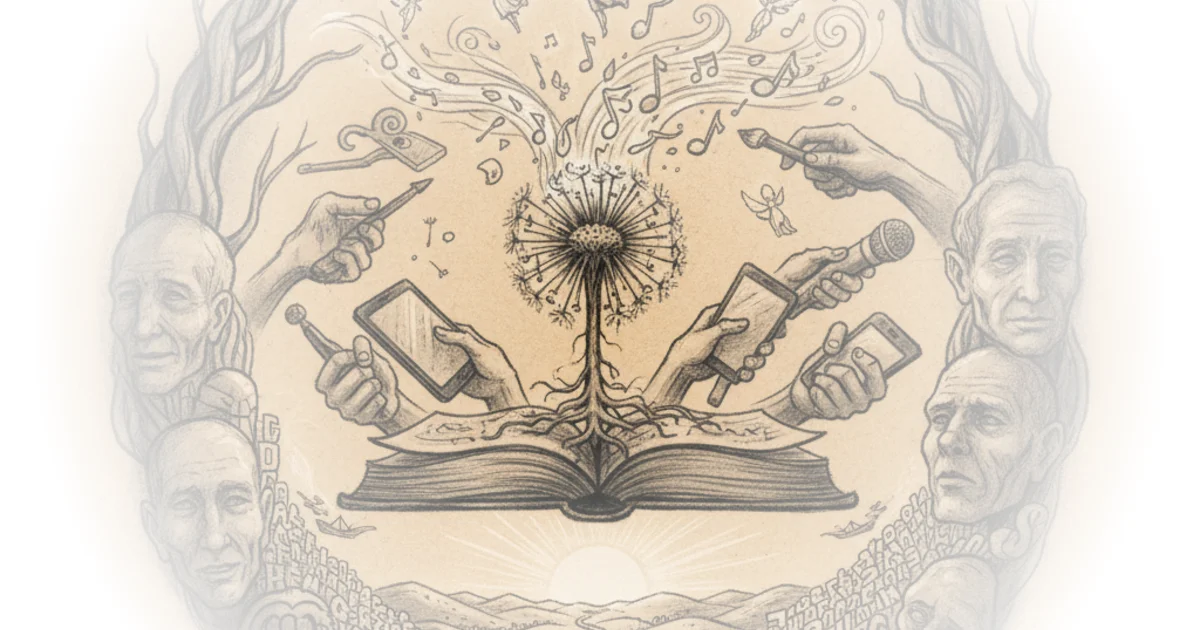
The author's approach is refreshingly devoid of the academic posturing that often alienates general readers. She notes that "the Great Books don't offer simple answers. They provoke complex reflections." By stripping away the requirement for a PhD to interpret these texts, she opens the door for a more democratic engagement with literature. This mirrors a historical shift seen in the mid-20th century, when the "Great Books" movement, championed by figures like Mortimer Adler, attempted to make the Western canon accessible to the general public, though often with a more rigid, prescriptive structure than Kanakia advocates. Her version is fluid, personal, and deeply human.
"I try to steer clear of having that kind of authority. I try to be open about the fact that this is a book I just read yesterday... it's essentially an amateur take. And that brings me a lot of peace because I'm not pretending to be a PhD or someone with a lot of authority."
Kanakia's admission of her own amateur status is her greatest strength. She argues that the "voice of authority" found in prestigious journals often creates a barrier, whereas her "minimalist" style invites the reader in. As she puts it, "My main innovation, and really the source of all my success, is that I eschew authority." This is a bold claim in a literary landscape that often equates depth with density and citation. Critics might argue that without rigorous academic training, readers risk misinterpreting complex texts or missing crucial historical context. However, Kanakia counters that the goal isn't to produce scholars, but to foster "more accepting" people through the act of reading itself.
The Economics of Independent Thought
The piece also tackles the precarious economics of writing for independent platforms. Kanakia acknowledges that "many of the essays I read—in prestigious and well-known magazines—were edited and written and fact-checked by people barely able to make a living from their work." She contrasts the rigid, format-driven world of traditional publishing with the freedom of her Substack, Woman of Letters. While traditional journals offer "membership in a community" and "the potential for some career progress," they often demand that writers conform to a specific "house style."
Kanakia describes the frustration of this system: "There'll be many rounds of editing trying to maneuver your piece into a certain shape. And ultimately they may decide that your piece just doesn't fit their vision." She notes that her style, which is "too loose, too conversational, too explanatory in an unembarrassed way," simply doesn't fit the mold of major magazines. This is a significant critique of the gatekeeping mechanisms in literary journalism. By choosing the amateur path, she gains the ability to "publish it once I decide that it's ready," free from the "strings" of editorial mandates.
"The future of literature belongs to amateurs... I think it means that we have to achieve sustainability through other means. In my case that means writing primarily for my blog, rather than for print publication."
This argument resonates deeply in a digital age where the barrier to entry for publishing has lowered, but the barrier to sustainable income remains high. Kanakia admits that her blog generates modest income, but the trade-off is autonomy. "I don't have to file invoices or pitch pieces. I can just write whatever I want." This freedom allows her to pursue long-term projects on her own timeline, a luxury rarely afforded to writers dependent on the whims of magazine editors. A counterargument worth considering is whether this model is scalable or if it merely represents a niche success story that cannot be replicated by the average writer. Yet, for Kanakia, the value lies in the integrity of the work, not the paycheck.
Reclaiming the Reader's Agency
Ultimately, Kanakia's work is a call to reclaim the reader's agency. She challenges the assumption that readers are passive consumers who need to be told what is valuable. "Most people want to read good books, but that doesn't mean they want to read the books that you consider good," she writes. This is a powerful reminder that literary value is subjective and that the "Great Books" should be a resource for personal growth, not a weapon of cultural superiority.
She recalls her own journey, noting that she "felt very condescended-to by the mainstream literary world" as a young reader. Her book is an attempt to explain the Great Books idea to people like her younger self: "people who love books, but who aren't necessarily sold on the idea that they should spend a significant part of their life reading Euripides and Chaucer and Tolstoy." By removing the academic scaffolding, she makes these texts accessible to a wider audience. "The way I'd sum it up... is that it's very likely the sort of book I would re-read on a three-hour flight, every seven or eight years, and find that the voice is incredibly warm and affable and friendly and familiar."
"In that act, we become, perhaps, not better people, but more accepting ones. A convincing case for Great Books as the road to self-discovery and moral action."
This sentiment encapsulates the core of her argument: reading is a moral act of empathy. It is not about memorizing facts or mastering a canon, but about engaging with diverse perspectives and complex ideas. The "Great Books" become a mirror for the reader's own life, offering "common ground" across differences of identity and background. This is a hopeful vision of literature's role in society, one that prioritizes connection over competition.
Bottom Line
Kanakia's argument is a compelling defense of the amateur reader, challenging the gatekeepers of literary culture to recognize the value of uncredentialed engagement. Her strongest move is reframing the "Great Books" not as a test of intelligence, but as a path to empathy and self-discovery. The biggest vulnerability in her approach is the potential for superficial engagement without the rigor of academic study, but her emphasis on personal reflection and open-mindedness mitigates this risk. As the landscape of publishing continues to shift, her model of independent, authentic writing offers a promising alternative to the rigid structures of traditional media.