The Son-in-Law in the Shadows
On the anniversary of a presidential acquittal following the Capitol breach of 2021, Mehdi Hasan trains his sights on a figure who has never been elected to any office yet appears to wield influence over foreign policy, diplomatic backchannels, and perhaps the contents of a government safe. The question isn't whether Jared Kushner is powerful. It's whether anyone can find out what he's actually doing with that power.
The Redaction Machine
Hasan opens with a staggering data point about transparency. The Department of Justice released roughly 3.5 million files in connection with an Epstein-related transparency mandate, heavily redacted. When a ranking member of the House Judiciary Committee searched the unredacted congressional version, the former president's name appeared over a million times — meaning at least 99.5 percent of references to him were blacked out in the public release. As Hasan writes, "The most transparent administration ever? Seriously?"
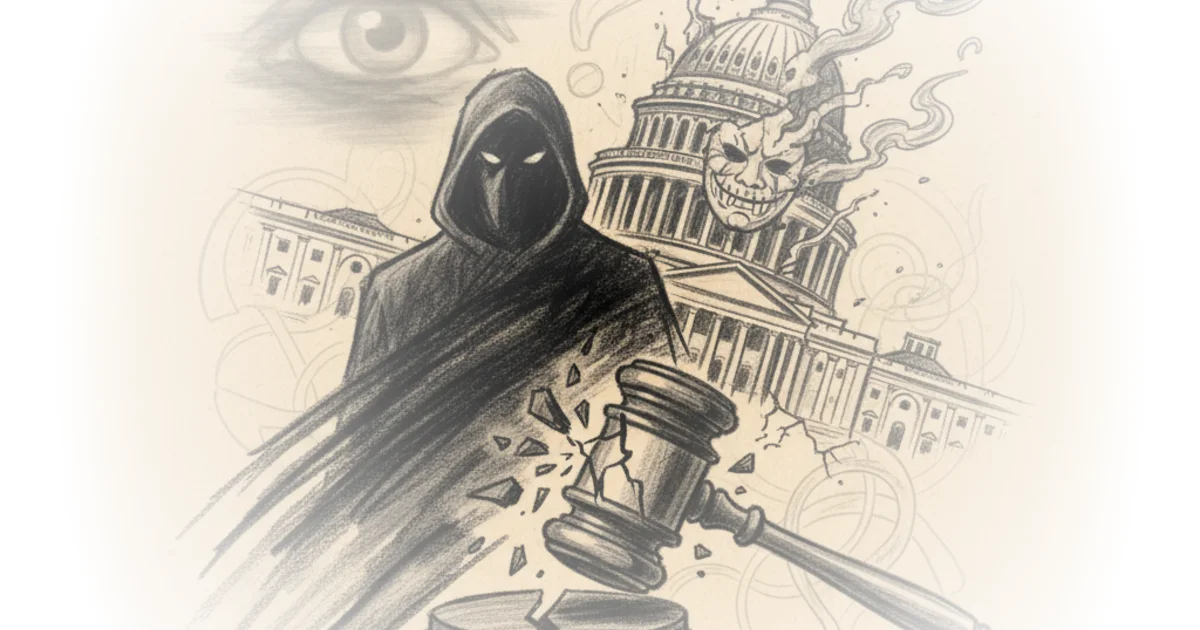
Then comes the broader pattern. A whistleblower complaint against the Director of National Intelligence — so sensitive it was reportedly locked in a safe — concerns an intercepted conversation between two unidentified foreign nationals discussing none other than Jared Kushner. The National Security Agency originally redacted Kushner's name from its own report. Readers with clearance figured it out anyway.
Hasan writes, "The foreign nationals, they said, were commenting on Mr. Kushner's influence with the Trump administration. At a time last year when Mr. Kushner's role in Middle East peace talks was less public than it is now, the foreign officials were recorded saying that he was the person to speak to in order to influence the talks."
"This is the most shamelessly, brazenly, openly corrupt and compromised government in modern American history and, astonishingly, the person who sits at the center of much of that corruption and compromise isn't even a member of the government: It's Jared Cory Kushner, First Son-in-Law."
A Private Citizen with Diplomatic Reach
The core tension here is constitutional, not partisan. Kushner held no government position during the period in question. Yet he was apparently the go-to interlocutor for foreign governments seeking to influence Middle East negotiations. He met with the Russian president before sitting cabinet members did. He maintains financial relationships with Gulf states and illegal Israeli settlements, all while operating as a private actor whose public accountability is virtually zero.
As Hasan puts it: "He gets involved with government-run investment funds, and those governments also happen to want things from the American government. So you have a president's son-in-law financially entangled with foreign governments, and what's good for him might not be what's good for the American people."
The financial arc is worth noting on its own. Before entering the political orbit in 2016, Kushner was, by most accounts, an unsuccessful real estate developer. He and his wife reportedly saw their combined wealth swell by approximately $200 million during the first presidential term. By late 2025, Forbes listed him as a billionaire — less than a year into the second term.
The Hunter Biden Double Standard
Hasan draws a pointed comparison. Conservative media and Republican lawmakers spent years scrutinizing the president's son for his overseas business dealings, despite Hunter Biden never attending high-level international government meetings. Meanwhile, Kushner attends those meetings as a matter of course, negotiates with sovereign wealth funds, and faces no comparable congressional investigation.
Critics might note that the scrutiny of Hunter Biden was driven partly by legitimate concerns about foreign influence through family members — concerns that, if genuine, should apply symmetrically to any president's relative. The asymmetry is the very point.
Hasan writes, "Where are the planned investigations from Rep. James Comer, the Hunter Biden-obsessed GOP chair of the House Oversight Committee, into Kushner's myriad conflicts of interest?"
The Saudi Connection
The financial pipeline runs through Riyadh. During the first term, the Saudi Crown Prince reportedly boasted to his Emirati counterpart that Kushner was "in his pocket." Within months of leaving government, Kushner secured a $2 billion investment from the Saudi sovereign wealth fund for his private equity firm — against the advice of the Crown Prince's own staff. More recently, Kushner's firm participated in a $5 billion buyout of Electronic Arts alongside that same sovereign wealth fund, on the same day that a Gaza plan backed by Saudi interests was announced.
This is not a conspiracy theory. These are documented transactions between a private citizen with deep personal ties to a sitting president and foreign governments that have material interests in American foreign policy.
Critics might argue that private citizens are entitled to conduct business freely, and that foreign governments invest in American companies routinely. They would be correct — except when the private citizen in question also controls access to the Oval Office and has shaped peace negotiations while holding stakes in the countries he's negotiating over.
What Gets Locked Away
The throughline connecting the Epstein files, the safe-bound whistleblower complaint, and the opaque diplomacy is a single question: who decides what the public gets to know? The answer appears to be a shrinking circle of officials whose decisions consistently benefit the same small set of players.
Hasan's broader point is institutional, not merely personal. The apparatus of American governance — intelligence agencies, diplomatic backchannels, investment vehicles, transparency mandates — is being operated in a manner that makes accountability structurally difficult. Redactions. Classification. Safes. Private citizens at government tables. It all forms a coherent picture of power concentrated beyond the reach of elections.
Bottom Line
Jared Kushner is not a member of government, does not face confirmation hearings, and is not subject to the same disclosure requirements as any sitting official. Yet foreign governments treat him as a gateway to American policy, and his personal wealth has multiplied accordingly while operating in diplomatic shadows. A system that permits this arrangement — and then redacts the records that might expose it — has abandoned the pretense that power flows through democratic channels at all.