Tim Mak's reporting from Houcunyan Airfield reveals a startling truth: while geopolitical uncertainty clouds the horizon, the people of Taiwan are not waiting for Washington's permission to prepare for war. The piece's most distinctive claim is that the island's most critical defense layer is no longer just the military, but a civilian ecosystem of drone pilots who have turned hobbyist enthusiasm into a national survival strategy. This is not a story about hardware; it is a story about the human will to adapt when institutional support wavers.
The Civilian Pivot
Mak frames the narrative around Lee Ding-Yu, a former reporter turned certified drone trainer, to illustrate a profound shift in societal readiness. The author writes, "If China attacked one day, we might be conscripted," Ding-Yu joked, "It would be my duty to serve the country." This casual remark belies a serious reality: nearly 35,000 civilians are now certified drone pilots, with a dedicated core of trainers preparing the population for asymmetric warfare. Mak argues that these individuals are filling the gaps left by legislative gridlock and foreign hesitation.
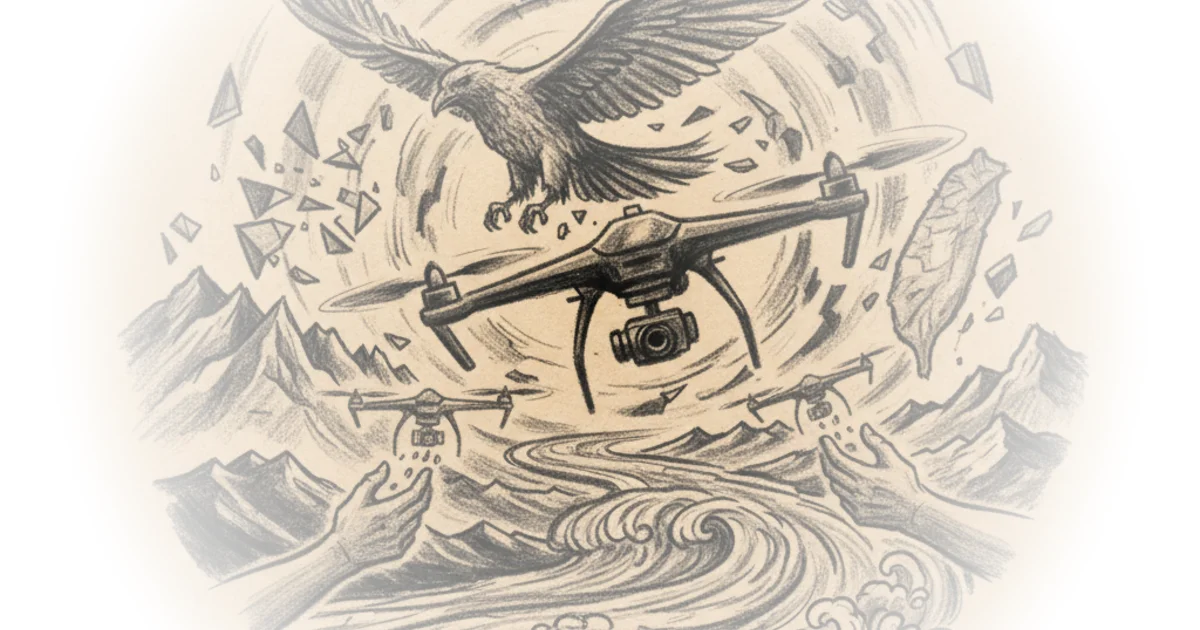
The article highlights how the Ukrainian conflict has served as a grim blueprint for Taiwan's defense. Mak notes that Ding-Yu was "shocked" after watching a video of a drone dropping a bomb on a battlefield, realizing he had "just witnessed the future of battlefields." This realization drove the civilian sector to adopt tactics that the official military training sometimes lacks. As Mak puts it, "Most people are aiming to get the drone-operator certificate. They can fly, but they don't know where to fly." The distinction between operating a machine and understanding its tactical application is where the civilian trainers are making their mark.
"You can't rely on other countries all the time. Or your drones won't be able to catch up with the newest technology."
Mak's reporting effectively underscores the urgency of domestic innovation. He details how the Taiwanese government's recent defense budget was slashed from $40 billion to $24 billion, specifically cutting drone development and countermeasure procurement. This reduction forces a reliance on imported American systems, which Mak suggests is a vulnerability. The author writes, "The new, reduced version of the bill only specifies arms purchases from the United States... meaning that Taiwan's defense will lack self-made modern technology and become more dependent." This framing is compelling because it connects abstract budget numbers to the tangible reality of supply chain fragility.
Critics might argue that focusing on civilian drones distracts from the need for a robust, unified military command structure. However, Mak counters this by showing that soldiers themselves are seeking out civilian trainers because "internal training doesn't satisfy the soldiers." The collaboration suggests that the line between civilian and military defense is blurring out of necessity, not just ideology.
The Supply Chain Dilemma
The narrative deepens as Mak explores the tension between using superior foreign technology and the need for sovereign supply chains. The article details a 2020 ban by the Executive Yuan on Chinese-made drones, such as DJI, due to data security fears. Mak writes, "They don't want any government data to leak," noting that public sector workers were told to "smash and destroy all the DJI drones." Yet, the economic reality is stark: DJI holds 70 percent of the global market, offering stability and price that domestic alternatives struggle to match.
Mak introduces Stacy Yu, CEO of Carbon-Based Technology Inc, to illustrate the struggle of local innovators. She notes that domestic companies "couldn't get the orders from the defense department because the budget bill was on hold," forcing them to rely on foreign markets. The author argues that without a solid domestic supply chain, Taiwan risks being stranded if external aid is delayed or denied. Mak writes, "If Trump withdraws the deal, Taiwan will lose its most important 'anti-China' supply before the domestic drone supply chain becomes solid."
This section of the coverage is particularly sharp because it avoids the trap of simple nationalism. Mak acknowledges that foreign drones, even American ones, "sometimes have trouble 'adapting' in Taiwan" due to communication system incompatibilities. The argument is that true resilience requires a hybrid approach: leveraging global technology while fiercely protecting the ability to manufacture one's own.
"No one wants a war," Ding-Yu said, "but the reality is hard to predict."
The human element remains central even in this discussion of hardware. Mak describes how Ding-Yu and his peers are training firefighters and police, using disaster scenarios to simulate war conditions. This "asymmetric warfare strategy" is not just about fighting; it is about survival. The author notes that Ding-Yu, who once had to "get so close that I could smell it" to find a body as a crime reporter, now sees drones as a way to make photos "three-dimensional" and save lives.
Bottom Line
Tim Mak's piece succeeds by grounding high-stakes geopolitical strategy in the quiet, determined work of civilians who refuse to be passive. The strongest part of the argument is its demonstration of how local innovation is outpacing bureaucratic inertia, creating a defense network that is both agile and deeply rooted in the community. However, the piece's biggest vulnerability lies in the assumption that this civilian surge can fully compensate for a lack of state-level funding and international guarantees. The reader should watch for whether Taiwan's domestic drone industry can survive the budget cuts and political pressure, or if it will remain a desperate stopgap in a rapidly shifting security landscape.