Joey Politano delivers a counterintuitive economic narrative: America's recent productivity surge isn't driven by factories or manufacturing policy, but by a chaotic, high-pressure service sector that forced efficiency upon itself. While the administration has poured billions into industrial revival, the real story lies in how cooks, coders, and caregivers have restructured their work, creating a boom that defies the stagnation of peer nations. This is essential listening for anyone trying to understand why wages are rising even as the labor market cools.
The Service Sector Surprise
Politano challenges the conventional wisdom that productivity lives in manufacturing. "Historically, spurts of productivity growth are most concentrated in the manufacturing sector and manifest only slowly in services," he notes, setting up a stark contrast with current data. The evidence suggests the opposite is true today. The author points out that while manufacturing productivity remains stagnant despite heavy government emphasis on industrial policy, the service sector has exploded. "The nation's recent productivity boom comes almost entirely from the service sector—cooks, programmers, drivers, nurses, bankers, teachers, cleaners, managers, caregivers, and more have all gotten significantly more efficient at their jobs over the last four years."
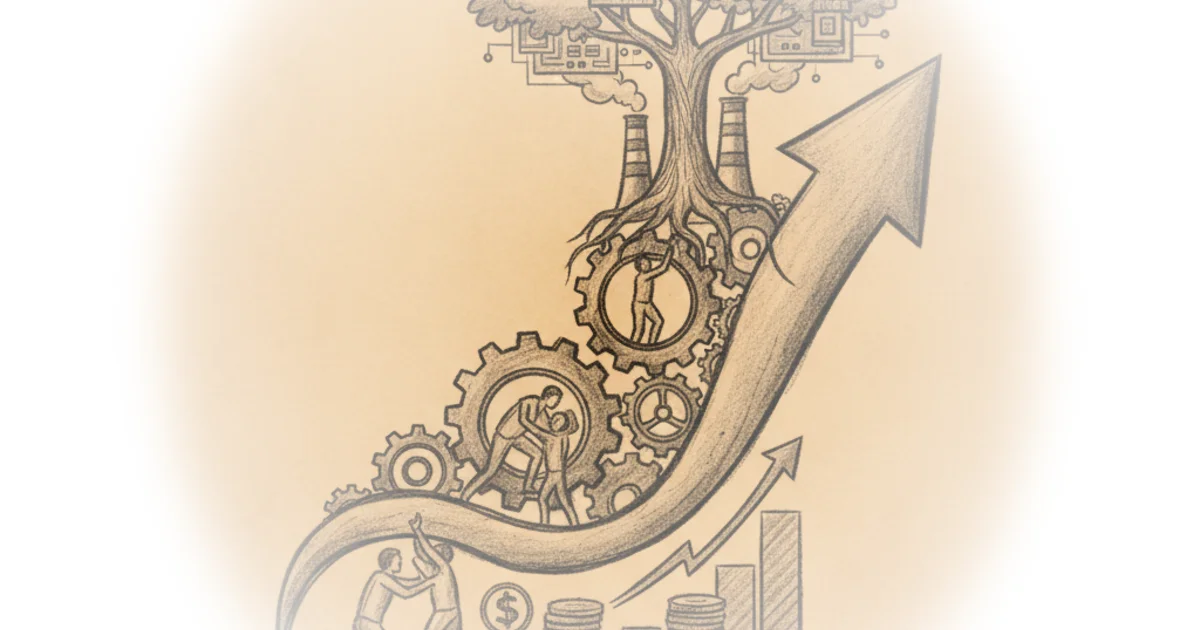
This framing is powerful because it shifts the focus from top-down policy to bottom-up adaptation. The data shows that American output per hour has risen 8.9% over the last five years, a rate unmatched by any other major economy. Politano writes, "Since late 2019, the US has seen more than double the productivity growth of the next-fastest major comparable economy." This isn't just a statistical blip; it represents a structural shift where the vast majority of American workers are doing more with less. Critics might note that service sector productivity is notoriously hard to measure accurately, and some of these gains could be artifacts of how hours are counted during volatile employment periods. However, the durability of these gains across diverse subsectors suggests something more fundamental is at play.
"The recent productivity boom has delivered significant gains in Americans' real wages throughout the pay distribution, which in turn has enabled higher household consumption and increased personal welfare."
The Mechanics of Efficiency
How did this happen? Politano argues it wasn't just new technology, but a unique combination of labor market dynamics and capital investment. The "Great Resignation" wasn't just a social phenomenon; it was an economic reallocation engine. "In the 'great resignation,' monthly job quits, which mostly reflect workers swapping into new higher-paying roles, rose nearly 30% above pre-COVID levels by early 2022," the author explains. This churn forced low-productivity firms to either innovate or perish, while high-productivity firms absorbed talent.
The argument extends to the restaurant industry, a sector long considered immune to efficiency gains. Politano highlights how wage pressure forced owners to invest in technology: "As the labor market tightened restaurant wages skyrocketed, increasing by more than 15% year-on-year at some points, forcing owners to invest in productivity-enhancing technologies behind and in front of the counter." The result is that price-adjusted restaurant spending has increased by 10% since January 2020, while employment has only risen by 1.6%. This is a classic case of capital intensity replacing labor, but driven by market necessity rather than corporate strategy.
However, the author acknowledges a looming threat. The very conditions that created this boom—tight labor markets and high demand—are now cooling. "If the labor market slows further, America's service sector productivity boom could be undermined at a key moment just as AI tools with key productivity implications are increasingly seeing mass adoption." This creates a precarious situation where the economy risks losing its momentum just as the next wave of technological innovation arrives.
The Policy Paradox
Politano offers a sharp critique of how the administration's approach differs from its international peers. The US chose to support people directly rather than preserving specific jobs, a move that inadvertently fueled productivity. "The US was unique among high-income nations for targeting its early COVID relief towards people moreso than jobs," he writes. This allowed workers to leave low-productivity roles and find better fits, a flexibility that furlough schemes in the UK or EU prevented.
The author uses a compelling exercise metaphor to describe the current economic cycle: "That helped America recover quickly from the pandemic and steadily build up its underlying 'muscle strength'—productivity growth. Then the US spent the last two years in the 'cutting' phase—losing the 'excess fat' by intentionally suppressing demand and cooling the labor market." The danger, as Politano sees it, is that the "cutting" phase is going too far. "If it goes too far the US could start losing muscle mass instead of fat." This is a crucial distinction for policymakers to consider as they balance inflation control with growth preservation.
"It's the combination of technological innovation and macroeconomic incentives for its rapid deployment which, when combined, brought American productivity growth back up."
Bottom Line
Politano's strongest contribution is identifying that the US productivity boom is a story of labor market fluidity and service-sector adaptation, not manufacturing policy or pure technological breakthrough. The argument's biggest vulnerability lies in the sustainability of this model; if the labor market cools too rapidly, the engine of reallocation stalls just as AI adoption accelerates. Readers should watch closely to see if the current cooling trend erodes the gains made in the service sector or if the new investments in automation can carry the momentum forward.