Greg Olear does not merely review a play; he excavates the biography of a mind that turned the trauma of displacement into a lifelong obsession with order, chaos, and the endurance of human knowledge. In this reflection on Tom Stoppard's Arcadia, Olear reveals that the play's intricate dance between 1809 and the present is not just a theatrical trick, but a direct reflection of the playwright's own fractured history—a journey from a Czech shoe factory to Singapore, then India, and finally to the English stage. This is essential listening for anyone who has ever felt like an outsider trying to decode a world that wasn't built for them.
The Architecture of Memory
Olear begins by dismantling his own unreliable memory, a move that perfectly mirrors the play's central theme: the elusive nature of truth. He recalls seeing the 1995 Broadway production with a vivid, yet factually incorrect, cast list, remembering Rufus Sewell where Billy Crudup actually stood. "My memory is faulty," Olear admits, noting that the actor playing Septimus Hodge was a "dashing young Rufus Sewell," when in reality, "the Broadway production starred an also-dashing Billy Crudup." This confusion is not a flaw in the commentary; it is the point. Just as the characters in Arcadia struggle to reconstruct the past from fragmented letters and burnt books, Olear reconstructs his own history from the debris of a summer in Hoboken.
The author argues that this confusion is "a mystery worthy of the play itself, which is a sort of hybrid period piece and low-stakes detective story, concerning, among many other things, who knew what when." By weaving his personal uncertainty into the critique, Olear demonstrates how Arcadia functions as a mirror for the audience's own cognitive limitations. The play forces us to confront the fact that our understanding of history is always incomplete, always filtered through the lens of the present.
"There is no blood in 'Arcadia,' although there is an unsuccessful duel and death by fire; and the love, such as it is, is for rhetoric—and, also, for Lord Byron, Lady Caroline Lamb, Fermat, idyllic rather than Gothic styles of British gardens, chaos theory, the Second Law of Thermodynamics, physics, mathematics, entropy, determinism, and whether a nineteenth-century hermitage did or did not contain a real-life hermit."
This exhaustive list serves as a testament to Stoppard's unique ability to synthesize disparate fields. Olear suggests that the play is not about the events themselves, but about the "pursuit of knowledge." Every character, from the precocious Thomasina to the arrogant academic Bernard, is driven by a desperate need to know more. This framing elevates the play from a simple period drama to a meditation on the human condition. Critics might argue that such intellectual density alienates general audiences, but Olear counters that the comedy and emotional stakes keep the high-concept physics grounded.
The Immigrant's Lens
The commentary takes a profound turn when Olear details Stoppard's origins, revealing that the man who mastered the English language was not a product of the British public school system, but a refugee. Born Tomáš Sträussler in Zlín, he fled the rising Nazi threat in 1939, eventually finding safety in Darjeeling, India, after his father perished in Singapore. Olear writes, "Tomáš spoke English from a very young age, but like a number of notable masters of the language—Conrad, Nabokov, and Aleksandar Hemon, to name but three—he was not a native speaker."
This biographical detail is crucial to understanding the texture of Stoppard's work. The playwright's sense of "imposter syndrome" and his feeling of not quite belonging inform the dual timelines of Arcadia. Olear notes that Stoppard once recalled, "I fairly often find I'm with people who forget I don't quite belong in the world we're in... suddenly I'm there naked, as someone with a pass, a press ticket." This vulnerability allows Stoppard to write with a unique clarity, stripping away the pretensions of the British establishment while simultaneously celebrating its intellectual heritage.
The author draws a parallel between Stoppard's life and the historical figure of Ada Lovelace, whose own genius was often overshadowed by her famous father, Lord Byron. Just as Lovelace was "so far ahead of her time she is widely regarded as the first computer programmer," Stoppard was ahead of his peers in his ability to blend science and literature. Olear points out that the play's exploration of the Second Law of Thermodynamics—the idea that heat flows spontaneously from hot to cold but never the other way around—is not just a scientific concept, but a metaphor for the irreversible nature of time and loss.
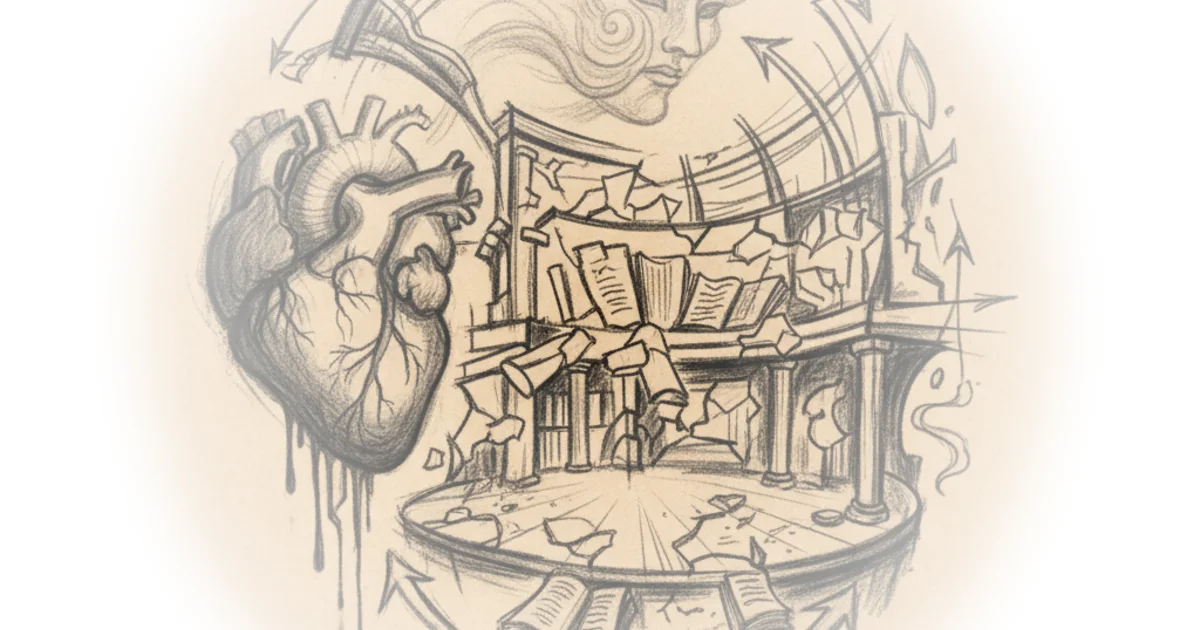
"We shed as we pick up, like travelers who must carry everything in their arms, and what we let fall will be picked up by those behind. The procession is very long and life is very short. We die on the march. But there is nothing outside the march so nothing could be lost to it."
This monologue, delivered by the character Septimus, is the emotional core of the play. Olear highlights how Stoppard uses this speech to offer a comforting, if melancholic, perspective on the loss of knowledge. The burning of the Library of Alexandria is not a tragedy that ends history, but a pause in an endless procession of discovery. The author suggests that this view is particularly resonant for anyone who has experienced the loss of home or identity. It is a reminder that while individuals may die, the collective pursuit of understanding continues.
The Comedy of Chaos
Despite the heavy themes of entropy and displacement, Olear emphasizes that Arcadia is, first and foremost, a comedy. He recounts the scene where Thomasina asks for the definition of "carnal embrace," and Septimus initially deflects with a joke about "throwing one's arms around a side of beef." Olear notes that "Stoppard and only Stoppard could write a good joke about Fermat's last theorem," and that the humor arises from the collision of high intellect and human absurdity.
The play's dialogue is described as a "ribald" mix of "elegant English of George III and the academic patois of the here and now." Olear argues that this blend is what makes the play accessible. It does not dumb down the science or the history; instead, it uses humor to make these complex ideas digestible. The character of Bernard, the vain academic, provides a foil to the more genuine seekers of truth, and his interactions with Hannah, the garden historian, are filled with sharp wit. Olear quotes their exchange: "Sex and literature. Literature and sex. Your conversation, left to itself, doesn't have many places to go. Like two marbles rolling around a pudding basin. One of them is always sex." This moment encapsulates the play's ability to find the absurd in the serious and the serious in the absurd.
"The unpredictable and the predetermined unfold together to make everything the way it is. It's how nature creates itself, on every scale, the snowflake and the snowstorm. It makes me so happy."
Olear uses this final monologue to tie the play's scientific and emotional threads together. The idea that chaos and order are not opposites, but partners in the creation of the universe, is the ultimate message of Arcadia. It is a message that resonates with the experience of a refugee who found a new life in a strange land, and with anyone who has ever felt that their life was a series of random events that somehow made sense in the end.
Bottom Line
Greg Olear's commentary succeeds because it refuses to treat Arcadia as a static artifact of theater history, instead presenting it as a living, breathing exploration of the human struggle to find meaning in a chaotic world. The strongest part of the argument is the connection drawn between Stoppard's refugee experience and the play's themes of displacement and the reconstruction of truth. The biggest vulnerability is the assumption that the reader has a baseline familiarity with the play's complex scientific references, though Olear's clear explanations mitigate this risk. As we navigate our own era of uncertainty, the play's reminder that "nothing could be lost to the march" offers a profound and necessary comfort.