Razib Khan's latest dispatch from Unsupervised Learning defies the typical news cycle by arguing that our deepest modern anxieties—from Halloween scares to the rise of extremist ideologies—are not cultural accidents, but evolutionary imperatives rooted in a 'preexistent universal shamanic mind.' Rather than dismissing these phenomena as irrational holdovers, Khan synthesizes anthropology, evolutionary biology, and history to suggest that the human brain is hardwired to seek out the supernatural and the horrific as a survival mechanism. This is a provocative lens for busy readers: it reframes the chaotic news of the day not as a breakdown of reason, but as the predictable friction between ancient instincts and modern institutions.
The Evolutionary Roots of Fear and Faith
Khan anchors his analysis in Manvir Singh's Shamanism: The Timeless Religion, positing that the distinction between 'higher' monotheistic faiths and primitive tribal shamanism is thinner than we admit. "Singh argues that shamanism is present in all societies, even if we conventionally differentiate it from the 'higher religions,'" Khan writes. The core of this argument is that the cognitive architecture for believing in spirits and magic was forged in the Pleistocene and remains active today, merely draped in new theological garments.
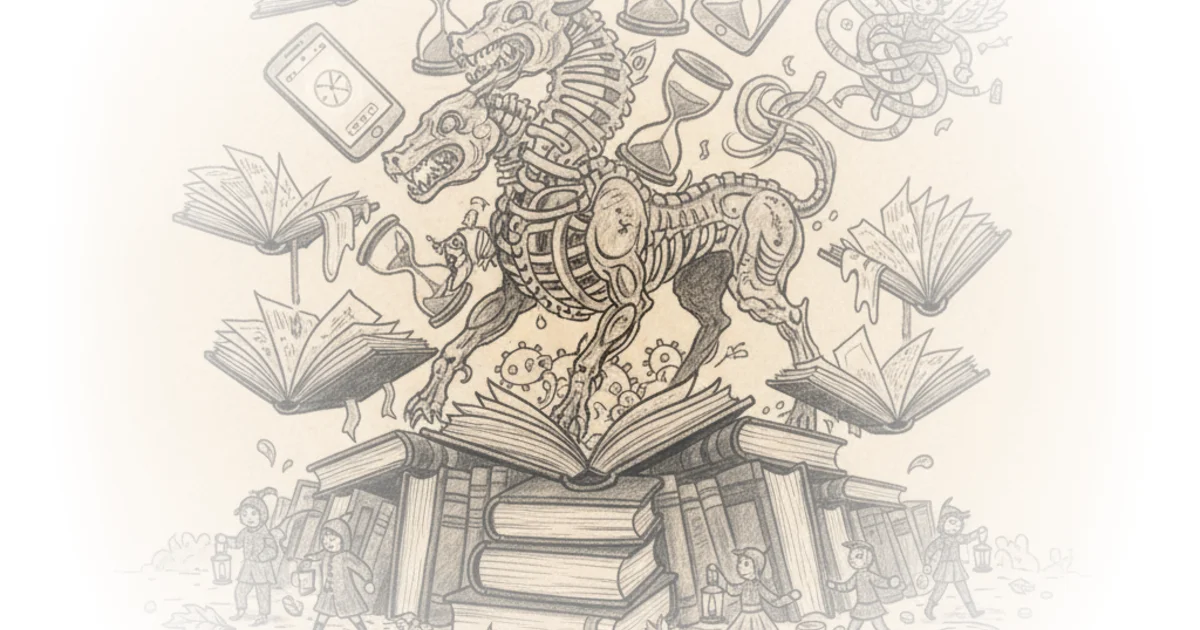
To illustrate this, Khan points to the Hebrew Bible not just as scripture, but as an ethnographic record of a people operating with these deep-seated instincts. He highlights the story of the witch of Endor summoning a spirit and the resurrection miracles of Jesus, noting that "in other contexts [these powers] would be those of a magician, with his greatest wizardry being his own resurrection from death." This framing is effective because it strips away the divine mystique to reveal the human psychological substrate underneath. It suggests that the persistence of these beliefs is not a failure of education, but a success of evolutionary adaptation.
The matrix of cognitive intuitions that seem to come preloaded in humans makes the widespread emergence of holidays like Halloween inevitable.
Khan extends this logic to our fascination with horror, drawing on Coltan Scrivner's work to argue that our love for scary stories is a relic of our time as prey animals. "Horror, a deep awareness of danger's ubiquity, would have kept us alert in an Ice-Age world of real-life monsters," he explains. While this evolutionary explanation is compelling, critics might note that it risks reducing complex cultural rituals to mere biological reflexes, potentially overlooking how specific historical traumas shape our modern fears in ways that go beyond generic predator-prey dynamics.
The Dark Side of Folk Belief
The commentary takes a sharper turn when Khan examines how these primal intuitions can be weaponized. He moves from the harmless superstitions of rural Europe to the catastrophic consequences of the Nazi regime's obsession with the occult. Citing Nicholas Goodrick-Clarke, Khan notes that the Nazis were not merely political actors but were driven by a "proto-Nazi occultism" that integrated folklore with pseudo-science. "Hitler's followers were inventing a new form of Germanic shamanism," Khan asserts, arguing that the regime was essentially a modern state harnessing primitive fears.
He leans heavily on Heather Pringle's Master Plan to detail how Heinrich Himmler and the SS leadership were motivated by a "bizarre belief" in magical technologies and a "credulous and naive" search for Aryan talismans. Khan writes, "The Nazi project was in a sense the stripping away of modernity and the scientific outlook, to leave little more than the most primitive mind's raw fears, emotions and reactions." This is a chilling and necessary reminder that the veneer of modernity is fragile; when institutional safeguards fail, the raw, unmediated fears of the 'shamanic mind' can drive industrial-scale destruction.
Critics might argue that focusing too heavily on the occult aspects of Nazism risks obscuring the very real, rational economic and political calculations that also drove the Holocaust. However, Khan's point remains vital: the irrationality of the leadership was not a bug, but a feature that allowed them to bypass moral constraints.
The Modern Landscape: From Tech Bubbles to Genetic Realities
Shifting gears, Khan applies his analytical rigor to contemporary issues, from the stagnation of big tech to the complexities of human genetics. He observes that the tech sector's recent struggles are a correction of the "boom times of the late 2010s," which were "underwritten by financial conditions, with very low interest rates allowing tech companies to flood the market with cash." He dismisses the nostalgia for this era, noting that "don't feel sorry for people who can get paid $250,000 per year while barely doing any work."
In the realm of science, Khan highlights recent genomic studies that are rewriting our understanding of human migration and identity. He points to research on the Hui people in China, noting that "Northern Hui are part Central Asia, while southern Hui are entirely East Asian," which complicates simple narratives about the spread of Islam. Similarly, he discusses how ancient DNA confirms that "Slavic migration into the Balkans is historically attested, but these data imply that they're newcomers in much of Central Europe as well." These findings underscore a recurring theme in Khan's work: the gap between our intuitive understanding of history and the messy, complex reality revealed by data.
Economies of scale matter in the modern world; 'mom and pop' airlines wouldn't really work.
Khan also touches on the rise of radical youth movements and the influence of figures like Nick Land, suggesting that the future of conservatism may belong to "energetic radical youth" rather than traditional moderates. While this observation captures the current energy of the political landscape, it overlooks the potential for these radical movements to fracture or burn out quickly, a common pattern in political history.
Bottom Line
Razib Khan's strongest contribution here is his ability to weave a single thread—our evolutionary inheritance—through everything from Halloween candy to the Holocaust and modern genetics. The argument is intellectually stimulating and challenges the reader to see current events as part of a much deeper human story. However, the piece's greatest vulnerability lies in its tendency to prioritize deep structural explanations over immediate, contingent political realities, which can sometimes flatten the urgency of specific crises. Readers should watch for how these ancient instincts interact with the accelerating pace of technological change in the coming years.