Jordan Schneider delivers a sharp, necessary correction to the prevailing narrative that AI chip exports are the primary battlefield in the US-China tech war. While the public eye fixates on whether the White House will allow Nvidia to sell its latest processors, Schneider argues that the real leverage lies not in the chips themselves, but in the foreign manufacturing tools required to build them. This piece cuts through the noise of corporate lobbying and political theater to expose a critical vulnerability: the US administration has been slow to close loopholes on equipment, even as it plays a high-stakes game with finished silicon.
The Real Lever: Tools Over Chips
Schneider's central thesis challenges the assumption that restricting chip sales is the most effective containment strategy. He points out a glaring inconsistency in the current approach. "The Trump administration has agency over the two variables most relevant to whether China will have enough compute to really compete with the US: how many chips they can make and how many chips they can buy," Schneider writes. Yet, he notes, "for all the drama we've had this administration around whether Trump will allow Jensen to sell chips to China, we've had basically zero movement on the tooling side."
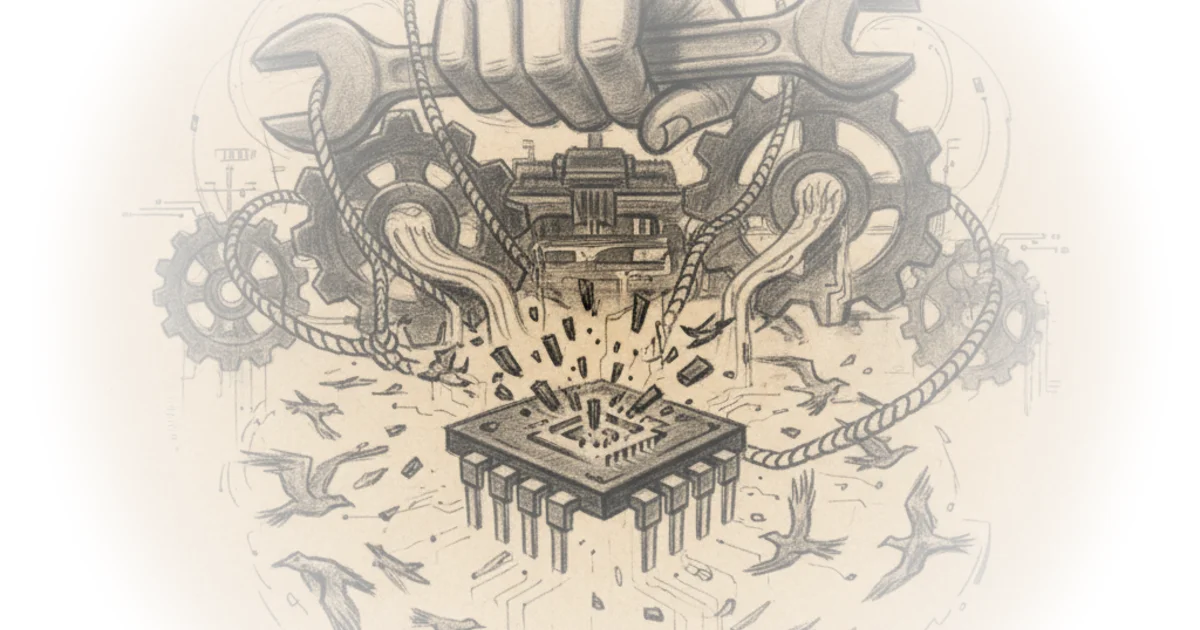
This observation is crucial. Without access to the lithography and etching equipment controlled by US allies, Chinese foundries like Semiconductor Manufacturing International Corporation (SMIC) cannot scale beyond their current, limited capacity. The author highlights that the administration teased controls on sub-systems in a July 2025 AI Action Plan, but largely failed to follow through. "Absent the headfake around the Affiliates Rule that was wound down after Beijing escalated on rare earths, we've had zero movement to close loopholes," Schneider notes. The stakes are high; without these tools, the Chinese fab industry "would not be in a position to even produce the meager amounts they can today."
Critics might argue that focusing on tools is a slower, more bureaucratic path than simply banning chip sales, which yields immediate revenue losses for Beijing. However, Schneider contends that the long-term strategic value of choking off the ability to manufacture outweighs the short-term pain of lost sales. The proposed MATCH Act in Congress aims to fix this by making controls country-wide rather than entity-specific, a move that would "tie the president to the mast" and prevent unilateral loosening of restrictions.
Without access to foreign tools the US could control, Chinese chip and memory makers would not be in a position to even produce the meager amounts they can today.
The Willful Blind Spot of the Tech Elite
The commentary takes a critical turn when examining the mindset of Jensen Huang, the CEO of Nvidia. Schneider contrasts Huang's decades of success in a globalized market with his apparent reluctance to grapple with the national security implications of his products. "Jensen spent decades building a company with zero dual-use implications and practically no reason to interact with Washington," Schneider writes. This historical context is vital; Huang's business model relied on the peace and stability provided by American military preeminence in East Asia, a fact that seems to have been overlooked in his current advocacy.
Schneider is particularly scathing about Huang's dismissal of the cyber threats posed by advanced AI. When pressed on whether giving China more compute power would aid their military, Huang argued that they already have enough. Schneider dismantles this logic by invoking Jevons' paradox, noting that "demand for compute is skyrocketing across industries because more of it means more productivity." He argues that algorithmic innovation itself requires massive compute, meaning that constraints do matter. "If you had a cyber hacker, it's much more dangerous if they have a million of them versus a thousand of them," Schneider paraphrases Dwarkesh's point, adding that Huang's response ignores the reality that "more compute isn't useful" only up to a point, after which it becomes a force multiplier for weaponry.
The author also critiques the broader national security community for failing to ask the hard questions. Schneider recounts a moment where John Hamre, a former Deputy Secretary of Defense, joked about Huang's intelligence rather than probing the export control policies. "It took Dwarkesh, who at 25 has not yet served as DepSecDef, to ask America's most prominent CEO about his most controversial national security policy," Schneider observes. This highlights a disturbing gap between the tech industry's self-perception and the geopolitical reality it is shaping.
Beyond Cyber: The Reality of Mass Precision
Schneider pushes back against the hype that AI will render traditional military mass obsolete. While acknowledging the potential of AI in cyber warfare, he argues that the "half-life of a first-mover edge, particularly in software, is short." He points to the limitations of software-only solutions, noting that "Claude Mythos 3.0 won't be able to keep the Strait of Hormuz open." The author reminds readers that despite the excitement around AI, "you still need lots of stuff that goes boom to feed 'the greatest of consumers.'"
This is a sobering counter-narrative to the idea that AI alone will win future conflicts. Schneider writes, "We will remain in an era of mass precision, where you still very much do need mass, for a long time to come." He argues that until AI can build robot armies, the US must still focus on scaling its defense industrial base. "We should not expect AI capabilities on the next few years to get the Pentagon and Congress off the hot seat to reform and build," he concludes. This grounding in material reality is a necessary antidote to the speculative fervor often found in tech circles.
We should not expect AI capabilities on the next few years to get the Pentagon and Congress off the hot seat to reform and build.
The Engineer vs. The Lawyer
The piece concludes with a reflection on the cultural clash between the engineering mindset of the tech sector and the legalistic approach of Washington. Schneider suggests that Huang's resistance to regulation stems from a fundamental difference in worldview. "Our country's leaders, incredible, but they're mostly lawyers... Their country's leaders... are incredible engineers," Schneider quotes Huang. Schneider interprets this not just as a complaint, but as a reflection of Huang's own journey from an immigrant struggling to survive to a "Singularity Kingmaker."
Schneider acknowledges that Huang's arguments may lack the "lawyerly Ivy League polish" of his critics, but argues that his "epistemology is not inferior; it is just different." The author suggests that Huang's drive to "Not Lose" is a functional part of his success, even if it leads to self-strengthening moves that ignore geopolitical risks. This nuanced view of Huang as a complex figure, rather than a simple villain or hero, adds depth to the analysis. "Jensen is the gangsta poster boy for American Dream," Schneider writes, citing a Twitter account that captures the magnitude of Huang's rise. Yet, this same drive blinds him to the consequences of his company's role in a great power competition.
Bottom Line
Schneider's analysis is a vital corrective to the myopic focus on chip sales, correctly identifying that the US holds its strongest leverage in the supply of manufacturing tools, not the chips themselves. The piece's greatest strength is its refusal to let the tech industry off the hook for ignoring the dual-use nature of its innovations, though it perhaps underestimates the political difficulty of enforcing tooling controls against allied pressure. As the MATCH Act moves forward, the real test will be whether the administration can resist the urge to loosen restrictions for short-term economic gain, a move that could undermine long-term national security.