In an era saturated with algorithmic noise and polarized narratives, Jeff Rich makes a startling claim: the ancient Indian epic, the Mahabharata, offers the most vital toolkit for understanding modern history. While most contemporary analysis treats history as a linear march of progress or a series of case studies, Rich argues that this neglected tradition provides a cyclical, fluid model that better captures the chaos of our current moment. This is not merely a literary exercise; it is a strategic intervention against the "epidemic of cheap, trashy, abusive narratives" that currently dominate our public discourse.
The Crisis of Narrative
Rich opens by diagnosing a profound cultural deficit. We are drowning in information but starving for meaning. "In a word," he writes, quoting Nobel laureate Olga Tokarczuk, "we lack new ways of telling the story of the world." Rich aligns himself with this sentiment, suggesting that the solution lies not in new data, but in rediscovering old stories that have been marginalized by Western-centric views of time. He frames history not as a dry academic discipline, but as a form of literature that serves as a "window onto history." This reframing is crucial because it restores the emotional and ethical weight to historical inquiry, which has often been stripped away by rigid, data-driven approaches.
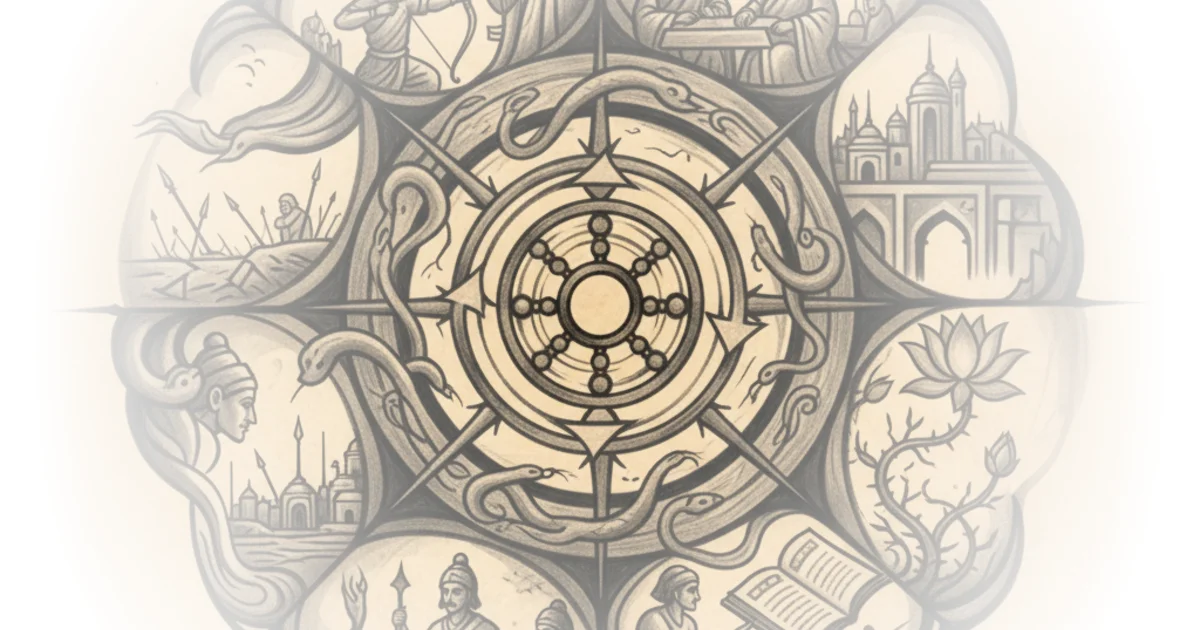
The author's choice to focus on the Mahabharata is deliberate. He notes that while the West clings to the "linear Pilgrims' Progress myths," this epic offers a "cyclical model of history" that resonates with the recurring patterns of human suffering and resilience. By treating history as literature, Rich argues we can access a "mild redemptive power" that allows us to make amends for present sorrows. This approach challenges the reader to abandon the search for a neat, predictable future in favor of engaging with the messy, unpredictable reality of the present.
"We are not going to reach the end of social evolution; time is cyclical. Liberation is not a condition we achieve at the end of linear time, but something we experience in fits and starts in the very pursuit of liberation."
Challenging the Myth of Progress
The core of Rich's argument draws heavily on the work of historian Priya Satia, particularly her book Time's Monster. Rich highlights how the concept of linear progress has historically been weaponized to justify imperial violence and dispossession. "The idea of progress allowed imperial actors to justify violence, dispossession, overrule and patronising contempt as vindicated by the judgment of history," he explains. This is a powerful critique of how dominant narratives sanitize atrocities by framing them as necessary steps toward a better future.
Rich contrasts this with the South Asian tradition of yugas, or ages, which views time as a cycle rather than a straight line. In this framework, the "long night of sorrow" is not an anomaly to be permanently solved, but a phase that inevitably gives way to dawn. He quotes the Urdu poet Faiz Ahmad Faiz, whose work emerged from the trauma of the Partition of India: "Long is the night of sorrow, but it is still just a night." This reference adds a layer of historical depth, connecting the ancient epic to the modern struggle against colonialism and the human capacity for endurance. Critics might argue that a cyclical view of history risks fostering fatalism, suggesting that suffering is inevitable and thus unchangeable. However, Rich counters this by emphasizing that the cycle offers "infinite possibilities" and "infinite ways to tell a story," rather than iron chains of destiny.
Beyond Philosophy by Example
Rich also tackles the traditional definition of history as "philosophy teaching by examples," a phrase attributed to the 18th-century politician Henry St. John, 1st Viscount Bolingbroke. While acknowledging the utility of this view, Rich argues that the Mahabharata transcends it. The epic does not offer neat moral lessons or clear distinctions between good and evil. "In the Mahabharata, because it is nuanced, we never quite know what is good and what is bad, who is good and who is bad," he writes, citing translator Bibek Debroy. Instead, the text presents a "galaxy of characters each of whom resists precepts, general principles and pedantic predictions."
This rejection of binary morality is perhaps the piece's most radical contribution. In a political climate defined by rigid ideological camps, Rich suggests that the "unsolvable riddle of the tension between free will and determinism" is where true wisdom lies. The epic blurs the boundaries between philosophy, religion, and history, forcing the reader to confront the complexity of human action without the comfort of absolute answers. This is a difficult but necessary stance for anyone seeking to navigate a world where "the struggle to renew humanity is an end in itself."
Bottom Line
Jeff Rich's commentary succeeds in repositioning the Mahabharata from a distant myth to a vital resource for modern ethical engagement. Its strongest asset is the refusal to offer easy answers, instead inviting readers to sit with the ambiguity of the human condition. The argument's vulnerability lies in its reliance on a specific literary tradition that may feel alien to readers steeped in Western linear historiography, requiring a significant leap of faith to accept. Ultimately, the piece serves as a compelling reminder that in times of deep uncertainty, the oldest stories may hold the clearest path forward.