While global markets obsess over semiconductor shortages and app valuations, a quieter but far more consequential shift is occurring in China's energy sector. Asianometry highlights a billion-dollar initial public offering that reveals the true architecture of Beijing's green transition: a state-backed utility pivoting from massive dams to the high-stakes frontier of offshore wind. This isn't just a stock listing; it is a blueprint for how a superpower is engineering its post-carbon future.
The Strategic Split
The piece begins by dissecting the corporate structure behind the listing, noting that the company, Three Gorges New Energy, is a subsidiary of the massive Three Gorges Corporation. Asianometry writes, "The business unit does not actually own or operate the Three Gorges dam more like branding... the operations associated with the company's eponymous dam belongs to a sibling company, China Yangtze Power." This distinction is crucial. The author argues that the separation of the dam operator from the renewable developer is a deliberate policy maneuver. Hydropower, while clean, is classified differently than "new energy" sources like wind and solar, which receive preferential treatment and feeding tariffs.
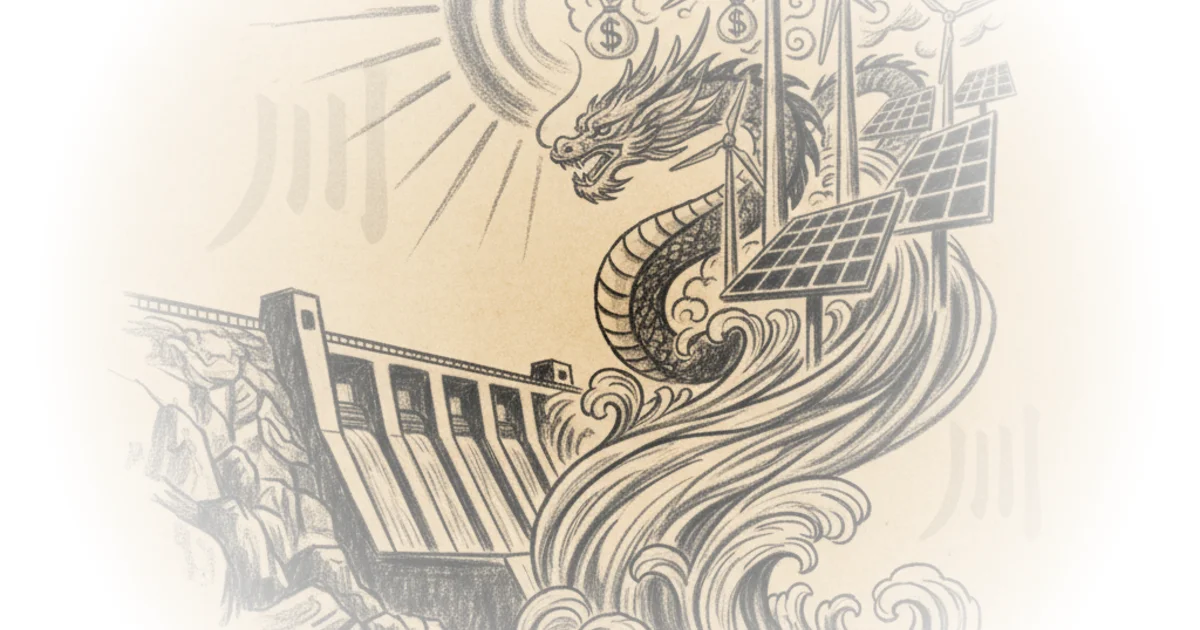
The commentary suggests this corporate bifurcation allows the state to isolate high-growth assets for capital markets while keeping stable, cash-generating hydro assets separate. Asianometry notes, "It makes sense... hydropower is not included and so does not receive the same treatment and feeding tariffs so it's not really a growth stock." This framing effectively explains why a single conglomerate would split its assets into two distinct public entities with different investor profiles. One offers income through dividends; the other offers the high-risk, high-reward trajectory of the green transition. Critics might argue that such segmentation creates unnecessary administrative overhead, but the market valuation suggests investors are buying the clarity of the strategy.
The Chinese government is pushing the development of quote-unquote new energy sources... without regulation capability whatever that means hydropower is not included.
Engineering the Offshore Frontier
The core of the analysis shifts to the company's aggressive expansion and its specific focus on offshore wind. The author points out that the utility has grown its installed capacity twelve-fold since 2008, a pace driven by the state's 14th Five-Year Plan. Asianometry writes, "The party has set a path for China to be a leader in offshore wind energy thus this is a special focus for the company." This is not merely about installing turbines; it is about mastering the complex engineering required to survive the open ocean.
The text details the technical hurdles, from sudden severe weather to deep-water topography, and highlights how the company has responded by building indigenous capabilities. "It has required them to build amongst other things China's first indigenous submarine cables and seabooster stations," Asianometry observes. This vertical integration is a key competitive advantage. By controlling the entire installation process, the company insulates itself from supply chain bottlenecks that plague competitors. The argument holds weight: in a capital-intensive industry, owning the means of deployment is just as valuable as owning the assets themselves.
However, the piece acknowledges that this growth cannot be infinite. As the best sites are developed, marginal benefits decline. Asianometry warns, "The number of areas with ideal solar and wind properties is limited as more of these get built out the marginal benefit of the next site declines hurting their overall profitability." This is a sobering reminder that even state-backed monopolies face the laws of diminishing returns. The government's decision to reduce feeding tariffs further shrinks the profit pie, forcing these giants to compete on efficiency rather than just policy support.
The Utility of State Capital
Perhaps the most insightful section compares the Chinese model to its American counterparts. Asianometry writes, "In the United States it is tough to pin down a close comparison... these massive companies... are quite old school and are not pure new energy plays." The author concludes that the closest analog, NextEra Energy Partners, is flawed by its structure as a limited partnership and its reliance on natural gas pipelines.
The commentary emphasizes that the true differentiator for Three Gorges New Energy is its access to safe, cheap capital derived from its state ownership. "These are capital intensive projects and this company is suited for deploying lots of safe capital thanks to its state ties," the author argues. This financial advantage allows the company to weather the volatility of regulated electricity prices and the uncertainty of market shifts in a way private competitors cannot. The strategy of withdrawing from manufacturing turbines in 2017 to focus solely on development has also paid off, with gross margins approaching 60 percent.
The company has gross margins approaching 60 furthermore these margins are rising year after year a trend that roughly begins after the 2017 decision to withdraw from turbine manufacturing.
Bottom Line
Asianometry successfully reframes a routine IPO as a critical case study in industrial policy, demonstrating how the Chinese state is leveraging corporate structure to accelerate its energy transition. The strongest part of the argument is the analysis of the "split" between hydro and new energy assets, which reveals the subtle mechanics of state capitalism. The biggest vulnerability lies in the assumption that state backing can indefinitely shield the company from the economic realities of falling tariffs and site saturation. Readers should watch whether the company's offshore wind ambitions can truly deliver the promised margins as competition intensifies and policy support inevitably wanes.