Matt Stoller identifies a silent tax on the American psyche that no government statistic captures: the relentless theft of time by corporate fraud and regulatory abdication. While economists debate inflation rates and unemployment figures, Stoller argues that the true cost of living crisis is the exhaustion generated by fighting "time bandits"—scammers and monopolists who dump the burden of proof onto consumers. This is not just about money lost; it is about the psychological toll of a marketplace where honesty is the exception and verification is a second, unpaid job.
The Invisible Cost of Doing Business
Stoller begins by dissecting the disconnect between positive macroeconomic data and the public's deepening sourness. He posits that conventional metrics miss a crucial variable: the friction of modern commerce. "I have identified interest rates, as well as surveillance pricing, as a meaningful cost of living that isn't incorporated into the Consumer Price Index," Stoller writes, but he quickly pivots to something more visceral. The real issue is the "increasing cost we are paying for everyday goods and services, not necessarily just in cash, but in terms of time dealing with bullshit."
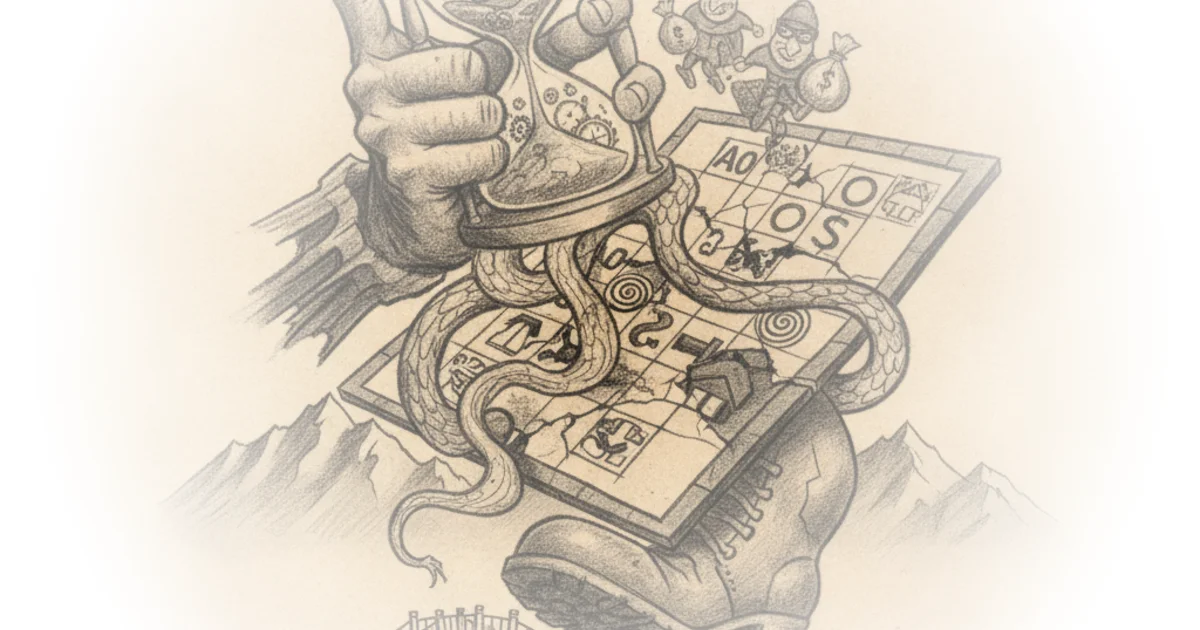
The author illustrates this with a personal anecdote about a hotel booking gone wrong, where a third-party platform sold a room that didn't exist, leaving the family stranded. The hotel owner, an independent operator, was helpless because the transaction was obscured by a "B2B distribution network" owned by a giant like Expedia. Stoller highlights the opacity of the system: "The hotel is not allowed to tell customers the commission they must pay third parties like Expedia. In addition, the hotel doesn't get our actual credit card, but a dummy credit card, and he wasn't even able to get our contact information until we showed up."
This framing is effective because it moves beyond abstract monopoly theory to the tangible frustration of the consumer. The scammers, Stoller argues, are not just stealing money; they are weaponizing bureaucracy. "The scammers here are dumping the burden of proof onto consumers and ordinary small business people like these hotel operators, which is a form of social pollution. They may only steal money from a few of us, but they steal time from all of us. They are time bandits."
Critics might argue that Stoller is conflating isolated bad actors with systemic economic forces, or that the solution lies in better consumer education rather than structural overhaul. However, the sheer volume of complaints suggests this is not a matter of individual negligence but of institutional design. As Stoller notes, the problem is exacerbated by a lack of enforcement: "That he has chosen not to police the marketplace is what matters, because that is why we're living in a scammers paradise."
They may only steal money from a few of us, but they steal time from all of us. They are time bandits.
The Regulatory Vacuum and the Rise of AI Friction
Stoller places the blame squarely on the failure of the Federal Trade Commission (FTC) under Chair Andrew Ferguson, arguing that the agency has abandoned its core mission. "The FTC was the agency tasked with preventing cheating, but it no longer does that," he asserts, pointing to a regulatory vacuum that allows tech-enabled fraud to flourish. This failure creates an environment where companies can offload the work of resolving disputes onto artificial intelligence chatbots. "Agoda then conceded there had been an error, offered a 'sincere' apology but kept asking on a loop if she agreed to keep her booking," Stoller recounts, illustrating how technology is used not to solve problems but to wear down the victim.
The argument extends to the broader digital ecosystem, where monopolies like Apple refuse to allow third-party spam filters, effectively enabling the theft of attention. "Apple could allow third parties to create text message spam filters, but it won't, because it's a monopolist and doesn't have to. It's easier to allow time theft," Stoller writes. This connects the dots between market concentration and the daily irritations that erode trust. The result is a society where citizens are constantly on guard. "I have realized, I am constantly on guard someone might be cheating me. And that's not even getting to the health care system, which is probably the biggest time bandit of all."
This perspective resonates with historical context found in related deep dives on prescription drug prices, where patients similarly spend hours navigating opaque billing systems rather than receiving care. Just as drug pricing mechanisms hide the true cost of medication, these digital platforms hide the true cost of time. The data supports Stoller's alarm: "Consumers lost eight times as much to scams in 2025 as they did in 2020," and the emotional fallout is severe, with Americans increasingly viewing their fellow citizens as unethical.
Institutional Corruption and the Path Forward
Stoller insists that the moral decay is not a reflection of the American people but of the institutions that govern them. "I think this constant barrage of time theft explains why Americans are so angry at data centers and AI," he suggests, reframing the backlash against technology as a rational response to being treated as a revenue stream for fraud rather than a human being. The solution, he argues, is straightforward but politically challenging: restore enforcement and shift liability. "We know how to stop cheating. Do more enforcement, allow people to sue directly by getting rid of arbitration agreements, and put liability onto platforms who are structural bedrock for deceptive practices in the marketplace."
The author's optimism stems from the visibility of the problem. "I am optimistic on this front, because it's so noticeable how much scamming is going on and the political winds are shifting." However, the piece also acknowledges the difficulty of articulating this cost. "It isn't the mountains ahead to climb that wear you out; it's the pebble in your shoe," Stoller quotes, admitting the quote itself is a misattribution—a final twist that underscores his point about the unreliability of information in the modern era.
The argument holds weight because it challenges the prevailing economic narrative that ignores non-monetary costs. By focusing on the "pebble in the shoe," Stoller forces a re-evaluation of what constitutes economic well-being. The vulnerability of this approach is that it relies on a political shift toward populism that may be difficult to sustain if the immediate economic indicators remain strong. Yet, as the fatigue sets in, the demand for accountability grows.
Bottom Line
Stoller's most compelling contribution is the redefinition of inflation to include the "time tax" extracted by monopolistic platforms and regulatory neglect. While the piece relies heavily on anecdotal evidence, the scale of the fraud statistics and the systemic nature of the barriers to redress validate the core thesis. The biggest vulnerability lies in the assumption that political will can be mustered to dismantle these entrenched interests, but the growing public anger suggests the ground may finally be shifting. Readers should watch for legislative attempts to ban arbitration clauses and hold platforms liable for deceptive practices, as these will be the true tests of whether the "time bandits" can be stopped.