Jenn Zuko transforms a cultural quirk—the widespread, visceral discomfort people feel toward mimes—into a profound inquiry into the mechanics of human mimicry and the terror of the artificial. By weaving together performance theory, horror cinema, and evolutionary psychology, Zuko argues that our revulsion is not merely a reaction to silence, but a primal fear of seeing our own social behaviors exposed and distorted. This is not a simple defense of an art form; it is a dissection of why the human brain rejects the uncanny when it is performed by a living body.
The Anatomy of Unease
Zuko anchors her theory in the concept of the Uncanny Valley, suggesting that mimes trigger the same alarm bells as realistic robots or animated mannequins. She writes, "Mimes make things visible that are invisible, and they do things with their bodies that are impossible." This observation reframes the mime not as a comedian, but as a biological glitch. The author illustrates this by examining Javier Botet, a physical actor with a rare medical condition whose elongated limbs and impossible joint movements make him a terrifyingly effective horror performer. Zuko notes that Botet's work is "deeply unsettling" because "his limbs don't seem to connect correctly, and his joints look like they're bending wrongly."
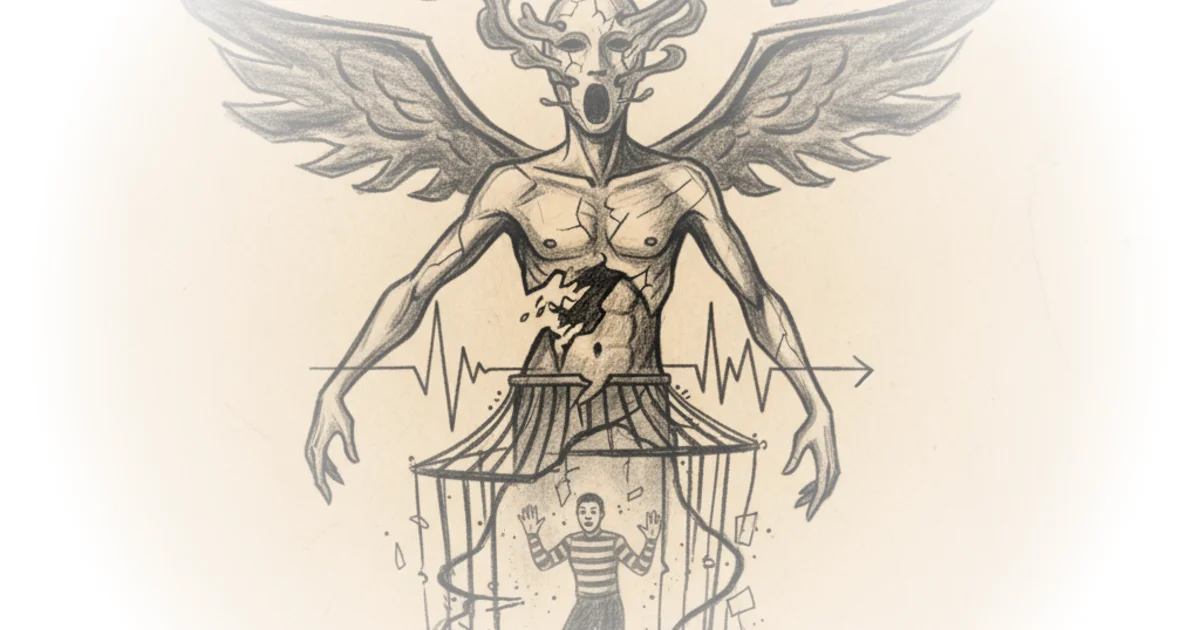
This analysis holds up well when applied to the specific physiology of the performance. The fear arises because the mime's body violates our internal map of human anatomy, creating a dissonance that the brain struggles to resolve. However, one might argue that Zuko focuses so heavily on the grotesque potential of the form that she risks conflating the mime with the monster, potentially overlooking the more subtle, non-threatening traditions of the art.
Creating Reality from Nothing
The commentary shifts to the virtuosity required to generate a world without props, citing the work of Andy Serkis and Jerzy Grotowski. Zuko explains that Serkis's portrayal of Gollum relied entirely on "physical virtuosity and uncanny character creation using high level movement skill and incredible facial expression." Similarly, she highlights Grotowski's "Poor Theatre," a style where actors are trained to create theatrical worlds with their bodies alone, stripped of design elements. "His style of playmaking was very sparse with props and sets," Zuko writes, noting that his actors were disciplined "down to every pinky finger, every capillary."
The strength of this section lies in connecting high-concept theater theory to modern motion-capture technology. By linking the 1970s experimental stage to the digital creation of Gollum, Zuko demonstrates that the core of mime is the ability to convince an audience of a reality that does not exist. This parallels the historical fascination with the "Uncanny Valley" in robotics, where the closer a machine gets to human perfection, the more terrifying it becomes if it falls just short. Zuko's inclusion of the 1970s boom in mime, connected to the "burgeoning romanticized tramp life of the RenFaire circuits," adds necessary historical texture, showing that this art form has always hovered between the sacred and the strange.
A mime's art is about mimicking reality. But they're doing it out in the open. When a mime holds, as t'were, the mirror up to Nature, he's breaking a deeply ingrained social rule.
The Social Transgression of Mimicry
Perhaps the most provocative claim in the piece is that the fear of mimes stems from their exposure of our own subconscious mimicry. Zuko argues that humans are constantly mirroring one another to build trust and social cohesion, a behavior we rarely acknowledge. "Imitation is the only way we humans are functionally social," she writes. When a mime performs, they are "mocking us to our very face" by making this invisible social contract visible. "Mimes say the quiet part out loud (!) by exposing what we all are," Zuko asserts. "Fuck that guy."
This reframing is brilliant. It moves the discussion from aesthetics to ethics. If the mime is simply holding up a mirror to our own automatic behaviors, then the hatred directed at them is a form of self-loathing or cognitive dissonance. The author draws a sharp parallel to modern anxieties about artificial intelligence, asking, "Is our newfound AI fear related to the uncanny fear of the mime?" She suggests that just as we fear what AI can mimic, we fear the mime because they reveal the artificiality of our own social performance. Critics might note that this psychological explanation, while compelling, doesn't fully account for the simple cultural stigma of the mime as a boring or pretentious street performer, a perception that has nothing to do with deep evolutionary fears.
The Sacred Duty of the Fool
In the conclusion, Zuko elevates the mime to the status of a sacred clown or shaman, arguing that they serve a vital societal function by reminding us of our mortality and absurdity. "Mimes do a similar thing as both of their above clownish siblings: they blow bubbles into a cupful of the void, then hold a mirror up to our own nature," she writes. The piece closes with a nod to the dark history of minstrelsy, acknowledging that while some clowning traditions are rooted in ugliness, the mime's specific brand of silence and isolation offers a different, more introspective path.
Zuko's final verdict is that the art form is "One to be appreciated, not hated." She suggests that the discomfort we feel is actually a sign of the art's power. By invoking H.P. Lovecraft's "non-Euclidean geometry," she posits that the mime's body is a source of horror because it bends reality in ways our brains cannot compute. This is a sophisticated, if slightly esoteric, way to defend an often-mocked art form.
Bottom Line
Jenn Zuko's piece is a masterful synthesis of performance theory and evolutionary psychology, successfully arguing that the fear of mimes is a reflection of our own discomfort with the artificial nature of human interaction. While the argument occasionally leans too heavily into the horror genre to make its point, the core insight—that mimes expose the invisible rules of social mimicry—offers a fresh and necessary perspective on why we recoil from the silent performer. The strongest takeaway is the connection between the mime's blank mask and the modern anxiety surrounding AI: both force us to confront the unsettling question of what it means to be human when the boundaries of reality are blurred.