In a decade defined by escalating geopolitical friction and the hardening of borders, a ten-year anniversary livestream from a niche media outlet offers a rare, unvarnished look at how independent journalism evolves in real-time. Chris Chappell's reflection on the last decade of "China Uncensored" does more than celebrate a subscriber milestone; it chronicles the shift from a solitary, theoretical critique of the Chinese government to a frontline documentation of human rights abuses and authoritarian consolidation.
From Theory to Reality
The piece opens with the chaotic, human reality of a live broadcast, immediately grounding the high-stakes subject matter in the mundane failures of technology. Chappell admits, "we still don't really know how technology works but that has never once stopped us." This self-deprecating honesty serves as a strategic framing device, suggesting that the content's value lies not in polished production but in the relentless pursuit of truth despite technical and institutional hurdles. The argument here is that the medium's imperfections are secondary to the message's urgency.
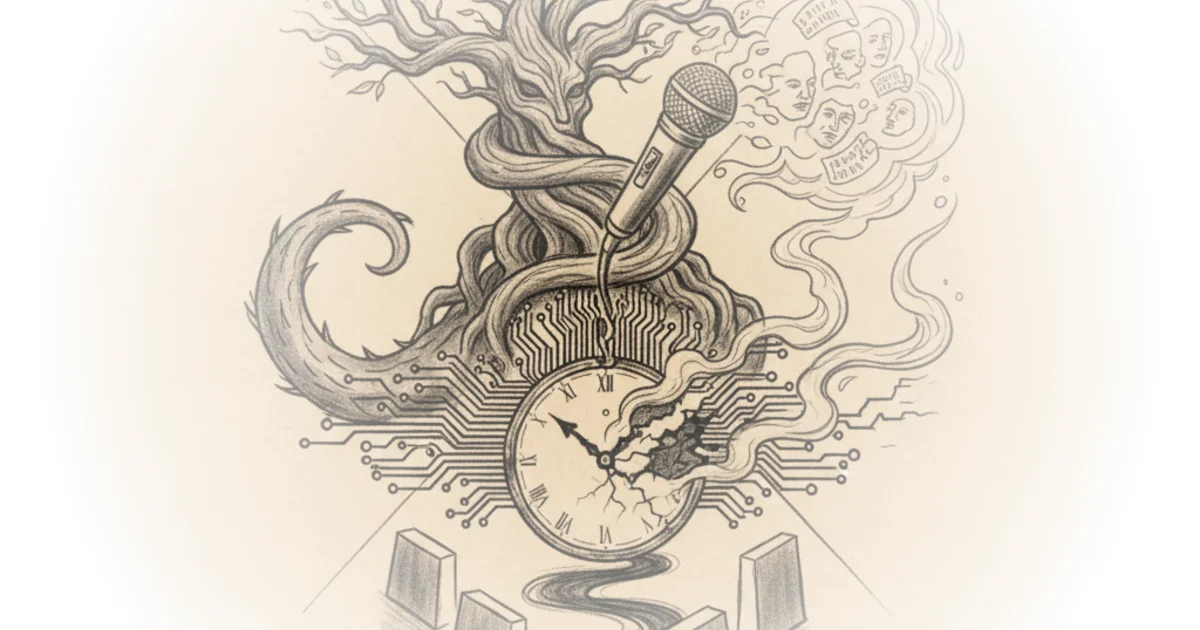
Chappell contextualizes the show's inception in October 2012, a time when the prevailing Western narrative about China was one of inevitable liberalization. He recalls the optimism of the era, noting that "people were thinking Xi Jinping could be like you know the Gorbachev reformer." This historical anchor is crucial; it highlights how drastically the geopolitical landscape has shifted. The show was born from a belief that the Chinese Communist Party might eventually collapse or reform, a hope Chappell now admits was misplaced. He reflects on the initial premise: "I was thinking well I won't be making the show that long since in like two months it's going to be the Mayan end of the world." This admission of a miscalculation regarding the regime's longevity underscores the resilience required to maintain a critical voice when the predicted collapse never comes.
"It wasn't until 2015 that Xi Jinping promised to not militarize they were already militarizing."
The commentary effectively contrasts the early days of the "Olympics" era propaganda with the current reality of militarization in the South China Sea. Chappell points out the dissonance between Western business optimism and the on-the-ground reality: "Uyghurs people still talk about that as fondly as like oh those were the good times." This observation is a powerful critique of the Western business community's willful blindness to human rights abuses in exchange for market access. The framing suggests that the "good times" were an illusion maintained by a lack of information, which the show aimed to correct.
The Human Cost of Coverage
The narrative shifts from macro-politics to the personal toll of the work, particularly through the experiences of co-hosts Shelly and Matt. The transition from a one-person operation to a team effort is described not as a corporate expansion, but as a survival mechanism. Chappell emphasizes that "without you watching what's the point really? We'd just be screaming into the wind." This reframes the audience from passive consumers to active participants in a shared mission, a common tactic in independent media to foster loyalty.
Shelly's backstory adds a layer of emotional gravity to the anniversary. She reveals that her entry into the show coincided with a personal tragedy, noting, "my mom died around that same time so like that yeah that year is kind of a blank bad year for me in general." This juxtaposition of professional growth and personal loss humanizes the often abstract concept of "freedom of the press." It suggests that the drive to expose truth often comes from a place of deep personal vulnerability.
Matt's recollection of the 2014 Hong Kong "Umbrella Movement" provides the most visceral evidence of the show's evolution. He describes the decision to travel to the protests as a moment of realization: "we could do more with the show than we were doing or we could have like a bigger impact." The description of the trip—buying tickets out of pocket, staying in a cramped Airbnb, and living on "canned coffee" that "made us sick"—paints a picture of grassroots journalism that stands in stark contrast to the well-funded, state-sponsored narratives from Beijing.
"It was like seeing people fighting for Freedom it was it was so moving to actually see that."
This moment is the emotional core of the piece. Chappell and his team moved from discussing abstract political theory to witnessing the tangible struggle for democracy. The comparison to early American history is telling: "you grow up reading about you know early American history and the founding fathers and the fight for freedom and it's all very you know kind of abstract and far away but like in Hong Kong like like we saw people fighting for Freedom." This framing elevates the Hong Kong protests from a regional dispute to a universal struggle for liberty, a narrative choice that resonates deeply with Western audiences but risks oversimplifying the complex local dynamics.
Critics might note that framing the Hong Kong protests solely through the lens of American-style freedom risks ignoring the specific legal and historical context of the "One Country, Two Systems" framework. While the emotional resonance is undeniable, the binary of "freedom fighters" versus "authoritarian oppressors" can sometimes obscure the nuanced realities of the protest movement's internal divisions and strategic challenges.
The Power of the Crowd
The piece concludes by acknowledging the role of the audience in sustaining the operation. Chappell highlights the financial model that allows them to operate independently: "when you contribute through patreon or locals it actually gives us the ability to bring in these people and build this team." This is a direct challenge to the traditional media model, suggesting that the future of independent journalism lies in direct support from viewers rather than corporate advertising or state funding.
The mention of reaching 1.8 million subscribers is not just a vanity metric; it is presented as proof of a growing appetite for unfiltered information. Chappell jokes about being bigger than "PewDiePie," but the underlying point is serious: "without this platform like we would not have been able to reach so many people about [Music]... talking about China." The sheer scale of the audience indicates that the "echo chamber" of Western media is not as impenetrable as some claim, and that there is a significant demand for alternative perspectives on China.
"It's symbolic of the show individually none of us can really do this it needs all of us together with you watching."
This final sentiment ties the technical glitches, the personal sacrifices, and the political analysis together. The show is portrayed not as a product, but as a collective effort. The "three of us" blowing out the candles together is a metaphor for the interdependence of the creators and the audience. It is a reminder that in an era of algorithmic curation and state censorship, the connection between the storyteller and the listener is the most fragile, yet most essential, link.
Bottom Line
The strongest element of this coverage is its ability to humanize the abstract geopolitical struggle between the West and China through the lens of personal sacrifice and technical improvisation. By anchoring the decade-long narrative in specific moments like the 2014 Hong Kong protests and the personal losses of the team, Chappell makes the case that independent journalism is a living, breathing entity rather than a static news source. The biggest vulnerability, however, lies in the potential for the narrative to become overly reliant on emotional appeals, which may sometimes overshadow the complex, often messy realities of the political situations being covered. As the show moves into its next decade, the challenge will be to maintain this emotional connection while deepening the analytical rigor required to navigate an increasingly complex global landscape.